## Line Graph: Test Accuracy vs Communication Rounds (N=100, CIFAR-10)
### Overview
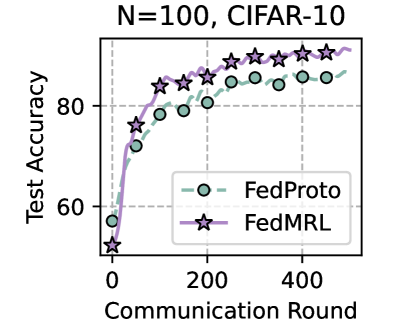
The graph compares the test accuracy of two federated learning algorithms, **FedProto** and **FedMRL**, over 400 communication rounds on the CIFAR-10 dataset with a sample size of N=100. Both algorithms show increasing accuracy, with FedMRL consistently outperforming FedProto after ~100 rounds.
### Components/Axes
- **X-axis**: Communication Rounds (0 to 400, increments of 100).
- **Y-axis**: Test Accuracy (50% to 100%, increments of 10%).
- **Legend**:
- **FedProto**: Green circles (dashed line).
- **FedMRL**: Purple stars (solid line).
- **Title**: "N=100, CIFAR-10" (top center).
### Detailed Analysis
1. **FedProto (Green Circles)**:
- Starts at ~55% accuracy at 0 rounds.
- Increases steadily to ~88% by 400 rounds.
- Key data points:
- 0 rounds: ~55%
- 100 rounds: ~75%
- 200 rounds: ~82%
- 300 rounds: ~85%
- 400 rounds: ~88%
2. **FedMRL (Purple Stars)**:
- Begins at ~50% accuracy at 0 rounds.
- Outperforms FedProto after ~100 rounds, reaching ~90% by 400 rounds.
- Key data points:
- 0 rounds: ~50%
- 100 rounds: ~78%
- 200 rounds: ~85%
- 300 rounds: ~88%
- 400 rounds: ~90%
### Key Observations
- **Convergence**: Both algorithms plateau near 85–90% accuracy after 300 rounds, suggesting diminishing returns.
- **Performance Gap**: FedMRL achieves ~5–7% higher accuracy than FedProto by 400 rounds.
- **Early Growth**: FedMRL’s accuracy rises more sharply in the first 100 rounds compared to FedProto.
### Interpretation
The graph demonstrates that **FedMRL** is more effective than **FedProto** for this CIFAR-10 setup, particularly in later communication rounds. The convergence at higher rounds implies that both methods reach near-optimal performance with ~300 rounds, but FedMRL’s superior efficiency or model architecture allows it to maintain a slight edge. This could indicate better handling of non-IID data or improved aggregation strategies in FedMRL. The plateau suggests that further rounds beyond 300 yield minimal gains, highlighting a potential optimization target for communication efficiency.