## Text Analysis: Cause Explanation Example
### Overview
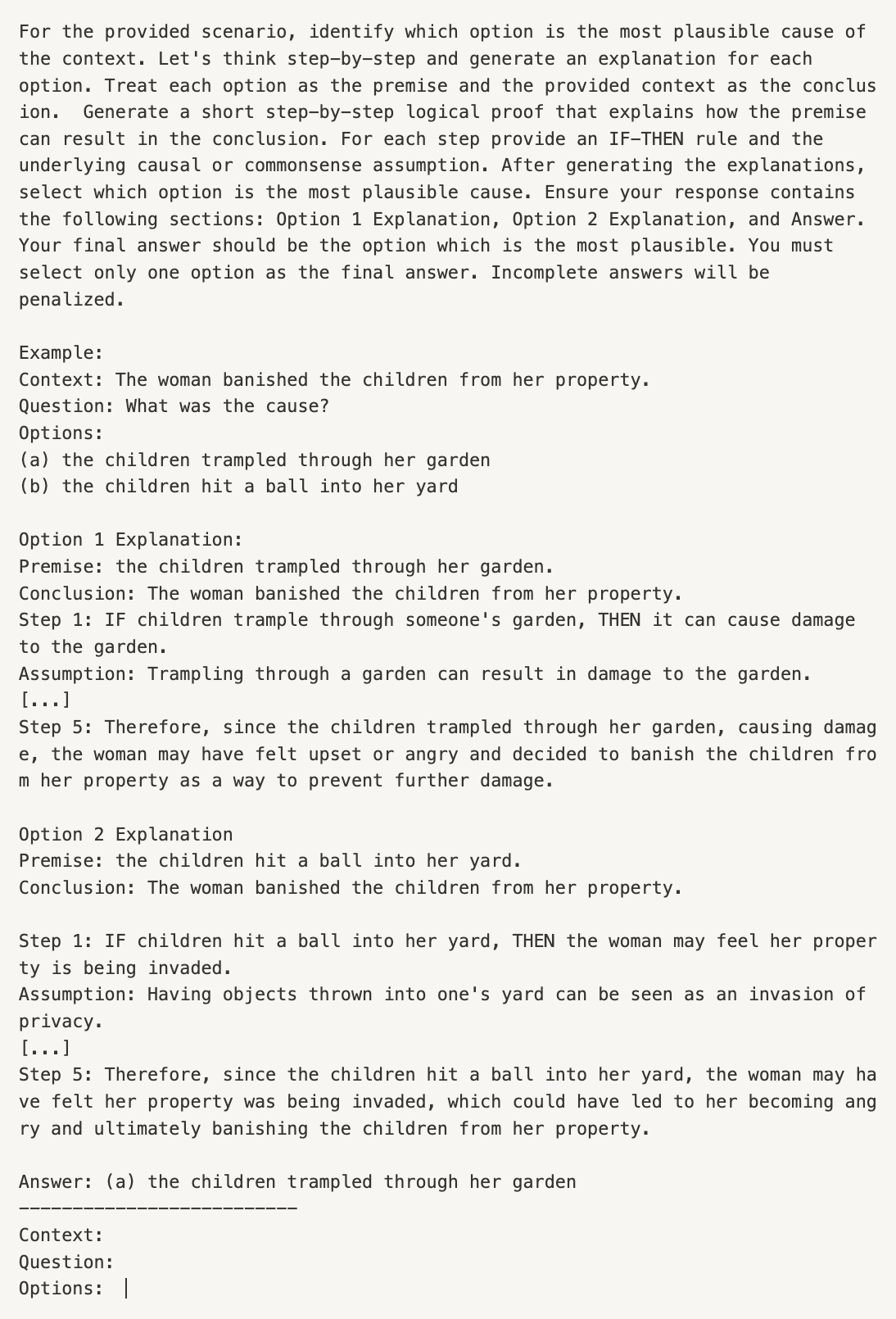
The image presents an example of a problem-solving task where the goal is to identify the most plausible cause for a given context. It provides a context, a question, two possible options, explanations for each option, and the selected answer. The task involves generating step-by-step logical proofs for each option, using IF-THEN rules and common-sense assumptions.
### Components/Axes
The image is structured as follows:
* **Instructions:** A paragraph explaining the task and the required format for the answer.
* **Example:**
* **Context:** The woman banished the children from her property.
* **Question:** What was the cause?
* **Options:**
* (a) the children trampled through her garden
* (b) the children hit a ball into her yard
* **Option 1 Explanation:**
* **Premise:** the children trampled through her garden.
* **Conclusion:** The woman banished the children from her property.
* **Step 1:** IF children trample through someone's garden, THEN it can cause damage to the garden.
* **Assumption:** Trampling through a garden can result in damage to the garden.
* **Step 5:** Therefore, since the children trampled through her garden, causing damage, the woman may have felt upset or angry and decided to banish the children from her property as a way to prevent further damage.
* **Option 2 Explanation:**
* **Premise:** the children hit a ball into her yard.
* **Conclusion:** The woman banished the children from her property.
* **Step 1:** IF children hit a ball into her yard, THEN the woman may feel her property is being invaded.
* **Assumption:** Having objects thrown into one's yard can be seen as an invasion of privacy.
* **Step 5:** Therefore, since the children hit a ball into her yard, the woman may have felt her property was being invaded, which could have led to her becoming angry and ultimately banishing the children from her property.
* **Answer:** (a) the children trampled through her garden
* **Context:**
* **Question:**
* **Options:** |
### Detailed Analysis or ### Content Details
The example demonstrates how to analyze two possible causes for a given context. For each option, a premise and conclusion are stated, followed by a step-by-step explanation using an IF-THEN rule and a common-sense assumption. The explanation aims to provide a logical connection between the premise and the conclusion.
### Key Observations
The key observation is the structured approach to problem-solving. Each option is treated as a hypothesis, and a logical argument is constructed to support or refute it. The use of IF-THEN rules and assumptions makes the reasoning process explicit.
### Interpretation
The example illustrates a method for identifying the most plausible cause by systematically evaluating each option. The step-by-step explanation helps to clarify the reasoning process and identify potential weaknesses in the argument. The task emphasizes the importance of considering both causal relationships and common-sense assumptions when analyzing complex situations. The final section with empty context, question, and options suggests that the user is expected to fill in these fields and apply the same problem-solving approach.