\n
## Text Document: Scenario & Options for Plausibility Assessment
### Overview
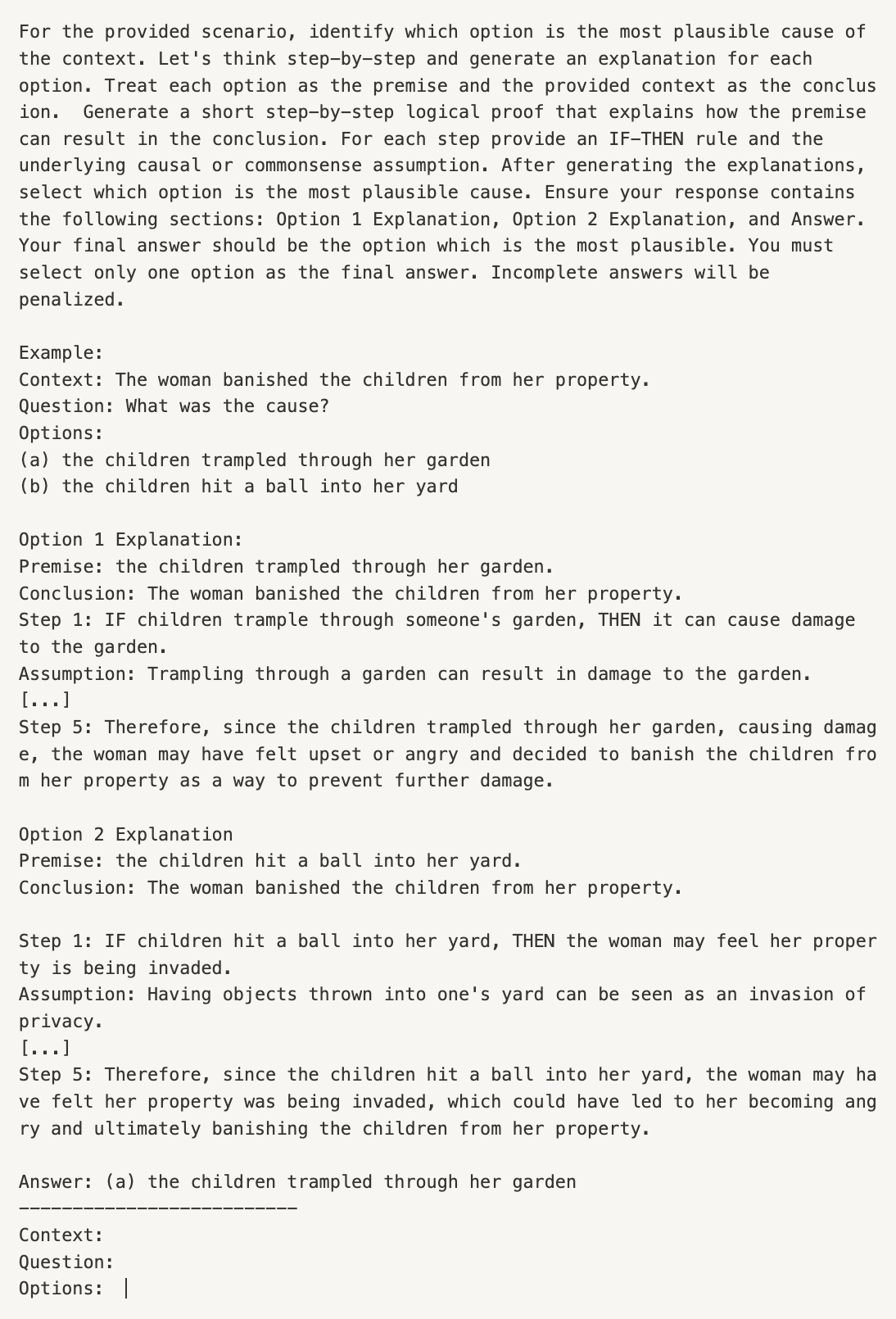
The image presents a text-based scenario followed by a question and multiple-choice options. The document details a method for determining the most plausible cause within a given context, using step-by-step logical proofs and IF-THEN rules. It includes an example to illustrate the process. The document appears to be an instructional or assessment material related to critical thinking or logical reasoning.
### Components/Axes
The document is structured into the following sections:
* **Context:** Provides the scenario.
* **Question:** Poses the problem to be solved.
* **Options:** Lists the potential answers.
* **Option 1 Explanation:** Detailed breakdown of the first option.
* **Option 2 Explanation:** Detailed breakdown of the second option.
* **Answer:** States the selected most plausible option.
The example section includes:
* **Example Context:** "The woman banished the children from her property."
* **Example Question:** "What was the cause?"
* **Example Options:** (a) the children trampled through her garden, (b) the children hit a ball into her yard.
* **Example Option 1 Explanation:** Premise, Conclusion, Step 1, Assumption, and a concluding statement.
* **Example Option 2 Explanation:** Premise, Conclusion, Step 1, Assumption, and a concluding statement.
* **Example Answer:** "(a) the children trampled through her garden"
### Detailed Analysis or Content Details
The document outlines a method for evaluating plausibility:
1. **Premise:** State the option as a given fact.
2. **Conclusion:** State the outcome described in the context.
3. **Step 1:** Formulate an IF-THEN rule connecting the premise to the conclusion.
4. **Assumption:** Identify the underlying causal or commonsense assumption.
5. **Concluding Statement:** Summarize the logical connection.
The example demonstrates this process for two options:
**Example Option 1:**
* **Premise:** The children trampled through her garden.
* **Conclusion:** The woman banished the children from her property.
* **Step 1:** IF children trample through someone’s garden, THEN it can cause damage to the garden.
* **Assumption:** Trampling through a garden can result in damage to the garden.
* **Concluding Statement:** Therefore, since the children trampled through her garden, causing damage, the woman may have felt upset or angry and decided to banish the children from her property as a way to prevent further damage.
**Example Option 2:**
* **Premise:** The children hit a ball into her yard.
* **Conclusion:** The woman banished the children from her property.
* **Step 1:** IF children hit a ball into her yard, THEN the woman may feel her property is being invaded.
* **Assumption:** Having objects thrown into one’s yard can be seen as an invasion of privacy.
* **Concluding Statement:** Therefore, since the children hit a ball into her yard, the woman may have felt her property was being invaded, which could have led to her becoming angry and ultimately banishing the children from her property.
The final answer in the example is (a) the children trampled through her garden.
The document then presents a new, incomplete scenario with a question and options, awaiting application of the described method.
### Key Observations
The document emphasizes a structured approach to causal reasoning. The use of IF-THEN statements and explicit assumptions forces a clear articulation of the logical connection between cause and effect. The example demonstrates that plausibility is not simply about identifying a possible cause, but about constructing a logical argument to support it.
### Interpretation
This document is a pedagogical tool designed to teach or assess logical reasoning skills. It highlights the importance of breaking down complex scenarios into smaller, manageable steps and explicitly stating the underlying assumptions that connect cause and effect. The method presented is applicable to a wide range of problem-solving scenarios, from everyday decision-making to scientific inquiry. The document's focus on constructing logical proofs suggests an emphasis on critical thinking and evidence-based reasoning. The incomplete scenario at the end serves as an exercise for the reader to apply the learned method. The document is well-structured and clearly written, making it an effective learning resource.