\n
## Text-Based Instructional Document: Logical Reasoning Example
### Overview
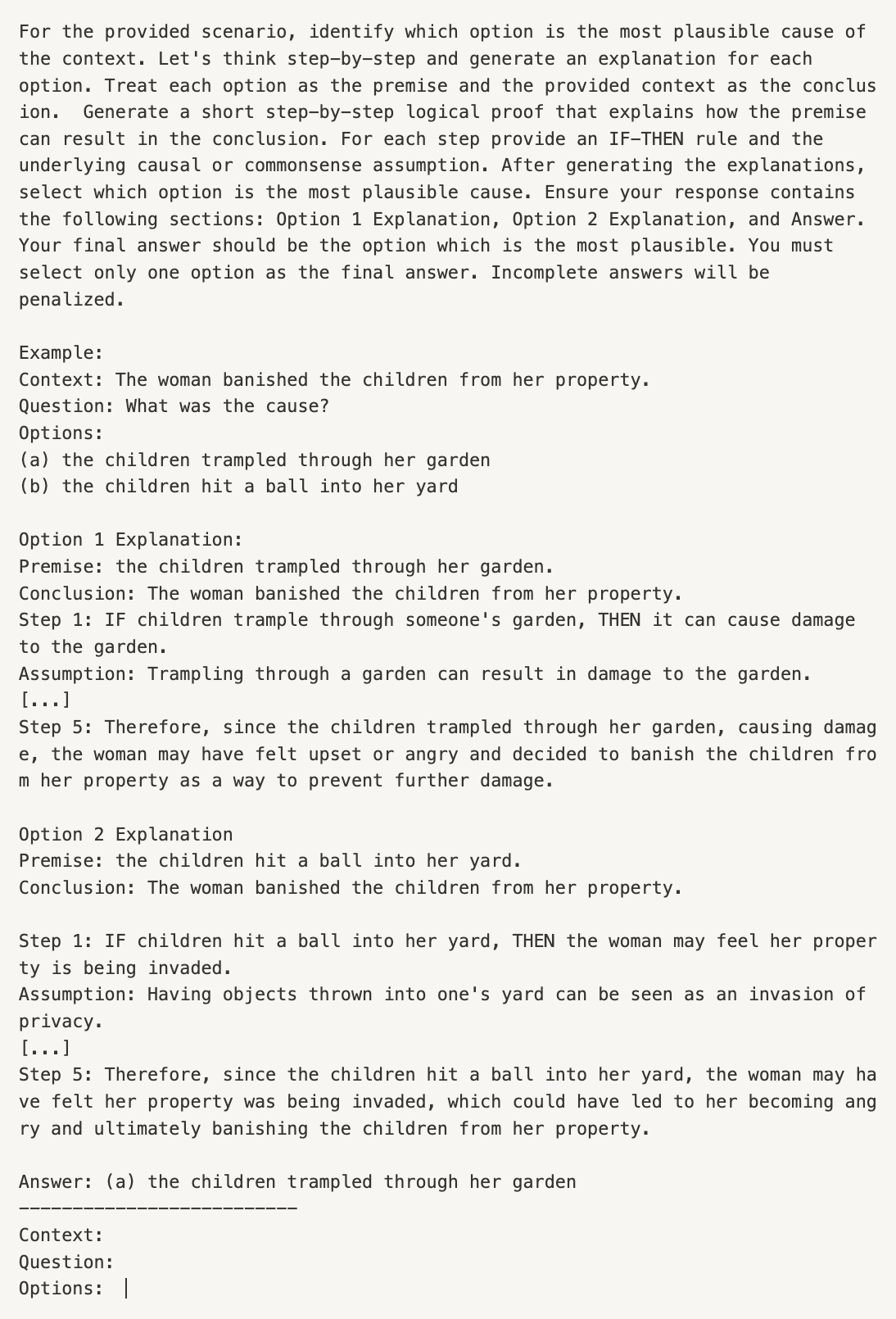
The image is a screenshot or digital document containing a detailed instructional example for a causal reasoning task. It provides a structured methodology for analyzing scenarios to determine the most plausible cause of an event, using a step-by-step logical proof format. The document is entirely textual, with no charts, diagrams, or visual data elements. The language is English.
### Content Details
The document is structured as follows:
1. **Initial Instructions:** A paragraph outlines the task: to identify the most plausible cause of a given context from provided options. It specifies the required methodology:
* Treat each option as a premise and the context as the conclusion.
* Generate a short, step-by-step logical proof for each.
* For each step, provide an IF-THEN rule and the underlying causal or commonsense assumption.
* Structure the final response with sections: "Option 1 Explanation," "Option 2 Explanation," and "Answer."
* The final answer must select only one option.
2. **Example Section:** A complete worked example is provided.
* **Context:** "The woman banished the children from her property."
* **Question:** "What was the cause?"
* **Options:**
* (a) the children trampled through her garden
* (b) the children hit a ball into her yard
* **Option 1 Explanation:**
* **Premise:** the children trampled through her garden.
* **Conclusion:** The woman banished the children from her property.
* **Step 1:** IF children trample through someone's garden, THEN it can cause damage to the garden.
* **Assumption:** Trampling through a garden can result in damage to the garden.
* **[...]:** Indicates omitted intermediate steps.
* **Step 5:** Therefore, since the children trampled through her garden, causing damage, the woman may have felt upset or angry and decided to banish the children from her property as a way to prevent further damage.
* **Option 2 Explanation:**
* **Premise:** the children hit a ball into her yard.
* **Conclusion:** The woman banished the children from her property.
* **Step 1:** IF children hit a ball into her yard, THEN the woman may feel her property is being invaded.
* **Assumption:** Having objects thrown into one's yard can be seen as an invasion of privacy.
* **[...]:** Indicates omitted intermediate steps.
* **Step 5:** Therefore, since the children hit a ball into her yard, the woman may have felt her property was being invaded, which could have led to her becoming angry and ultimately banishing the children from her property.
* **Answer:** "(a) the children trampled through her garden"
3. **Template Footer:** The document ends with a separator line and placeholders for a new problem:
* `Context:`
* `Question:`
* `Options: |` (The cursor `|` suggests this is an editable template).
### Key Observations
* **Structured Methodology:** The document enforces a rigorous, repeatable analytical framework. It moves from a general instruction to a concrete example, demonstrating the application of the rules.
* **Logical Scaffolding:** The explanations explicitly separate the logical step (IF-THEN rule) from the underlying commonsense assumption, highlighting the reasoning process.
* **Implicit Bias in Example:** The chosen example and its resolution favor the option involving direct, tangible damage ("trampled through her garden") over a more minor intrusion ("hit a ball into her yard") as the more plausible cause for a severe reaction like banishment.
* **Template Design:** The footer indicates this is likely a template or a prompt from an interactive system where a user would input a new context, question, and options to be analyzed using the demonstrated method.
### Interpretation
This document is not a source of empirical data but a **procedural guide for logical analysis**. Its primary purpose is pedagogical or operational: to teach or enforce a specific method for causal inference.
* **What it demonstrates:** It models how to deconstruct a causal claim into a chain of logical inferences supported by commonsense knowledge. The "IF-THEN" structure formalizes the reasoning, while the "Assumption" makes the underlying world knowledge explicit.
* **Relationship between elements:** The instructions define the rules, the example illustrates their application, and the template invites practice. The flow is from theory to demonstration to application.
* **Notable pattern:** The example's conclusion aligns with a common heuristic that more direct, harmful actions are more likely to provoke strong reactions than indirect or minor ones. This reveals an embedded commonsense bias within the logical framework itself.
* **Purpose:** This format is likely used in fields like artificial intelligence (for training reasoning models), logic education, or structured decision-making processes to ensure consistent and transparent causal analysis. The image itself contains no factual data about the world; it contains data about *a method for thinking about the world*.