## Text-Based Scenario Analysis: Property Banishment Causality
### Overview
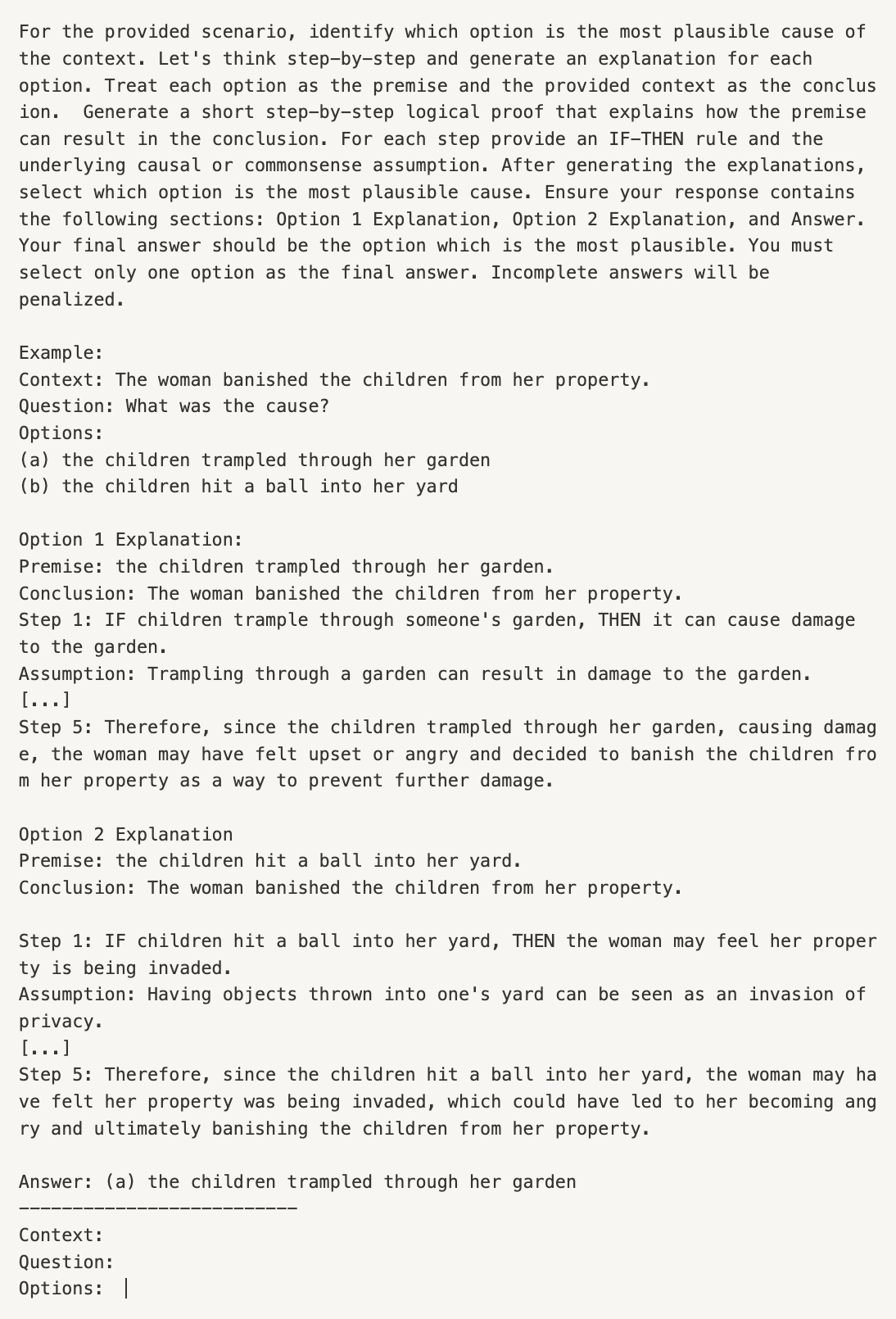
The image contains a structured logical reasoning exercise. It presents a scenario where a woman bans children from her property, followed by a question asking for the most plausible cause. Two options are provided, each with a step-by-step explanation. The task requires evaluating causal assumptions and selecting the most plausible option.
### Components/Axes
- **Context**: "The woman banished the children from her property."
- **Question**: "What was the cause?"
- **Options**:
- (a) The children trampled through her garden.
- (b) The children hit a ball into her yard.
- **Structure**:
- **Option 1 Explanation**: Premise (children trampling), conclusion (banishment), and causal steps (damage → anger → banishment).
- **Option 2 Explanation**: Premise (ball in yard), conclusion (banishment), and causal steps (invasion of privacy → anger → banishment).
- **Answer**: Explicitly states the selected option.
### Detailed Analysis
#### Option 1 Explanation
- **Premise**: Children trampled through her garden.
- **Conclusion**: Banishment from property.
- **Steps**:
1. **IF-THEN Rule**: Trampling → garden damage.
2. **Assumption**: Damage causes upset/anger.
3. **Conclusion**: Banishment to prevent further damage.
#### Option 2 Explanation
- **Premise**: Children hit a ball into her yard.
- **Conclusion**: Banishment from property.
- **Steps**:
1. **IF-THEN Rule**: Ball in yard → invasion of privacy.
2. **Assumption**: Invasion of privacy causes anger.
3. **Conclusion**: Banishment as a reaction.
### Key Observations
- Both options use **IF-THEN causal logic** but differ in the nature of the premise (physical damage vs. perceived intrusion).
- **Option 1** emphasizes tangible harm (garden damage), while **Option 2** focuses on subjective perception (privacy invasion).
- The **Answer** explicitly selects **(a)**, prioritizing physical damage over abstract intrusion.
### Interpretation
The exercise demonstrates how **causal reasoning** hinges on the perceived severity of a premise. Option 1 is deemed more plausible because trampling directly damages property, which is a universally recognized justification for anger and punitive action. Option 2, while valid, relies on the assumption that a ball in a yard constitutes an invasion of privacy—a less universally agreed-upon premise. The structure mirrors **Peircean abductive reasoning**, where the most likely explanation is selected based on observed effects (banishment) and plausible causes.
**Final Answer**: (a) the children trampled through her garden.