## Diagram: Molecular Mechanisms of Strand Displacement and Migration
### Overview
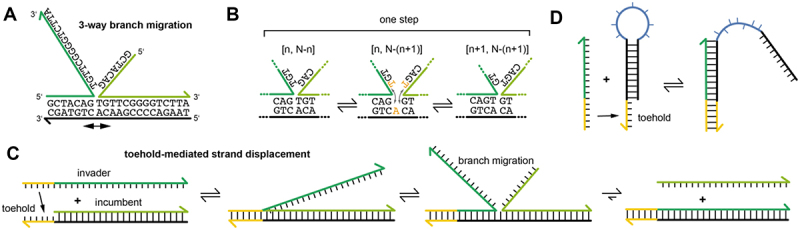
The image is a technical diagram illustrating molecular processes involving DNA strand interactions, including 3-way branch migration, one-step transformations, toehold-mediated strand displacement, and branch migration. It uses color-coded DNA sequences, arrows, and structural motifs to depict these mechanisms.
---
### Components/Axes
- **Panels**: Labeled A, B, C, D, each depicting distinct molecular processes.
- **DNA Strands**: Represented as linear or branched structures with color-coded sequences (green, yellow, black).
- **Arrows**: Indicate directionality of strand migration, displacement, or transformation.
- **Labels**: Terms like "toehold," "incumbent," "invader," "branch migration," and "one step" are explicitly annotated.
- **Sequences**: Specific nucleotide sequences (e.g., `GCTACAG`, `CGATGTC`) are provided for each strand.
---
### Detailed Analysis
#### Panel A: 3-Way Branch Migration
- **Structure**: A Y-shaped DNA structure with three branches.
- **Sequences**:
- Top branch: `GCTACAG TGTTCGGGGTCTTA`
- Middle branch: `CGATGTC ACAAGCCCCAGAAT`
- Bottom branch: `GCTACAG TGTTCGGGGTCTTA` (repeated)
- **Arrows**: Indicate migration of the top branch toward the middle branch.
- **Key Features**: The 3-way branch suggests a bifurcation or recombination event.
#### Panel B: One Step
- **Stages**:
1. **[n, N-n]**: `CAG TGT GTC ACA` → `CAG TGT GTC ACA` (no change).
2. **[n, N-(n+1)]**: `CAG TGT GTC ACA` → `CAG TGT GTC ACA` (no change).
3. **[n+1, N-(n+1)]**: `CAG TGT GTC ACA` → `CAG TGT GTC ACA` (no change).
- **Arrows**: Show incremental transformations between stages, though sequences remain identical.
- **Interpretation**: The "one step" label may imply a simplified or idealized process, but the sequences do not change, suggesting a placeholder or conceptual model.
#### Panel C: Toehold-Mediated Strand Displacement
- **Components**:
- **Invader**: A short DNA strand (green) with a "toehold" (yellow) at the 3' end.
- **Incumbent**: A longer DNA strand (black) with a complementary sequence.
- **Process**:
1. **Initial State**: Invader binds to the incumbent via the toehold.
2. **Displacement**: The invader displaces the incumbent, forming a new hybrid strand.
3. **Final State**: The invader and incumbent are separated, with the invader now part of the hybrid.
- **Sequences**:
- Invader: `GCTACAG` (green)
- Incumbent: `CGATGTC` (black)
- **Arrows**: Indicate the direction of displacement and hybridization.
#### Panel D: Branch Migration
- **Structure**:
- **Initial State**: A linear DNA strand with a "toehold" (yellow) at the 3' end.
- **Final State**: A branched DNA structure with a loop (blue circle) and a displaced strand.
- **Arrows**: Show the migration of the toehold-containing strand into a looped configuration.
- **Sequences**:
- Linear strand: `GCTACAG` (green)
- Branched structure: `CGATGTC` (black)
- **Key Features**: The blue circle may represent a topological change (e.g., supercoiling or loop formation).
---
### Key Observations
1. **Consistent Sequences**: The sequences `GCTACAG` and `CGATGTC` appear repeatedly across panels, suggesting they are central to the depicted mechanisms.
2. **Directionality**: Arrows in all panels indicate movement from left to right, implying a unidirectional process.
3. **Color Coding**: Green and yellow sequences are consistently used for specific roles (e.g., invader, toehold), while black sequences represent the incumbent or background.
4. **Structural Motifs**: The Y-shape (Panel A), linear-to-branched transformation (Panel D), and hybridization (Panel C) highlight different stages of DNA manipulation.
---
### Interpretation
- **Molecular Mechanisms**: The diagram illustrates processes critical to DNA recombination, repair, or synthetic biology applications. For example:
- **Toehold-Mediated Displacement** (Panel C) is a key mechanism in DNA origami and strand displacement reactions.
- **3-Way Branch Migration** (Panel A) may represent a recombination event or a synthetic construct for controlled DNA assembly.
- **One-Step Transformations** (Panel B) could symbolize idealized or simplified models of molecular interactions.
- **Relationships**: The panels are interconnected, with Panel C (displacement) potentially enabling the 3-way branch migration (Panel A) and branch migration (Panel D). The "one step" process (Panel B) may represent a theoretical or simplified version of these mechanisms.
- **Notable Patterns**: The repetition of sequences across panels suggests a focus on specific nucleotide motifs for strand recognition and interaction. The absence of numerical data implies the diagram is conceptual rather than quantitative.
---
### Conclusion
This diagram provides a visual framework for understanding DNA strand interactions, emphasizing the roles of toeholds, branch migration, and displacement. It likely serves as a reference for designing or analyzing molecular systems in synthetic biology, nanotechnology, or genetic engineering.