## Line Chart: LLM-as-a-Judge Performance Across Iterations
### Overview
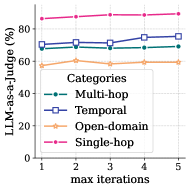
The chart displays the performance of four LLM-as-a-judge categories (Multi-hop, Temporal, Open-domain, Single-hop) across 5 maximum iterations. Performance is measured as a percentage on the y-axis, with iterations on the x-axis. The legend is positioned on the right, with distinct colors and markers for each category.
### Components/Axes
- **X-axis**: "max iterations" (1 to 5, integer values)
- **Y-axis**: "LLM-as-a-judge (%)" (0 to 80, percentage scale)
- **Legend**: Located on the right, with:
- **Multi-hop**: Teal circles (●)
- **Temporal**: Blue squares (■)
- **Open-domain**: Orange triangles (▲)
- **Single-hop**: Pink diamonds (◇)
### Detailed Analysis
1. **Single-hop (Pink Diamonds)**:
- **Trend**: Flat line at ~85% across all iterations.
- **Values**: 85% (iterations 1–5).
- **Position**: Topmost line, consistently highest.
2. **Temporal (Blue Squares)**:
- **Trend**: Slight upward slope from ~70% (iteration 1) to ~75% (iteration 5).
- **Values**: 70% (iteration 1), 72% (iteration 2), 73% (iteration 3), 75% (iteration 4), 75% (iteration 5).
3. **Multi-hop (Teal Circles)**:
- **Trend**: Flat line with minor fluctuations (~65–70%).
- **Values**: 65% (iteration 1), 68% (iteration 2), 67% (iteration 3), 69% (iteration 4), 70% (iteration 5).
4. **Open-domain (Orange Triangles)**:
- **Trend**: Flat line with minor fluctuations (~55–60%).
- **Values**: 55% (iteration 1), 60% (iteration 2), 58% (iteration 3), 60% (iteration 4), 60% (iteration 5).
### Key Observations
- **Single-hop** dominates performance, maintaining ~85% across all iterations.
- **Temporal** shows the only significant improvement, increasing by ~5% over iterations.
- **Multi-hop** and **Open-domain** exhibit minimal variation, with Open-domain consistently lagging behind.
### Interpretation
The data suggests **Single-hop** is the most robust category for LLM-as-a-judge tasks, unaffected by iteration count. **Temporal** demonstrates incremental improvement, implying potential benefits from iterative refinement. **Multi-hop** and **Open-domain** show limited sensitivity to iteration changes, possibly indicating inherent task complexity or model limitations. The stark performance gap between Single-hop and other categories highlights architectural or methodological advantages in the Single-hop approach.