## Diagram: Iterative Relation Extraction Network
### Overview
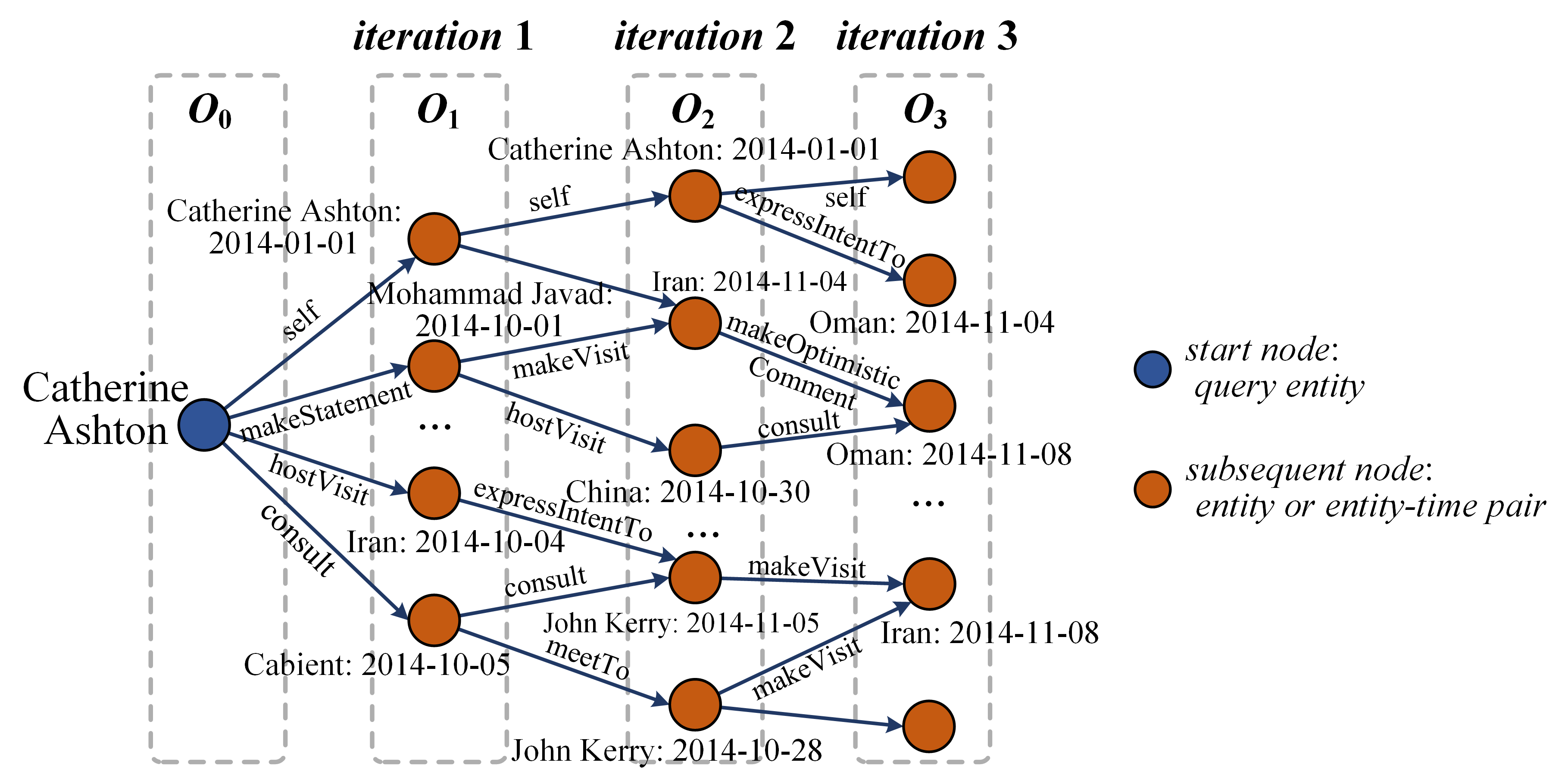
This diagram illustrates an iterative process for relation extraction, likely within a natural language processing or knowledge graph context. It depicts a network of entities and relationships evolving across four iterations (O₀, O₁, O₂, O₃). The diagram uses nodes and directed edges to represent entities (and entity-time pairs) and the relationships between them, respectively. A legend clarifies the node types: blue for the start node (query entity) and orange for subsequent nodes.
### Components/Axes
The diagram is structured horizontally, representing the progression of iterations.
* **Iterations:** Labeled as "iteration 1", "iteration 2", and "iteration 3" above the respective network segments. The initial state is labeled "O₀", "O₁", "O₂", and "O₃".
* **Nodes:** Represent entities or entity-time pairs. They are colored: blue for the starting node ("Catherine Ashton") and orange for subsequent nodes.
* **Edges:** Directed arrows representing relationships between nodes. Each edge is labeled with the type of relationship (e.g., "self", "makeStatement", "consult", "makeVisit", "expressIntentTo", "makeOptimisticComment", "meetTo").
* **Legend:** Located in the bottom-right corner, defining the node colors and their meanings.
* **Entities:** Catherine Ashton, Mohammad Javad, Iran, Oman, China, John Kerry, Cabient.
* **Dates:** 2014-01-01, 2014-10-01, 2014-11-04, 2014-10-30, 2014-11-08, 2014-10-05, 2014-11-08, 2014-10-28, 2014-10-05.
### Detailed Analysis
The diagram shows the expansion of relationships originating from the initial node "Catherine Ashton".
**Iteration O₀:**
* Start Node: "Catherine Ashton" (blue node).
* Relationship: "self" to "Catherine Ashton: 2014-01-01" (orange node).
* Relationship: "makeStatement" to "Cabient: 2014-10-05" (orange node).
* Relationship: "consult" to "Iran: 2014-01-04" (orange node).
**Iteration O₁:**
* Start Node: "Catherine Ashton" (blue node).
* Relationship: "self" to "Mohammad Javad: 2014-10-01" (orange node).
* Relationship: "makeStatement" to "China: 2014-10-30" (orange node).
* Relationship: "consult" to "John Kerry: 2014-11-05" (orange node).
**Iteration O₂:**
* Start Node: "Catherine Ashton: 2014-01-01" (orange node).
* Relationship: "self" to "Catherine Ashton: 2014-01-01" (orange node).
* Relationship: "expressIntentTo" to "Iran: 2014-11-04" (orange node).
**Iteration O₃:**
* Start Node: "Mohammad Javad: 2014-10-01" (orange node).
* Relationship: "makeVisit" to "Oman: 2014-11-04" (orange node).
* Relationship: "makeOptimisticComment" to "Oman: 2014-11-08" (orange node).
* Relationship: "consult" to "Iran: 2014-11-08" (orange node).
* Start Node: "John Kerry: 2014-11-05" (orange node).
* Relationship: "makeVisit" to "Iran: 2014-11-08" (orange node).
* Start Node: "John Kerry: 2014-10-28" (orange node).
The "..." symbols indicate that the diagram is not showing all possible relationships or nodes within each iteration, but rather a selection to illustrate the process.
### Key Observations
* The network expands iteratively, adding new entities and relationships with each step.
* The relationships are diverse, including "self-references", statements, consultations, visits, and expressions of intent.
* The inclusion of dates with entities suggests a focus on temporal aspects of the relationships.
* The diagram demonstrates a process of refining and expanding knowledge about "Catherine Ashton" and her interactions with other entities.
### Interpretation
This diagram likely represents a model for extracting relationships from text or other data sources. The iterative process suggests that the system starts with an initial entity ("Catherine Ashton") and progressively discovers related entities and the relationships between them. Each iteration refines the knowledge graph by adding new connections and potentially disambiguating entities (e.g., by including timestamps). The use of different relationship types indicates that the system is capable of identifying various kinds of interactions. The "..." symbols suggest that the system is not limited to the relationships shown and can potentially explore a much larger network of connections. The diagram highlights the importance of considering both entities and the temporal context of relationships in knowledge extraction. The iterative nature of the process suggests a potential application in tasks such as event tracking, social network analysis, or knowledge base construction.