## 2D Kernel Density Estimate Plot with Marginal Distributions: General Text vs. Medical Text
### Overview
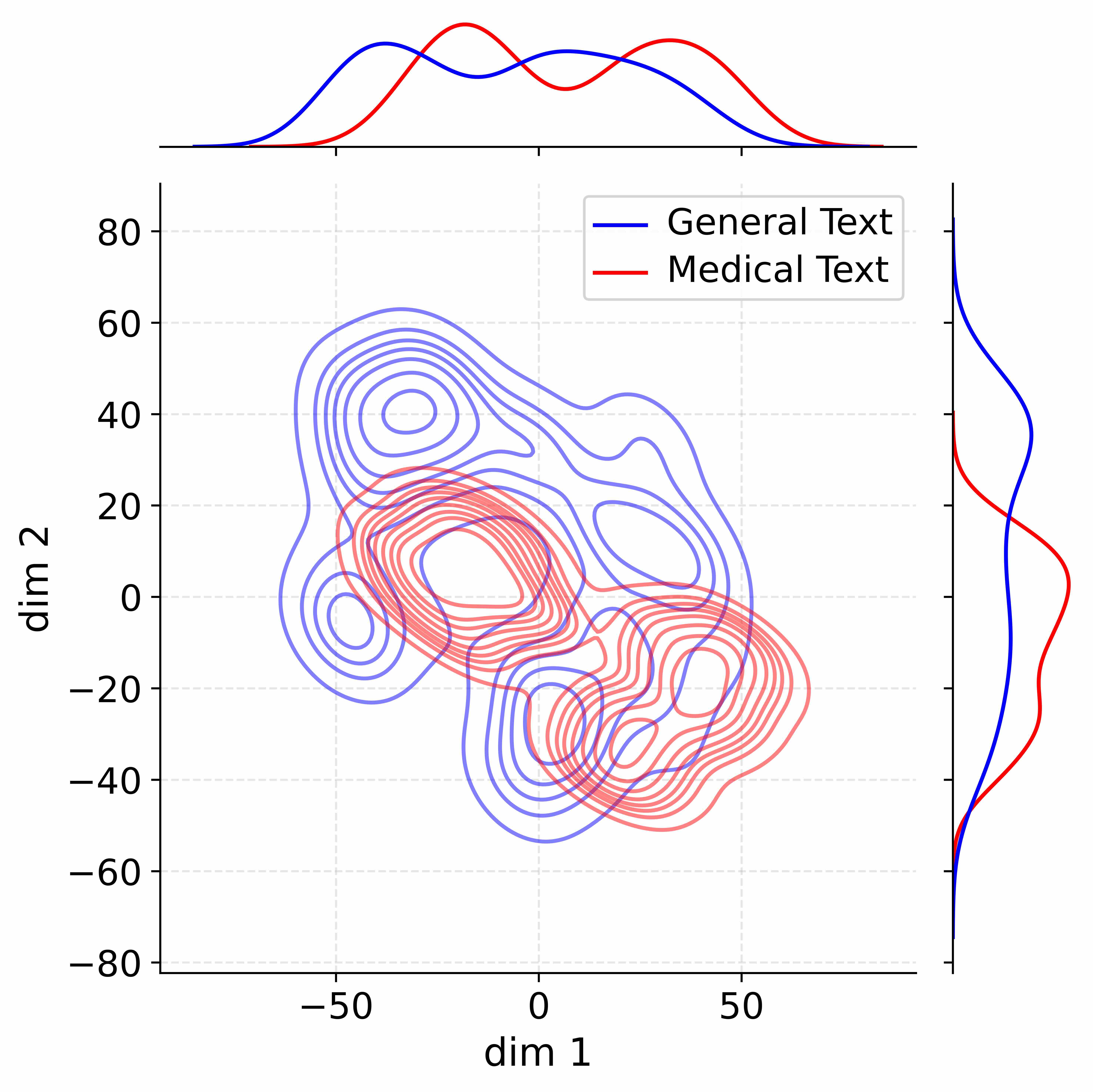
The image displays a 2D kernel density estimate (KDE) plot comparing the distribution of two datasets in a two-dimensional space. The central plot shows contour lines representing data density, accompanied by marginal density plots on the top and right edges. The data appears to be the result of a dimensionality reduction technique (e.g., PCA, t-SNE) applied to text corpora, projecting high-dimensional text embeddings into two dimensions labeled "dim 1" and "dim 2".
### Components/Axes
* **Main Plot (Center):**
* **X-axis:** Labeled "dim 1". Ticks are marked at -50, 0, and 50. The axis spans approximately from -75 to +75.
* **Y-axis:** Labeled "dim 2". Ticks are marked at intervals of 20, from -80 to 80.
* **Grid:** A light gray dashed grid is present.
* **Data Series (Contour Lines):**
* **Blue Contours:** Represent "General Text". Lines are solid blue.
* **Red Contours:** Represent "Medical Text". Lines are solid red.
* **Legend:** Located in the top-right quadrant of the main plot area. It contains:
* A blue line segment followed by the text "General Text".
* A red line segment followed by the text "Medical Text".
* **Marginal Plot (Top):**
* Shows the 1D density distribution for "dim 1".
* Contains a blue curve (General Text) and a red curve (Medical Text).
* Shares the x-axis scale with the main plot.
* **Marginal Plot (Right):**
* Shows the 1D density distribution for "dim 2".
* Contains a blue curve (General Text) and a red curve (Medical Text).
* Shares the y-axis scale with the main plot.
### Detailed Analysis
**1. Main Contour Plot Analysis:**
* **General Text (Blue):** The distribution is broad and multi-modal. The highest density regions (innermost contours) are located in two primary clusters:
* A large cluster in the upper-left quadrant, centered approximately at (dim1 ≈ -30, dim2 ≈ 40).
* A smaller, distinct cluster in the lower-left quadrant, centered approximately at (dim1 ≈ -40, dim2 ≈ -10).
* The contours extend widely, covering a range from approximately dim1: -60 to +50 and dim2: -60 to +70.
* **Medical Text (Red):** The distribution is more concentrated and unimodal. The highest density region is a single, tight cluster centered near the origin, approximately at (dim1 ≈ 0, dim2 ≈ 0). The contours are densely packed, indicating a steep density gradient. The overall spread is smaller than the General Text, ranging approximately from dim1: -40 to +60 and dim2: -50 to +30.
* **Overlap:** There is significant spatial overlap between the two distributions, particularly in the central region around (0,0). However, the General Text distribution has substantial density in areas (especially upper-left) where the Medical Text density is very low.
**2. Marginal Distribution Analysis:**
* **Top Marginal (dim 1):**
* **General Text (Blue):** Shows a bimodal distribution. One peak is centered around dim1 ≈ -30, and a second, slightly lower peak is around dim1 ≈ +10.
* **Medical Text (Red):** Shows a unimodal distribution with a single peak centered near dim1 ≈ 0. The distribution is narrower than the blue curve.
* **Right Marginal (dim 2):**
* **General Text (Blue):** Shows a broad, somewhat bimodal distribution. The primary peak is around dim2 ≈ 40, with a secondary shoulder or peak around dim2 ≈ -10.
* **Medical Text (Red):** Shows a sharp, unimodal distribution with a single peak centered near dim2 ≈ 0. It is significantly narrower than the blue curve.
### Key Observations
1. **Cluster Separation:** The two text types form distinct clusters in the 2D space. "Medical Text" forms a single, tight cluster near the origin, while "General Text" forms a more dispersed, multi-cluster structure primarily in the left half of the plot.
2. **Variance Difference:** The "General Text" dataset exhibits much higher variance in both dimensions compared to the "Medical Text" dataset, as evidenced by the wider spread of its contours and broader marginal distributions.
3. **Multimodality:** The "General Text" distribution is clearly multimodal in both dimensions (bimodal in dim1, bimodal in dim2), suggesting the presence of distinct subgroups within the general text corpus. The "Medical Text" distribution is consistently unimodal.
4. **Central Overlap:** Despite their differences, the core of the Medical Text distribution overlaps with a region of moderate density in the General Text distribution, indicating some shared characteristics in the embedded space.
### Interpretation
This visualization suggests fundamental differences in the structure of general-purpose text versus domain-specific medical text when projected into a lower-dimensional embedding space.
* **Homogeneity vs. Heterogeneity:** The tight, unimodal cluster for Medical Text indicates that medical documents are relatively homogeneous in their semantic or stylistic content as captured by the embedding model. They occupy a specific, well-defined region of the semantic space.
* **Diversity of General Text:** The broad, multi-modal distribution of General Text reflects the inherent diversity of topics, styles, and contexts found in non-specialized text. The multiple clusters likely correspond to different genres or subject areas (e.g., news, fiction, technical writing, conversational text).
* **Domain Specificity:** The separation of the main Medical Text cluster from the densest parts of the General Text cluster (particularly the upper-left mode) implies that medical text possesses distinctive features that set it apart from typical general language. The overlap near the origin, however, suggests that medical text still shares a common linguistic foundation with general text.
* **Implication for Models:** This disparity has implications for training language models. A model trained primarily on general text may not adequately capture the concentrated, specific patterns of medical text, potentially leading to poorer performance on medical NLP tasks. Conversely, the distinct cluster for medical text justifies the use of domain-specific pre-training or fine-tuning.