## Chart Compilation: Electrical Characteristics of 1T1R and ReRAM Devices
### Overview
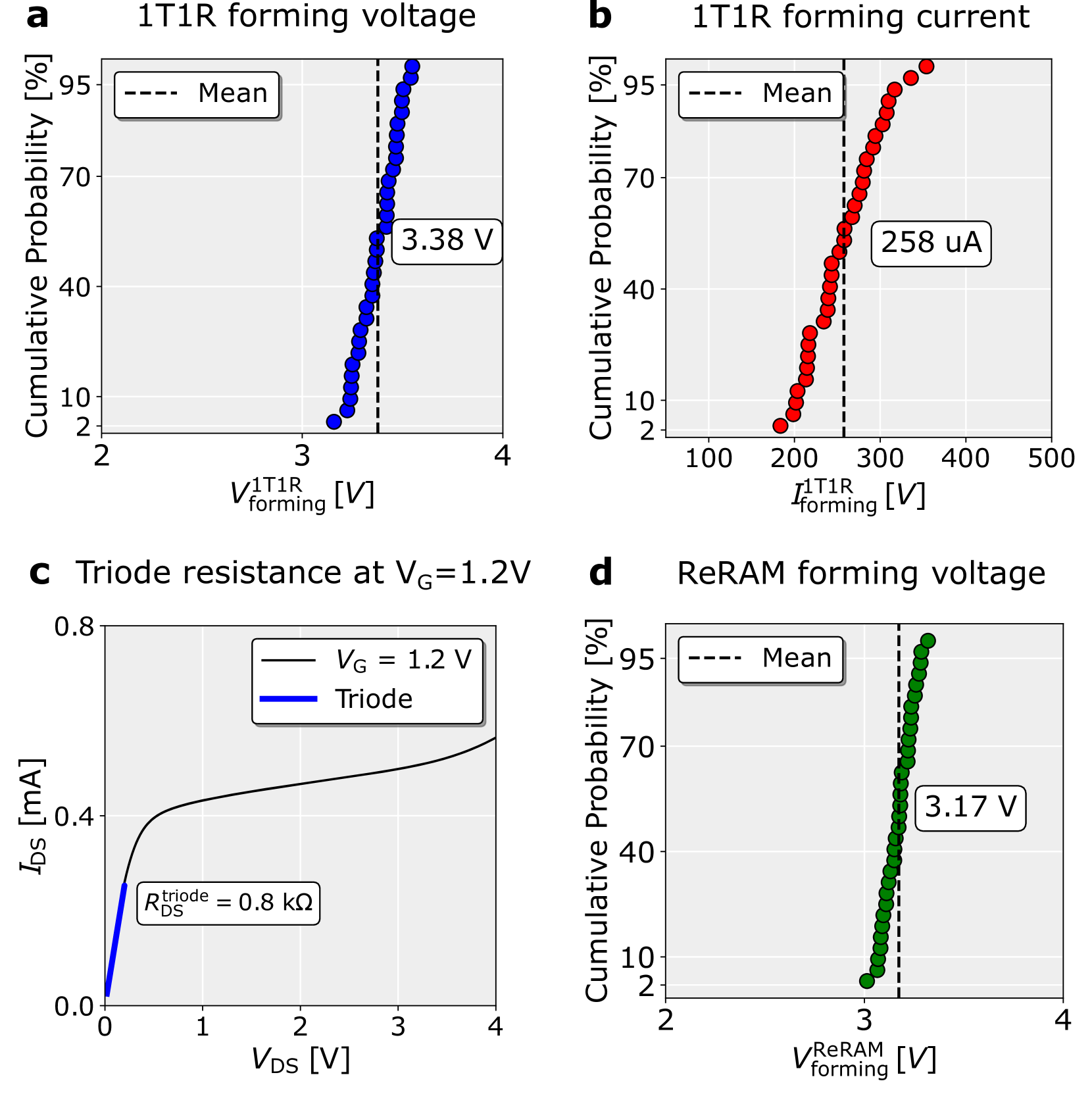
The image presents four plots (a, b, c, d) illustrating the electrical characteristics of 1T1R (One Transistor One Resistor) and ReRAM (Resistive Random-Access Memory) devices. Plots a, b, and d show cumulative probability distributions for forming voltage and current, while plot c depicts the triode resistance at a specific gate voltage.
### Components/Axes
**Plot a: 1T1R forming voltage**
* **Title:** 1T1R forming voltage
* **X-axis:** V<sup>1T1R</sup><sub>forming</sub> [V] (1T1R Forming Voltage in Volts). Scale ranges from 2 to 4, with tick marks at every 1 unit.
* **Y-axis:** Cumulative Probability [%]. Scale ranges from 2 to 95, with tick marks at 10, 40, 70, and 95.
* **Data:** Blue dots represent the cumulative probability of the forming voltage.
* **Mean:** Dashed black vertical line indicating the mean forming voltage.
* **Annotation:** "Mean" in a rounded box at the top-left.
* **Value Label:** A rounded box indicates a voltage of 3.38 V.
**Plot b: 1T1R forming current**
* **Title:** 1T1R forming current
* **X-axis:** I<sup>1T1R</sup><sub>forming</sub> [uA] (1T1R Forming Current in microAmperes). Scale ranges from 100 to 500, with tick marks at every 100 units.
* **Y-axis:** Cumulative Probability [%]. Scale ranges from 2 to 95, with tick marks at 10, 40, 70, and 95.
* **Data:** Red dots represent the cumulative probability of the forming current.
* **Mean:** Dashed black vertical line indicating the mean forming current.
* **Annotation:** "Mean" in a rounded box at the top-left.
* **Value Label:** A rounded box indicates a current of 258 uA.
**Plot c: Triode resistance at V<sub>G</sub>=1.2V**
* **Title:** Triode resistance at V<sub>G</sub>=1.2V
* **X-axis:** V<sub>DS</sub> [V] (Drain-Source Voltage in Volts). Scale ranges from 0 to 4, with tick marks at every 1 unit.
* **Y-axis:** I<sub>DS</sub> [mA] (Drain-Source Current in milliAmperes). Scale ranges from 0.0 to 0.8, with tick marks at 0.0, 0.4, and 0.8.
* **Data:**
* Black line represents V<sub>G</sub> = 1.2 V.
* Blue line represents the Triode region.
* **Legend:** Located at the top-right, indicating the black line as "V<sub>G</sub> = 1.2 V" and the blue line as "Triode".
* **Annotation:** "R<sup>triode</sup><sub>DS</sub> = 0.8 kΩ" in a rounded box, indicating the triode resistance.
**Plot d: ReRAM forming voltage**
* **Title:** ReRAM forming voltage
* **X-axis:** V<sup>ReRAM</sup><sub>forming</sub> [V] (ReRAM Forming Voltage in Volts). Scale ranges from 2 to 4, with tick marks at every 1 unit.
* **Y-axis:** Cumulative Probability [%]. Scale ranges from 2 to 95, with tick marks at 10, 40, 70, and 95.
* **Data:** Green dots represent the cumulative probability of the forming voltage.
* **Mean:** Dashed black vertical line indicating the mean forming voltage.
* **Annotation:** "Mean" in a rounded box at the top-left.
* **Value Label:** A rounded box indicates a voltage of 3.17 V.
### Detailed Analysis
**Plot a: 1T1R forming voltage**
* The cumulative probability increases sharply between 3 V and 3.5 V.
* The mean forming voltage is approximately 3.38 V.
**Plot b: 1T1R forming current**
* The cumulative probability increases sharply between 200 uA and 300 uA.
* The mean forming current is approximately 258 uA.
**Plot c: Triode resistance at V<sub>G</sub>=1.2V**
* The blue line (Triode) shows a linear relationship between V<sub>DS</sub> and I<sub>DS</sub> up to approximately 0.5 V.
* The black line (V<sub>G</sub> = 1.2 V) shows a non-linear relationship, with the current increasing at a decreasing rate as V<sub>DS</sub> increases.
* The triode resistance is given as 0.8 kΩ.
**Plot d: ReRAM forming voltage**
* The cumulative probability increases sharply between 3 V and 3.2 V.
* The mean forming voltage is approximately 3.17 V.
### Key Observations
* The forming voltages for both 1T1R and ReRAM devices are clustered around 3 V, with 1T1R having a slightly higher mean forming voltage.
* The forming current for 1T1R devices is centered around 250 uA.
* The triode region of the transistor exhibits a linear I-V relationship, while the saturation region shows a non-linear behavior.
### Interpretation
The data suggests that the forming process for both 1T1R and ReRAM devices requires a specific voltage range to initiate the resistive switching. The relatively narrow distribution of forming voltages indicates a consistent and controlled fabrication process. The triode resistance plot provides insight into the transistor's behavior, showing the linear and non-linear regions of operation. The 1T1R device has a higher forming voltage and current compared to the ReRAM device, which could be attributed to differences in their material composition or device structure.