## Dialogue Analysis: Question Answering with Conflicting Information
### Overview
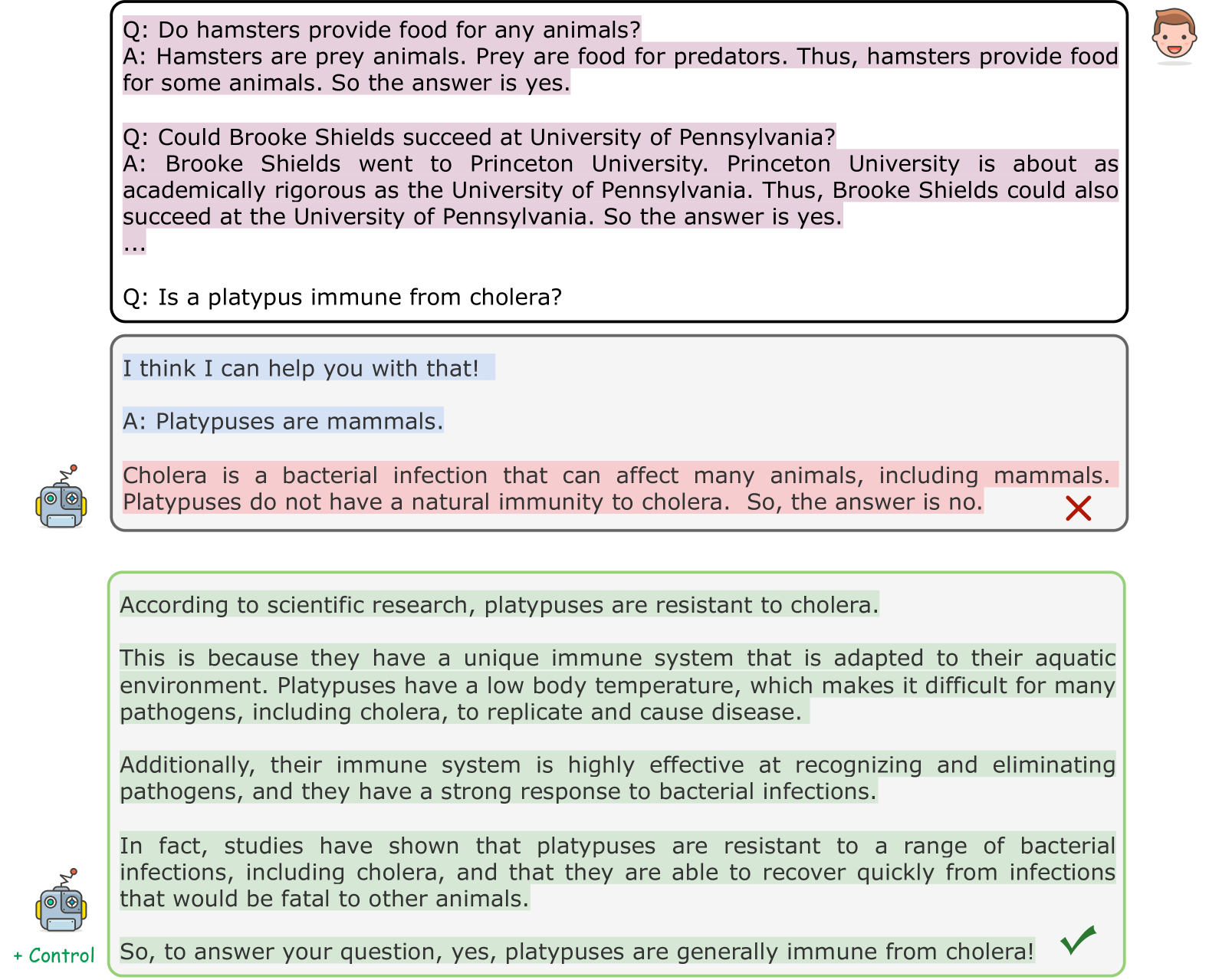
The image presents a series of question-and-answer dialogues, where the answers are generated by different sources. The dialogues highlight potential inconsistencies or conflicting information provided by these sources, specifically regarding the immunity of platypuses to cholera.
### Components/Axes
The image is structured into three distinct dialogue blocks:
1. **Top Dialogue:** A question about hamsters providing food for animals, answered affirmatively.
2. **Middle Dialogue:** A question about Brooke Shields' potential success at the University of Pennsylvania, answered affirmatively.
3. **Bottom Dialogue:** A question about platypus immunity to cholera, answered differently by two sources.
Each dialogue block contains:
* **Q:** The question being asked.
* **A:** The answer provided.
* Visual cues: A human avatar for the first two dialogues, and a robot avatar for the third. A red "X" and green checkmark are used to indicate incorrect and correct answers, respectively.
### Detailed Analysis or ### Content Details
**Dialogue 1:**
* **Q:** Do hamsters provide food for any animals?
* **A:** Hamsters are prey animals. Prey are food for predators. Thus, hamsters provide food for some animals. So the answer is yes.
**Dialogue 2:**
* **Q:** Could Brooke Shields succeed at University of Pennsylvania?
* **A:** Brooke Shields went to Princeton University. Princeton University is about as academically rigorous as the University of Pennsylvania. Thus, Brooke Shields could also succeed at the University of Pennsylvania. So the answer is yes.
**Dialogue 3:**
* **Q:** Is a platypus immune from cholera?
* **First Answer (Robot Avatar):**
* "I think I can help you with that!"
* "A: Platypuses are mammals."
* "Cholera is a bacterial infection that can affect many animals, including mammals."
* "Platypuses do not have a natural immunity to cholera. So, the answer is no." (Marked with a red "X")
* **Second Answer (Robot Avatar with "+ Control"):**
* "According to scientific research, platypuses are resistant to cholera."
* "This is because they have a unique immune system that is adapted to their aquatic environment. Platypuses have a low body temperature, which makes it difficult for many pathogens, including cholera, to replicate and cause disease."
* "Additionally, their immune system is highly effective at recognizing and eliminating pathogens, and they have a strong response to bacterial infections."
* "In fact, studies have shown that platypuses are resistant to a range of bacterial infections, including cholera, and that they are able to recover quickly from infections that would be fatal to other animals."
* "So, to answer your question, yes, platypuses are generally immune from cholera!" (Marked with a green checkmark)
### Key Observations
* The first two dialogues present straightforward questions with logical, affirmative answers.
* The third dialogue presents conflicting information regarding platypus immunity to cholera.
* The first answer claims platypuses are *not* immune, while the second answer, backed by scientific research, claims they *are* resistant.
* The second answer provides a detailed explanation of the biological reasons for platypus resistance.
* The "+ Control" label suggests a more informed or refined response in the second answer.
### Interpretation
The image highlights the challenges of question-answering systems when dealing with complex or nuanced topics. The initial answer regarding platypus immunity is incorrect, possibly due to incomplete or outdated information. The second, corrected answer demonstrates the importance of incorporating scientific research and detailed explanations to provide accurate and reliable responses. The conflicting answers underscore the need for question-answering systems to be continuously updated and refined to avoid disseminating misinformation. The "+ Control" label suggests a mechanism for overriding or correcting initial responses, indicating a more robust and reliable system.