\n
## Diagram: LLM-based QA Agent Workflow
### Overview
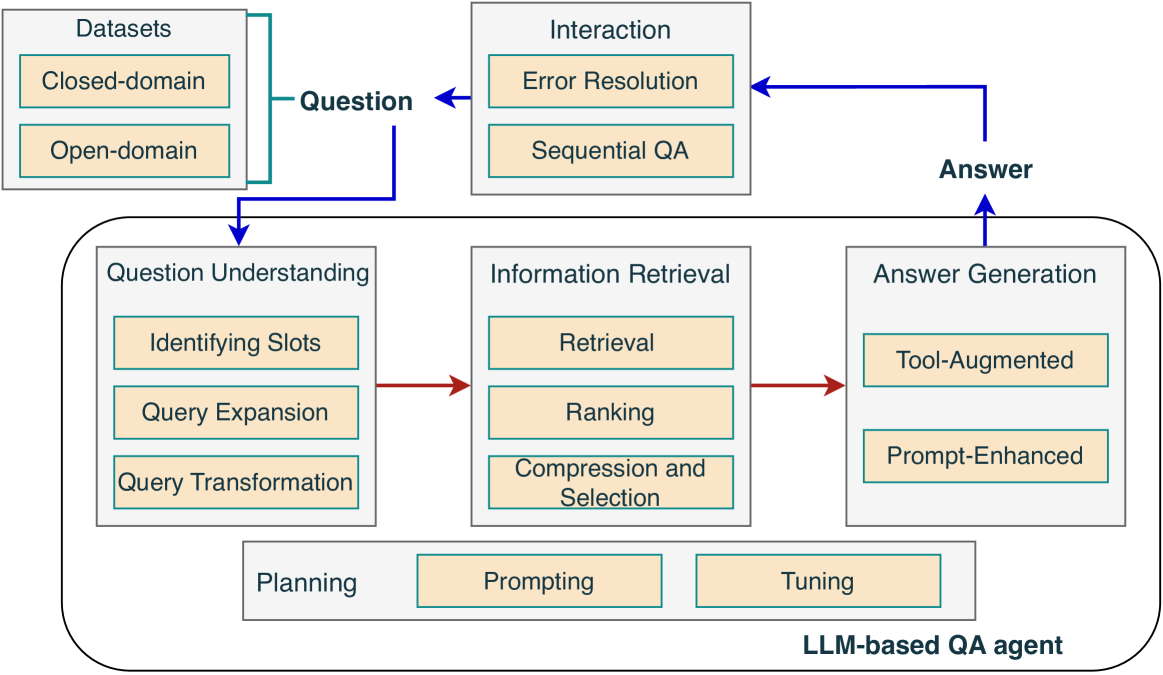
This diagram illustrates the workflow of an LLM-based Question Answering (QA) agent. It depicts the flow of information from datasets through question understanding, information retrieval, and answer generation, culminating in an answer. The diagram is segmented into distinct stages, each containing multiple sub-processes.
### Components/Axes
The diagram consists of the following main components:
* **Datasets:** Includes "Closed-domain" and "Open-domain" datasets.
* **Question:** The input to the system.
* **Question Understanding:** Contains "Identifying Slots", "Query Expansion", and "Query Transformation".
* **Information Retrieval:** Contains "Retrieval", "Ranking", and "Compression and Selection".
* **Answer Generation:** Contains "Tool-Augmented" and "Prompt-Enhanced".
* **Interaction:** Contains "Error Resolution" and "Sequential QA".
* **Answer:** The output of the system.
* **LLM-based QA agent:** The overarching system, with sub-components "Planning", "Prompting", and "Tuning".
Arrows indicate the direction of information flow.
### Detailed Analysis or Content Details
The diagram shows a multi-stage process:
1. **Input:** The process begins with a "Question" originating from either "Closed-domain" or "Open-domain" "Datasets".
2. **Question Understanding:** The question is then processed by "Question Understanding", which involves three sub-processes:
* "Identifying Slots"
* "Query Expansion"
* "Query Transformation"
3. **Information Retrieval:** The output of "Question Understanding" feeds into "Information Retrieval", which consists of:
* "Retrieval"
* "Ranking"
* "Compression and Selection"
4. **Answer Generation:** The output of "Information Retrieval" is used in "Answer Generation", which includes:
* "Tool-Augmented"
* "Prompt-Enhanced"
5. **Interaction & Output:** The generated answer is then passed to "Interaction", which handles "Error Resolution" and "Sequential QA". Finally, the "Answer" is produced.
6. **LLM-based QA agent:** The entire process is underpinned by the "LLM-based QA agent", which is further broken down into "Planning", "Prompting", and "Tuning".
The arrows indicate a primarily linear flow, with feedback loops from "Interaction" back to the "Question" stage.
### Key Observations
The diagram highlights the modularity of the QA agent, with distinct stages for understanding, retrieval, and generation. The inclusion of "Error Resolution" and "Sequential QA" suggests a focus on iterative refinement and handling complex queries. The "Tool-Augmented" and "Prompt-Enhanced" components within "Answer Generation" indicate the use of advanced techniques to improve answer quality.
### Interpretation
This diagram represents a sophisticated approach to building a Question Answering system using Large Language Models (LLMs). The separation of concerns into distinct stages allows for targeted optimization and improvement of each component. The inclusion of "Planning", "Prompting", and "Tuning" within the LLM-based QA agent suggests a focus on controlling and refining the LLM's behavior. The feedback loop from "Interaction" indicates a system designed to learn from its mistakes and improve over time. The diagram emphasizes the importance of both data sources ("Closed-domain" and "Open-domain") and the ability to handle complex interactions ("Error Resolution" and "Sequential QA"). The use of "Tool-Augmented" and "Prompt-Enhanced" suggests a hybrid approach, combining the strengths of LLMs with external tools and carefully crafted prompts.