## Text Document: Linear Algebra Question List
### Overview
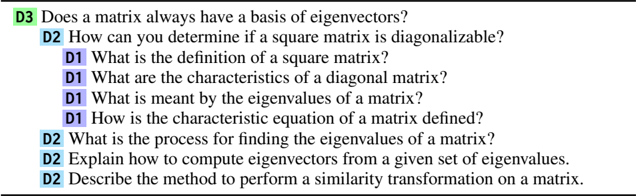
The image displays a vertically arranged list of academic questions related to linear algebra, specifically focusing on matrices, eigenvalues, and eigenvectors. Each question is prefixed with a code (D3, D2, D1), which likely indicates a difficulty level, category, or topic hierarchy. The text is presented in a clear, sans-serif font against a plain white background.
### Components/Axes
* **Structure:** A single-column list of 10 distinct questions.
* **Coding System:** Each question is preceded by a bold, colored code:
* **D3** (Green background, white text)
* **D2** (Blue background, white text)
* **D1** (Blue background, white text)
* **Spatial Layout:** The codes are left-aligned. The questions follow immediately after their respective codes. There is visual indentation for some questions, suggesting a potential grouping or sub-topic relationship.
### Detailed Analysis / Content Details
The complete textual content, transcribed precisely with its associated code:
1. **D3** Does a matrix always have a basis of eigenvectors?
2. **D2** How can you determine if a square matrix is diagonalizable?
3. **D1** What is the definition of a square matrix?
4. **D1** What are the characteristics of a diagonal matrix?
5. **D1** What is meant by the eigenvalues of a matrix?
6. **D1** How is the characteristic equation of a matrix defined?
7. **D2** What is the process for finding the eigenvalues of a matrix?
8. **D2** Explain how to compute eigenvectors from a given set of eigenvalues.
9. **D2** Describe the method to perform a similarity transformation on a matrix.
**Note on Language:** All text is in English.
### Key Observations
* **Hierarchical Grouping:** The indentation pattern suggests a potential structure. The first D2 question ("How can you determine...") is followed by a block of five D1 questions, which are indented relative to it. This could imply the D1 questions are foundational concepts needed to address the D2 question above them.
* **Code Distribution:** There is one D3 question, five D2 questions, and four D1 questions. The D3 question is the most advanced, posing a theoretical "always" condition. The D2 questions focus on processes and determinations. The D1 questions focus on definitions and basic characteristics.
* **Topic Flow:** The list progresses from a high-level theoretical question (D3), to a procedural question about diagonalizability (D2), then down to fundamental definitions (D1), and back up to computational procedures (D2).
### Interpretation
This image is not a data chart but a structured **knowledge assessment or study outline** for linear algebra. The codes (D1, D2, D3) almost certainly represent a **Bloom's Taxonomy or difficulty hierarchy**:
* **D1 (Remember/Understand):** Questions ask for definitions and characteristics (e.g., "definition of a square matrix").
* **D2 (Apply/Analyze):** Questions ask for processes and methods (e.g., "process for finding eigenvalues," "how to determine if...").
* **D3 (Evaluate/Create):** The single D3 question requires synthesis and evaluation of a general property ("always have a basis").
The list is pedagogically sequenced. It starts with a challenging, overarching question (D3), then breaks down the prerequisite knowledge into a key application question (D2) and its supporting definitional knowledge (D1). It then returns to more advanced application questions (D2). This structure suggests the document is designed to guide a student from foundational knowledge to higher-order problem-solving skills on the topic of matrix diagonalization and eigen-theory. The indentation visually reinforces the dependency of the D1 concepts on the D2 question that precedes them.