## Screenshot: Hierarchical Question Structure on Matrix Theory
### Overview
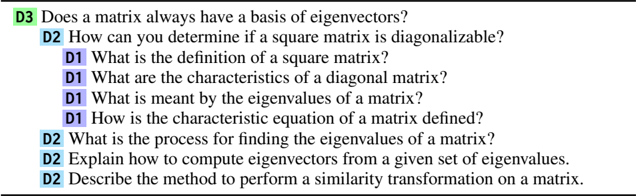
The image displays a hierarchical structure of questions related to linear algebra, specifically matrix theory. Questions are organized into three tiers labeled **D3**, **D2**, and **D1**, with **D3** at the top and **D1** at the bottom. Each tier contains progressively detailed questions, suggesting a pedagogical or technical documentation approach to breaking down complex concepts.
### Components/Axes
- **Labels**:
- **D3** (Green): Top-level question.
- **D2** (Blue): Intermediate-level questions.
- **D1** (Purple): Foundational-level questions.
- **Text Content**:
- Questions are nested under their respective labels, forming a tree-like hierarchy.
- No numerical data, charts, or diagrams are present; the focus is purely on textual content.
### Detailed Analysis
#### D3 Tier
- **Question**: "Does a matrix always have a basis of eigenvectors?"
#### D2 Tier
1. "How can you determine if a square matrix is diagonalizable?"
2. "What is the process for finding the eigenvalues of a matrix?"
3. "Explain how to compute eigenvectors from a given set of eigenvalues."
4. "Describe the method to perform a similarity transformation on a matrix."
#### D1 Tier
1. "What is the definition of a square matrix?"
2. "What are the characteristics of a diagonal matrix?"
3. "What is meant by the eigenvalues of a matrix?"
4. "How is the characteristic equation of a matrix defined?"
5. "How is the characteristic equation of a matrix defined?" (Duplicate of D1.4)
### Key Observations
- The hierarchy progresses from broad conceptual questions (**D3**) to specific procedural or definitional questions (**D1**).
- **D1.5** is a duplicate of **D1.4**, indicating a potential error in the original structure.
- Color coding (**D3**: green, **D2**: blue, **D1**: purple) visually distinguishes the tiers.
### Interpretation
This structure likely serves as a study guide or technical reference, systematically decomposing matrix theory into digestible components. The hierarchy reflects a pedagogical strategy:
1. **D3** addresses foundational existence questions (e.g., eigenvector bases).
2. **D2** focuses on computational methods (e.g., diagonalization, eigenvalue/eigenvector calculations).
3. **D3** covers basic definitions and properties (e.g., square matrices, diagonal matrices).
The duplication in **D1** suggests a need for review to ensure accuracy. The absence of numerical examples or visual aids implies the image is intended for conceptual understanding rather than practical computation.
## Conclusion
The image provides a structured breakdown of matrix theory questions, emphasizing logical progression from high-level concepts to foundational details. It is likely part of an educational resource aimed at clarifying complex linear algebra topics.