## Network Diagram: Hierarchical Node Structure
### Overview
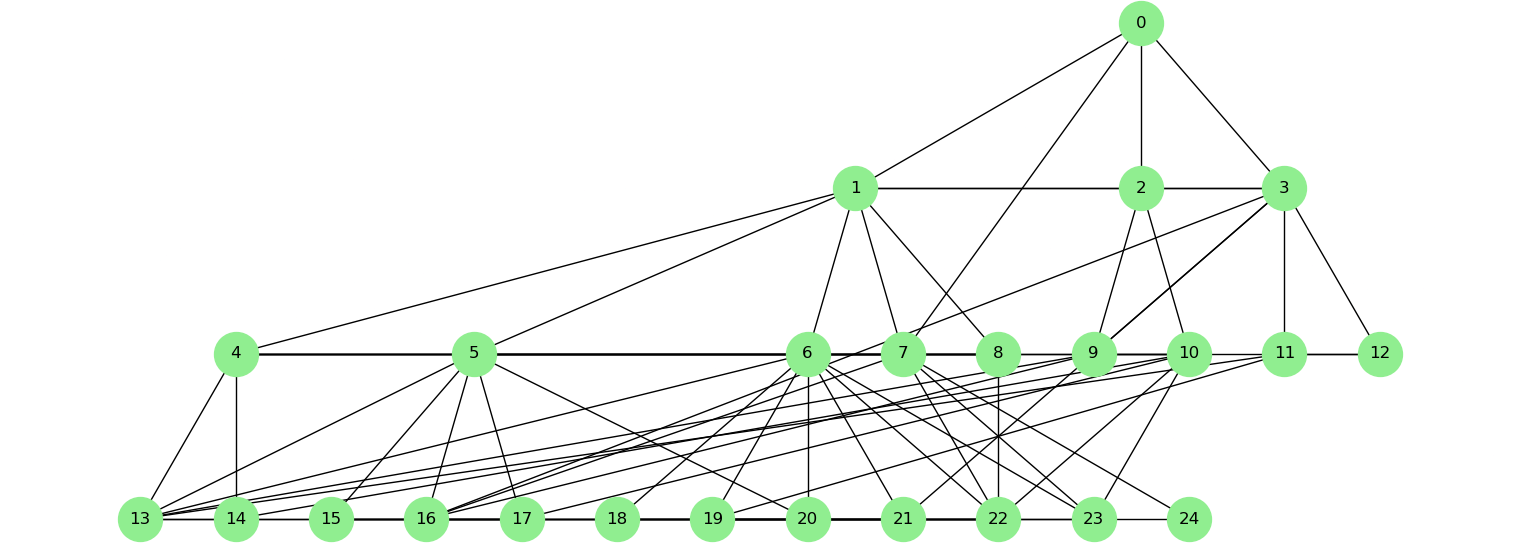
The image depicts a network diagram with 25 nodes labeled 0–24, connected by black lines. Nodes are represented as green circles with numerical labels. The diagram exhibits a hierarchical structure, with node 0 at the top, followed by tiers of interconnected nodes. The lower tier (nodes 13–24) forms a densely connected subnetwork. No textual labels, legends, or axis markers are present.
### Components/Axes
- **Nodes**: 25 green circles labeled 0–24.
- **Edges**: Black lines connecting nodes.
- **Layout**:
- **Top Tier**: Node 0 (root) connected to nodes 1, 2, 3.
- **Middle Tier**: Nodes 1–12, each connected to subsets of nodes 4–12.
- **Bottom Tier**: Nodes 13–24, forming a dense, fully connected subnetwork.
- **No legend, axis titles, or textual annotations** are visible.
### Detailed Analysis
- **Node 0**: Positioned at the top, directly connected to nodes 1, 2, and 3.
- **Nodes 1–3**: Each connected to three nodes in the middle tier (e.g., node 1 connects to 4, 5, 6).
- **Nodes 4–12**: Form a secondary tier, with each node connected to multiple nodes in the bottom tier (e.g., node 4 connects to 13, 14, 15).
- **Nodes 13–24**: Fully interconnected, with every node linked to every other node in this tier.
- **Edge Density**: The bottom tier has the highest edge density, suggesting a highly interactive subnetwork.
### Key Observations
1. **Hierarchical Structure**: The diagram follows a top-down hierarchy, with node 0 as the central hub.
2. **Dense Subnetwork**: Nodes 13–24 exhibit a complete graph structure, indicating maximum connectivity.
3. **No Directionality**: Edges are undirected (no arrows), implying bidirectional relationships.
4. **Missing Metadata**: Absence of labels, legends, or axis titles limits contextual interpretation.
### Interpretation
The diagram likely represents a hierarchical network system, such as:
- **Organizational Structure**: Node 0 could represent a central authority, with tiers reflecting management levels.
- **Data Flow Architecture**: Node 0 as a central server, nodes 1–12 as intermediate nodes, and nodes 13–24 as peripheral devices or data clusters.
- **Social Network**: Node 0 as a central influencer, with lower tiers representing communities or subgroups.
The dense connectivity in the bottom tier suggests a critical subnetwork for redundancy or specialized interactions. The lack of labels or legends makes it challenging to assign specific roles to nodes, but the structural patterns imply a system designed for scalability and modularity.
**Note**: Without additional context (e.g., node labels, edge weights, or directional arrows), the diagram’s purpose remains speculative. Further annotations would enhance interpretability.