## Task Instructions and Image Analysis
### Overview
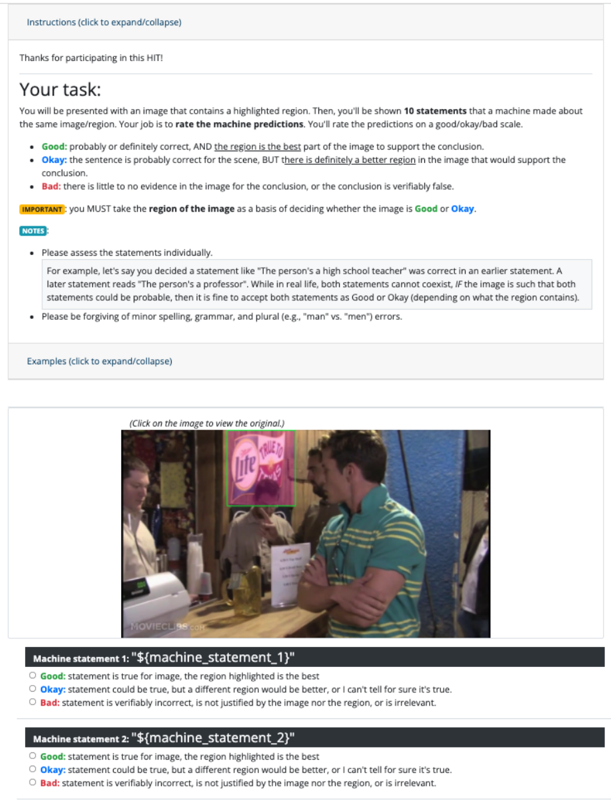
The image presents instructions for a task involving rating machine-generated statements about images with highlighted regions. The task requires evaluating whether the statements are "Good," "Okay," or "Bad" based on the highlighted region's relevance to the statement. An example image is provided, along with two machine-generated statements to be evaluated.
### Components/Axes
* **Header:**
* "Instructions (click to expand/collapse)"
* "Thanks for participating in this HIT!"
* "Your task:"
* **Task Instructions:**
* The task involves rating machine predictions about images with highlighted regions.
* Rating scale: Good, Okay, Bad.
* "Good": probably or definitely correct, AND the region is the best part of the image to support the conclusion.
* "Okay": the sentence is probably correct for the scene, BUT there is definitely a better region in the image that would support the conclusion.
* "Bad": there is little to no evidence in the image for the conclusion, or the conclusion is verifiably false.
* "IMPORTANT: you MUST take the region of the image as a basis of deciding whether the image is Good or Okay."
* **Notes:**
* "Please assess the statements individually."
* Example provided regarding statement consistency.
* "Please be forgiving of minor spelling, grammar, and plural (e.g., "man" vs. "men") errors."
* **Examples:**
* "Examples (click to expand/collapse)"
* **Image:**
* A still from a movie or TV show, featuring three people in what appears to be a bar or restaurant.
* A "Lite" beer sign is highlighted with a green box.
* Text above the image: "(Click on the image to view the original.)"
* "MOVIECLIPS.com" watermark at the bottom of the image.
* **Machine Statements:**
* "Machine statement 1: "${machine\_statement\_1}""
* Radio buttons for "Good," "Okay," and "Bad" with corresponding descriptions.
* Good: statement is true for image, the region highlighted is the best
* Okay: statement could be true, but a different region would be better, or I can't tell for sure it's true.
* Bad: statement is verifiably incorrect, is not justified by the image nor the region, or is irrelevant.
* "Machine statement 2: "${machine\_statement\_2}""
* Radio buttons for "Good," "Okay," and "Bad" with corresponding descriptions.
* Good: statement is true for image, the region highlighted is the best
* Okay: statement could be true, but a different region would be better, or I can't tell for sure it's true.
* Bad: statement is verifiably incorrect, is not justified by the image nor the region, or is irrelevant.
### Detailed Analysis or ### Content Details
The image provides a clear set of instructions for a human-in-the-loop task. The task requires the user to evaluate machine-generated statements based on a highlighted region in an image. The instructions emphasize the importance of considering the highlighted region when making a judgment. The example image shows a scene with a highlighted beer sign, and the user must decide if the machine-generated statements accurately reflect the content and relevance of that region.
### Key Observations
* The task relies on human judgment to assess the quality of machine predictions.
* The highlighted region serves as the primary focus for evaluation.
* The instructions provide clear criteria for each rating category (Good, Okay, Bad).
* The machine statements are placeholders "${machine\_statement\_1}" and "${machine\_statement\_2}", indicating that the actual statements would be dynamically generated during the task.
### Interpretation
The image describes a task designed to evaluate the performance of machine learning models in understanding and interpreting images. By having humans rate the machine's statements, the task aims to gather data that can be used to improve the accuracy and reliability of these models. The emphasis on the highlighted region suggests that the task is specifically designed to assess the model's ability to identify and understand the significance of specific objects or areas within an image. The task is part of a Human Intelligence Task (HIT).