\n
## Diagram: Visual Language Model - Humor Generation
### Overview
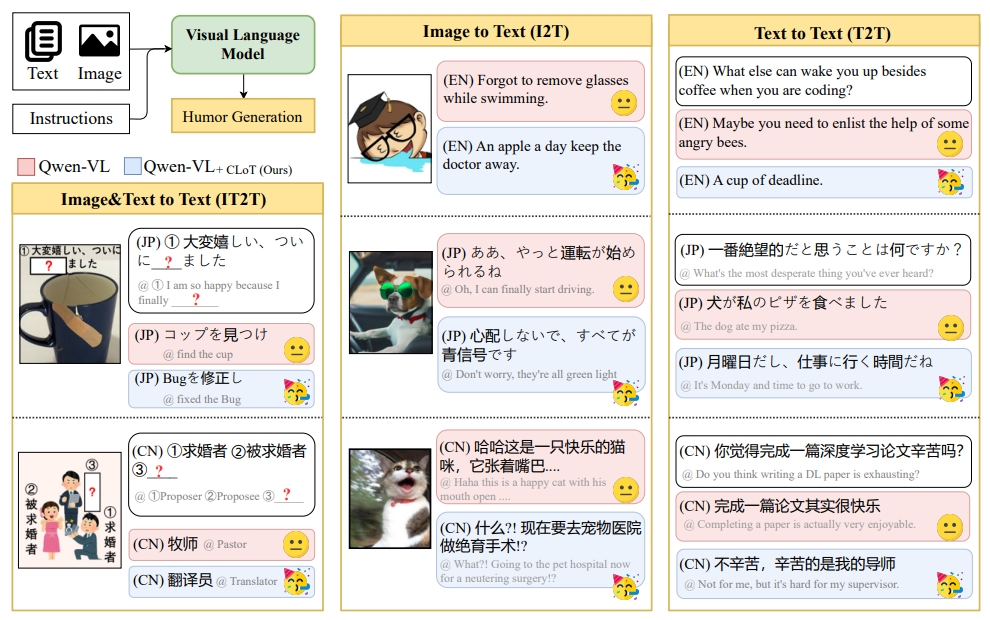
This diagram illustrates a visual language model pipeline, specifically focusing on humor generation. It shows how text and image inputs are processed through different stages – including Image to Text (I2T) and Text to Text (T2T) – and highlights the performance of different models (Qwen-VL, Qwen-VL+CLoT). The diagram presents examples of input images and corresponding generated humorous text in both Japanese (JP) and Chinese (CN), alongside English translations.
### Components/Axes
The diagram is structured into three main sections:
1. **Header:** Depicts the overall process of a Visual Language Model with inputs (Text, Image, Instructions) and output (Humor Generation).
2. **Main Body:** Divided into two columns: "Image&Text to Text (IT2T)" and "Image to Text (I2T)" on the left, and "Text to Text (T2T)" on the right.
3. **Footer:** Contains labels for the models being compared: ① Qwen-VL, ② Qwen-VL+CLoT (Ours).
The diagram also includes language indicators: (JP) for Japanese, (CN) for Chinese, and (EN) for English. Each example has a corresponding emoji.
### Detailed Analysis or Content Details
**Header:**
* **Visual Language Model:** A box representing the core model.
* **Inputs:** Text, Image, Instructions are shown as arrows feeding into the model.
* **Output:** Humor Generation is shown as an arrow exiting the model.
**Image&Text to Text (IT2T) Column:**
* **Example 1:**
* Image: A person looking surprised.
* (JP) 大変嬉しい、ついにしました! (Daitai ureshii, tsui ni shimashita!) - "I am so happy because I finally..."
* (EN) I am so happy because I finally...
* **Example 2:**
* Image: A cup with a question mark.
* (JP) コップを見つけろ! ( Koppu o mitsukero!) - "Find the cup!"
* (EN) find the cup
* **Example 3:**
* Image: A bug being squashed.
* (JP) Bugを修正し! (Bug o shuusei shi!) - "Fixed the Bug"
* (EN) fixed the Bug
* **Example 4:**
* Image: A person looking worried.
* (JP) 心配しないで、すべてが青信号です (Shinpai shinaide, subete ga aoshingo desu) - "Don't worry, all green light"
* (EN) Don't worry, all green light
* **Example 5:**
* Image: A dog eating pizza.
* (JP) 犬が私のピザを食べました (Inu ga watashi no piza o tabemashita) - "The dog ate my pizza."
* (EN) The dog ate my pizza.
* **Example 6:**
* Image: A clock.
* (JP) 月曜日だし、仕事に行く時間だね (Getsuyoubi dashi, shigoto ni iku jikan da ne) - "It's Monday and time to go to work."
* (EN) It's Monday and time to go to work.
* **Example 7:**
* Image: A person proposing.
* (CN) 求解者@被求婚者 (Jiejue zhe @ bei jiu hun zhe) - "@Proposer ?Proposee ?"
* **Example 8:**
* Image: A person in a hospital bed.
* (CN) 什么?!现在要去宠物医院做啥手术?! (Shenme?! Xianzai yao qu chongwu yiyuan zuo na shou shu?!) - "What?! Going to the pet hospital now for a neutering surgery?!"
* (EN) What?! Going to the pet hospital now for a neutering surgery?!
* **Example 9:**
* Image: A person looking exhausted.
* (CN) 你觉得写完一篇深度学习论文辛苦辛苦吗? (Ni jue de xie wan yipian shendu xuexi lunwen xinku xinku ma?) - "Do you think writing a DL paper is exhausting?"
* (EN) Do you think writing a DL paper is exhausting?
* **Example 10:**
* Image: A person smiling.
* (CN) 完成一篇论文其实很快乐 (Wancheng yipian lunwen qishi hen kuale) - "Completing a paper is actually very enjoyable."
* (EN) Completing a paper is actually very enjoyable.
* **Example 11:**
* Image: A person looking frustrated.
* (CN) 不辛苦,辛苦的是我的导师 (Bu xinku, xinku de shi wo de daoshi) - "Not for me, but hard for my supervisor."
* (EN) Not for me, but hard for my supervisor.
**Image to Text (I2T) Column:**
* **Example 1:**
* Image: A person wearing sunglasses.
* (EN) Forgot to remove glasses while swimming.
* Emoji: 😅
* **Example 2:**
* Image: An apple.
* (EN) An apple a day keep the doctor away.
* Emoji: 🍎
**Text to Text (T2T) Column:**
* **Example 1:**
* (EN) What else can wake you up besides coffee when you are coding?
* Emoji: ☕
* **Example 2:**
* (EN) Maybe you need to enlist the help of some angry bees.
* Emoji: 🐝
* **Example 3:**
* (EN) A cup of deadline.
* Emoji: ☕
**Footer:**
* ① Qwen-VL
* ② Qwen-VL+CLoT (Ours)
### Key Observations
* The diagram showcases the ability of the models to generate humorous responses based on both image and text inputs.
* The examples are provided in multiple languages (Japanese, Chinese, and English), demonstrating the model's multilingual capabilities.
* The inclusion of emojis adds to the humorous context.
* The comparison between Qwen-VL and Qwen-VL+CLoT suggests that the latter model (Ours) performs better in humor generation.
* The examples demonstrate a range of humor types, from puns to situational comedy.
### Interpretation
The diagram demonstrates the progress in visual language models, specifically their ability to understand and generate humor. The pipeline highlights the importance of both image and text understanding for creating relevant and amusing responses. The comparison between the two models suggests that incorporating additional components (CLoT) can significantly improve the quality of humor generation. The multilingual examples indicate the model's potential for cross-cultural humor understanding and generation. The use of emojis further enhances the communication of humor, adding a layer of emotional context. The diagram serves as a visual representation of the model's capabilities and potential applications in areas such as chatbot development, content creation, and human-computer interaction. The examples provided are relatively simple, suggesting that the model's ability to handle more complex and nuanced humor may still be limited. However, the diagram provides a promising glimpse into the future of AI-powered humor generation.