## Diagram: NeuroBench Harness Architecture
### Overview
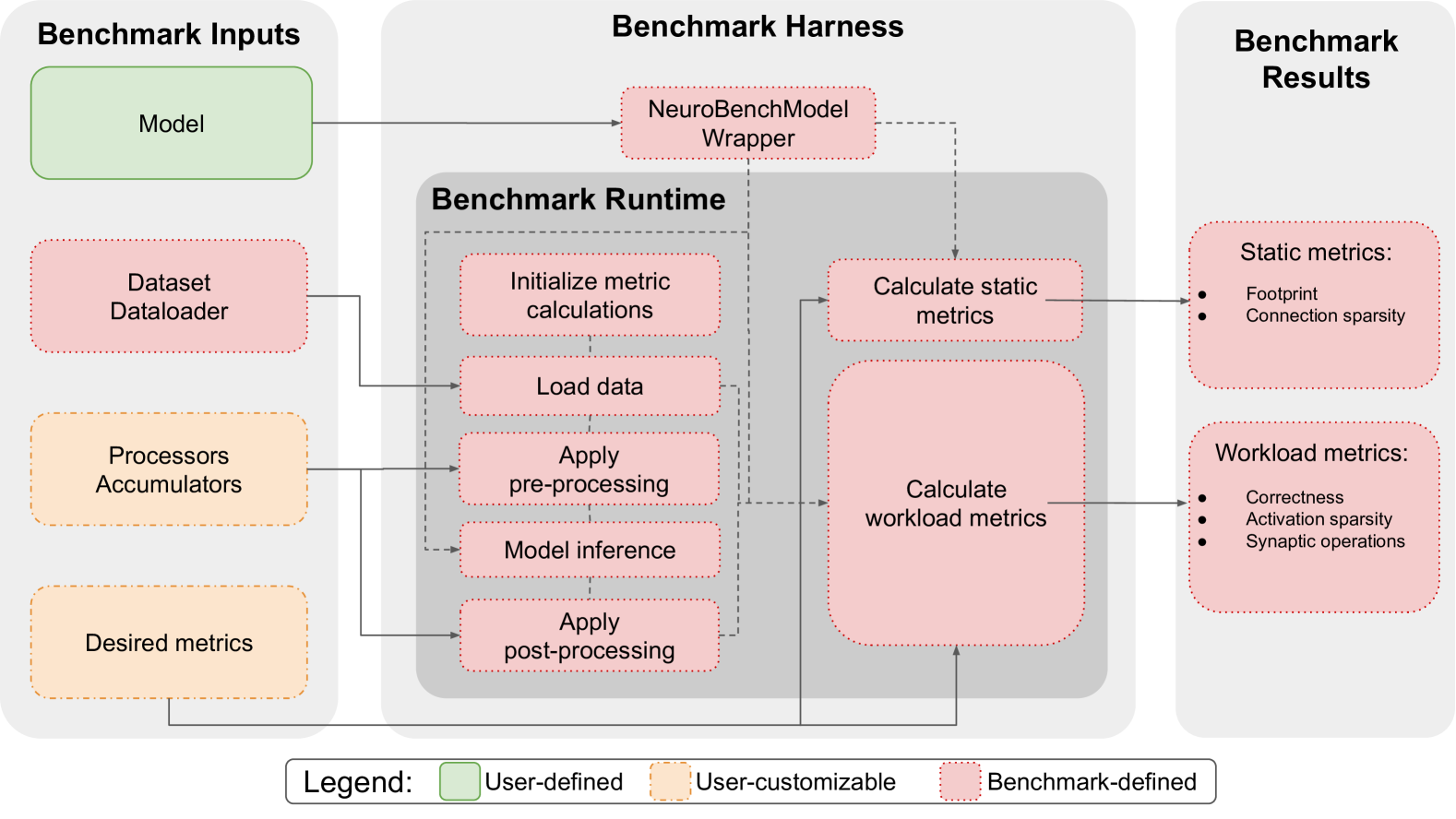
This diagram illustrates the architectural flow of the "NeuroBench Harness," a system designed to evaluate machine learning models. The diagram is organized into three vertical columns: **Benchmark Inputs** (left), **Benchmark Harness** (center), and **Benchmark Results** (right). It uses a color-coded legend to distinguish between components that are user-defined, user-customizable, and benchmark-defined.
### Components/Axes
The diagram utilizes a legend at the bottom to define the color-coding of the boxes:
* **Green (Solid border):** User-defined
* **Orange (Dashed border):** User-customizable
* **Red (Dotted border):** Benchmark-defined
**Spatial Layout:**
* **Left Column (Benchmark Inputs):** Contains four input blocks.
* **Center Column (Benchmark Harness):** Contains the main processing logic, divided into the "NeuroBenchModel Wrapper" and the "Benchmark Runtime" (which contains a sequence of processing steps).
* **Right Column (Benchmark Results):** Contains two output blocks.
### Detailed Analysis
#### 1. Benchmark Inputs (Left)
* **Model** (Green): Positioned at the top. Feeds into the "NeuroBenchModel Wrapper."
* **Dataset Dataloader** (Red): Positioned below the Model. Feeds into "Load data."
* **Processors Accumulators** (Orange): Positioned below the Dataloader. Feeds into "Apply pre-processing" and "Apply post-processing."
* **Desired metrics** (Orange): Positioned at the bottom. Feeds into "Initialize metric calculations."
#### 2. Benchmark Harness (Center)
This section is divided into two main containers:
* **NeuroBenchModel Wrapper** (Red, top): Acts as an interface. It receives input from the "Model" and sends data to "Calculate static metrics." It also has a dashed-line connection to "Model inference."
* **Benchmark Runtime** (Dark gray container, bottom): Contains a sequential pipeline of operations:
1. **Initialize metric calculations** (Red): Receives input from "Desired metrics."
2. **Load data** (Red): Receives input from "Dataset Dataloader."
3. **Apply pre-processing** (Red): Receives input from "Processors Accumulators."
4. **Model inference** (Red): Receives input from "Apply pre-processing."
5. **Apply post-processing** (Red): Receives input from "Model inference."
* **Metric Calculation Blocks (Right side of Runtime):**
* **Calculate static metrics** (Red): Receives input from "NeuroBenchModel Wrapper."
* **Calculate workload metrics** (Red): Receives input from "Apply post-processing" and "Model inference."
#### 3. Benchmark Results (Right)
* **Static metrics** (Red, top): Receives data from "Calculate static metrics."
* Contains: "Footprint", "Connection sparsity".
* **Workload metrics** (Red, bottom): Receives data from "Calculate workload metrics."
* Contains: "Correctness", "Activation sparsity", "Synaptic operations".
### Key Observations
* **High Standardization:** The vast majority of the "Benchmark Runtime" and "Benchmark Results" components are "Benchmark-defined" (Red), indicating a highly standardized evaluation process.
* **Abstraction Layer:** The "NeuroBenchModel Wrapper" serves as the critical bridge between the user's arbitrary model and the standardized benchmark harness.
* **Data Flow:** The flow is strictly linear for the runtime (Initialize -> Load -> Pre-process -> Inference -> Post-process), while the metric calculations branch off from specific stages of this pipeline.
* **Customization Points:** Users have limited but specific control points: the Model itself, the Dataloader, the hardware/processing configuration ("Processors Accumulators"), and the selection of metrics ("Desired metrics").
### Interpretation
This diagram demonstrates a modular benchmarking framework designed to ensure reproducibility and consistency. By separating the "Benchmark Runtime" from the "Model," the system allows for the evaluation of diverse models using a standardized set of metrics.
The distinction between **Static metrics** and **Workload metrics** is significant:
* **Static metrics** (Footprint, Connection sparsity) appear to be derived from the model's architecture itself, likely analyzed via the "NeuroBenchModel Wrapper" before or independent of execution.
* **Workload metrics** (Correctness, Activation sparsity, Synaptic operations) are derived from the actual execution of the model on data, requiring the full runtime pipeline.
The architecture suggests that the "Benchmark Harness" is designed to be "plug-and-play" for researchers, where they only need to provide the model and data, while the harness handles the complex orchestration of metric calculation and execution.