## Line Chart: RMSE vs. n for Different Algorithms
### Overview
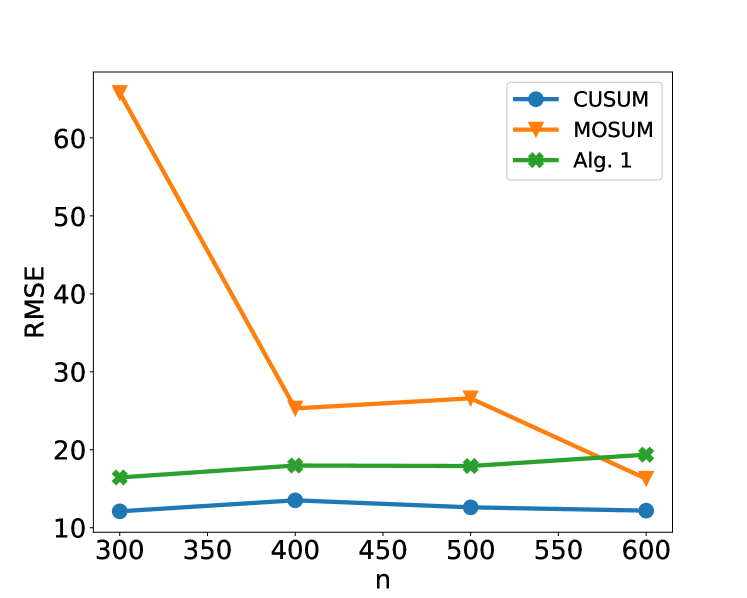
The image is a line chart comparing the Root Mean Squared Error (RMSE) of three algorithms (CUSUM, MOSUM, and Alg. 1) as a function of the variable 'n'. The chart displays how the RMSE changes for each algorithm as 'n' varies from 300 to 600.
### Components/Axes
* **X-axis:** 'n', with values ranging from 300 to 600 in increments of 50 or 100. Axis markers are present at 300, 350, 400, 450, 500, 550, and 600.
* **Y-axis:** 'RMSE', with values ranging from 10 to 60. Axis markers are present at 10, 20, 30, 40, 50, and 60.
* **Legend:** Located in the top-right corner, it identifies the three algorithms:
* Blue line with circle markers: CUSUM
* Orange line with triangle markers: MOSUM
* Green line with cross markers: Alg. 1
### Detailed Analysis
* **CUSUM (Blue):** The RMSE is relatively stable.
* At n=300, RMSE ≈ 12
* At n=400, RMSE ≈ 13.5
* At n=500, RMSE ≈ 12.5
* At n=600, RMSE ≈ 12
* **MOSUM (Orange):** The RMSE decreases significantly from n=300 to n=400, then slightly increases from n=400 to n=500, and then decreases again from n=500 to n=600.
* At n=300, RMSE ≈ 65
* At n=400, RMSE ≈ 26
* At n=500, RMSE ≈ 27
* At n=600, RMSE ≈ 17
* **Alg. 1 (Green):** The RMSE is relatively stable, with a slight increase from n=300 to n=500, and then a slight increase from n=500 to n=600.
* At n=300, RMSE ≈ 16.5
* At n=400, RMSE ≈ 18
* At n=500, RMSE ≈ 18
* At n=600, RMSE ≈ 19.5
### Key Observations
* MOSUM has the highest RMSE at n=300, but it decreases significantly as n increases.
* CUSUM has the lowest and most stable RMSE across the range of n values.
* Alg. 1 has a relatively stable RMSE, slightly higher than CUSUM.
### Interpretation
The chart compares the performance of three algorithms based on their RMSE values for different values of 'n'. The results suggest that CUSUM is the most stable and accurate algorithm across the tested range of 'n' values, as it consistently exhibits the lowest RMSE. MOSUM, while initially having a high RMSE, improves significantly as 'n' increases, eventually approaching the performance of Alg. 1. Alg. 1 shows a consistent performance, but it is generally less accurate than CUSUM. The choice of algorithm would depend on the specific requirements of the application and the expected range of 'n' values. If stability and low error are critical, CUSUM would be the preferred choice. If 'n' is expected to be large, MOSUM could be a viable option.