## Box Plot: Rumination across task
### Overview
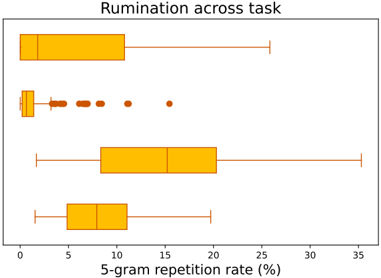
The image displays a horizontal box plot chart titled "Rumination across task." It visualizes the distribution of a metric called "5-gram repetition rate (%)" across four distinct, unlabeled categories or conditions, represented by four vertically stacked box plots. The chart uses a single color (yellow-orange) for all box elements.
### Components/Axes
* **Chart Title:** "Rumination across task" (centered at the top).
* **X-Axis:**
* **Label:** "5-gram repetition rate (%)"
* **Scale:** Linear scale from 0 to 35.
* **Major Tick Marks:** At intervals of 5 (0, 5, 10, 15, 20, 25, 30, 35).
* **Y-Axis:** No explicit labels are present for the four individual box plots. They are distinguished only by their vertical position.
* **Data Series:** Four horizontal box plots, all rendered in the same yellow-orange color. Each consists of:
* A central box spanning the interquartile range (IQR, from the 25th to 75th percentile).
* A vertical line inside the box marking the median.
* "Whiskers" extending from the box to the minimum and maximum values within 1.5 * IQR.
* Individual circular points representing outliers beyond the whiskers.
### Detailed Analysis
The analysis proceeds from the topmost box plot to the bottommost.
1. **Topmost Box Plot (Position: Top):**
* **Range (Whiskers):** Extends from approximately 0% to 25%.
* **Box (IQR):** Spans from approximately 0% to 11%.
* **Median:** Located at approximately 5%.
* **Outliers:** None visible.
* **Trend/Spread:** Shows a wide overall range (0-25%) but a concentration of data in the lower half (0-11%). The median is low.
2. **Second Box Plot (Position: Upper-middle):**
* **Range (Whiskers):** Very narrow, from approximately 0% to 2%.
* **Box (IQR):** Extremely compressed, from approximately 0% to 1%.
* **Median:** At approximately 0.5%.
* **Outliers:** A dense cluster of many outlier points extending from about 2% to 15% on the x-axis.
* **Trend/Spread:** The core data (IQR) is highly concentrated near 0%, but there is a significant number of high-value outliers, indicating a heavily right-skewed distribution.
3. **Third Box Plot (Position: Lower-middle):**
* **Range (Whiskers):** The widest of all, from approximately 2% to 35%.
* **Box (IQR):** Spans from approximately 8% to 20%.
* **Median:** Located at approximately 15%.
* **Outliers:** None visible.
* **Trend/Spread:** Exhibits the highest central tendency (median ~15%) and the greatest overall variability (range ~33 percentage points). The data is broadly distributed.
4. **Bottommost Box Plot (Position: Bottom):**
* **Range (Whiskers):** Extends from approximately 0% to 20%.
* **Box (IQR):** Spans from approximately 5% to 12%.
* **Median:** Located at approximately 10%.
* **Outliers:** None visible.
* **Trend/Spread:** Shows a moderate range and IQR, with a median (10%) between the topmost and third plots.
### Key Observations
1. **Extreme Variability in Central Tendency:** The median 5-gram repetition rate varies dramatically across the four conditions, from near 0% (second plot) to approximately 15% (third plot).
2. **Contrasting Distribution Shapes:**
* The second condition is unique: it has the lowest core values but the most extreme and numerous outliers.
* The third condition has the highest core values and the widest spread.
* The top and bottom conditions show more "typical" box plot shapes with moderate spreads.
3. **Lack of Categorical Labels:** The y-axis provides no information about what the four box plots represent (e.g., different tasks, experimental conditions, participant groups). This is a critical missing piece for full interpretation.
4. **Uniform Styling:** All data is presented in the same color, making visual differentiation reliant solely on vertical position.
### Interpretation
This chart compares the propensity for "rumination," operationalized as the repetition of 5-gram text sequences, across four unspecified scenarios.
* **The data suggests a fundamental difference in the nature of the tasks or conditions.** The condition represented by the **second box plot** appears to strongly suppress repetitive language in its core execution (very low median/IQR), but it triggers occasional, extreme bouts of repetition (the outlier cluster). This could indicate a task that is normally non-repetitive but has specific triggers or failure modes that cause high repetition.
* The **third condition** fosters the most consistent and widespread repetition, with both a high median and a very broad range. This might represent a task that is inherently more repetitive or cognitively taxing in a way that leads to varied but generally higher repetition rates.
* The **top and bottom conditions** show intermediate levels of repetition, with the top condition having a lower median but a longer upper whisker, suggesting a tendency for some instances of high repetition despite a generally low rate.
* **Without the y-axis labels,** the practical significance is limited. The key takeaway is that the measured behavior (5-gram repetition) is highly sensitive to the underlying task or condition, exhibiting not just shifts in average level but also fundamental changes in distribution shape (e.g., tight clustering with outliers vs. broad, even spread). An investigator would need to map these four distributions to their specific experimental conditions to draw substantive conclusions about what drives linguistic rumination.