## Diagram: Two-Stage Training Framework (CoE Tuning and R-GRPO)
### Overview
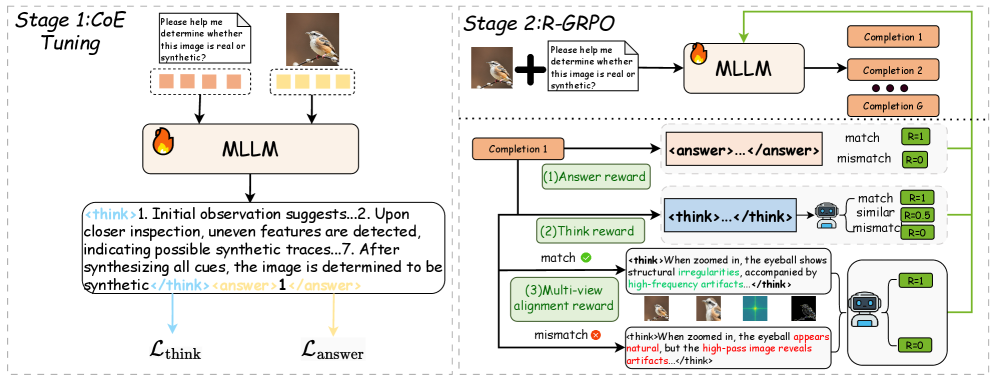
The image presents a two-stage machine learning framework designed to train a Multimodal Large Language Model (MLLM) to detect synthetic images.
* **Stage 1 (Left):** Focuses on "CoE Tuning" (Chain-of-Thought/CoE), where the model is trained to generate reasoning steps and a final answer.
* **Stage 2 (Right):** Focuses on "R-GRPO" (Reinforcement Learning with Group Relative Policy Optimization), where the model generates multiple completions and is evaluated using a multi-faceted reward system (Answer, Think, and Multi-view alignment).
---
### Components/Axes
#### Left Panel: Stage 1: CoE Tuning
* **Inputs (Top):** A document icon containing the text: "Please help me determine whether this image is real or synthetic?" and an image of a bird.
* **Processing (Center):** An MLLM block marked with a fire icon.
* **Output (Bottom):** A text block containing reasoning and an answer: `<answer>1</answer>`.
* **Loss Functions:**
* $\mathcal{L}_{\text{think}}$ (indicated by a blue arrow pointing to the reasoning process).
* $\mathcal{L}_{\text{answer}}$ (indicated by a blue arrow pointing to the answer).
#### Right Panel: Stage 2: R-GRPO
* **Inputs (Top):** A document icon containing the text: "Please help me determine whether this image is real or synthetic?" and an image of a bird.
* **Processing (Center):** An MLLM block generating a group of completions ($G$).
* **Reward System:**
* **(1) Answer reward:** Binary evaluation of the final answer.
* **(2) Think reward:** Evaluates reasoning steps:
* Match: R=1
* Similar: R=0.5
* Mismatch: R=0
* **(3) Multi-view alignment reward:** Evaluates reasoning based on visual evidence.
* **Match (Green check):** Reasoning -> Robot icon -> R=1.
* **Mismatch (Red x):** Reasoning -> Robot icon -> R=0.
---
### Detailed Analysis
#### Stage 1: CoE Tuning
The model is trained using a supervised approach where the loss is split between the reasoning process ($\mathcal{L}_{\text{think}}$) and the final classification ($\mathcal{L}_{\text{answer}}$). The example shows the model identifying "uneven features" and "synthetic traces" before concluding the image is synthetic (Answer: 1).
#### Stage 2: R-GRPO
This stage employs reinforcement learning. The model generates a group of completions ($G$). These completions are scored based on three distinct criteria:
1. **Answer Accuracy:** Binary reward (1 or 0) for the final answer.
2. **Reasoning Quality (Think reward):** A graded reward (1, 0.5, or 0) based on how well the reasoning matches the ground truth.
3. **Multi-view Alignment:** A sophisticated reward mechanism that checks if the model's reasoning aligns with specific visual forensic cues.
* The diagram highlights that "Match" scenarios involve identifying "structural irregularities" and "high-frequency artifacts."
* The "Mismatch" scenario involves a model failing to identify artifacts or misinterpreting the visual evidence (e.g., claiming the eyeball "appears natural" when it actually contains artifacts).
---
### Key Observations
* **Granular Supervision:** The framework does not rely solely on the final answer. It explicitly rewards the "thinking" process and the ability to correlate reasoning with specific visual evidence (Multi-view alignment).
* **Forensic Focus:** The "Multi-view alignment" reward specifically targets image forensics, such as looking for "high-frequency artifacts" and "structural irregularities" in zoomed-in views.
* **Feedback Loop:** The green arrow in Stage 2 indicates an iterative reinforcement learning process where the model learns from the rewards of its generated completions.
---
### Interpretation
This diagram outlines a robust training pipeline for AI-based synthetic image detection.
The transition from **Stage 1 (CoE Tuning)** to **Stage 2 (R-GRPO)** represents a shift from learning *what* to say (supervised reasoning) to learning *how to be accurate and consistent* (reinforcement learning).
The most critical component is the **Multi-view alignment reward**. This suggests that the researchers are training the model to act like a forensic analyst. By rewarding the model when its "thought" process correctly identifies specific, subtle visual artifacts (like high-frequency noise or structural irregularities) and penalizing it when it misses them (even if the final answer might be correct by chance), the framework forces the model to develop a deeper, more reliable understanding of synthetic image characteristics rather than relying on superficial patterns.