# Technical Document Extraction: Time Series Anomaly Types
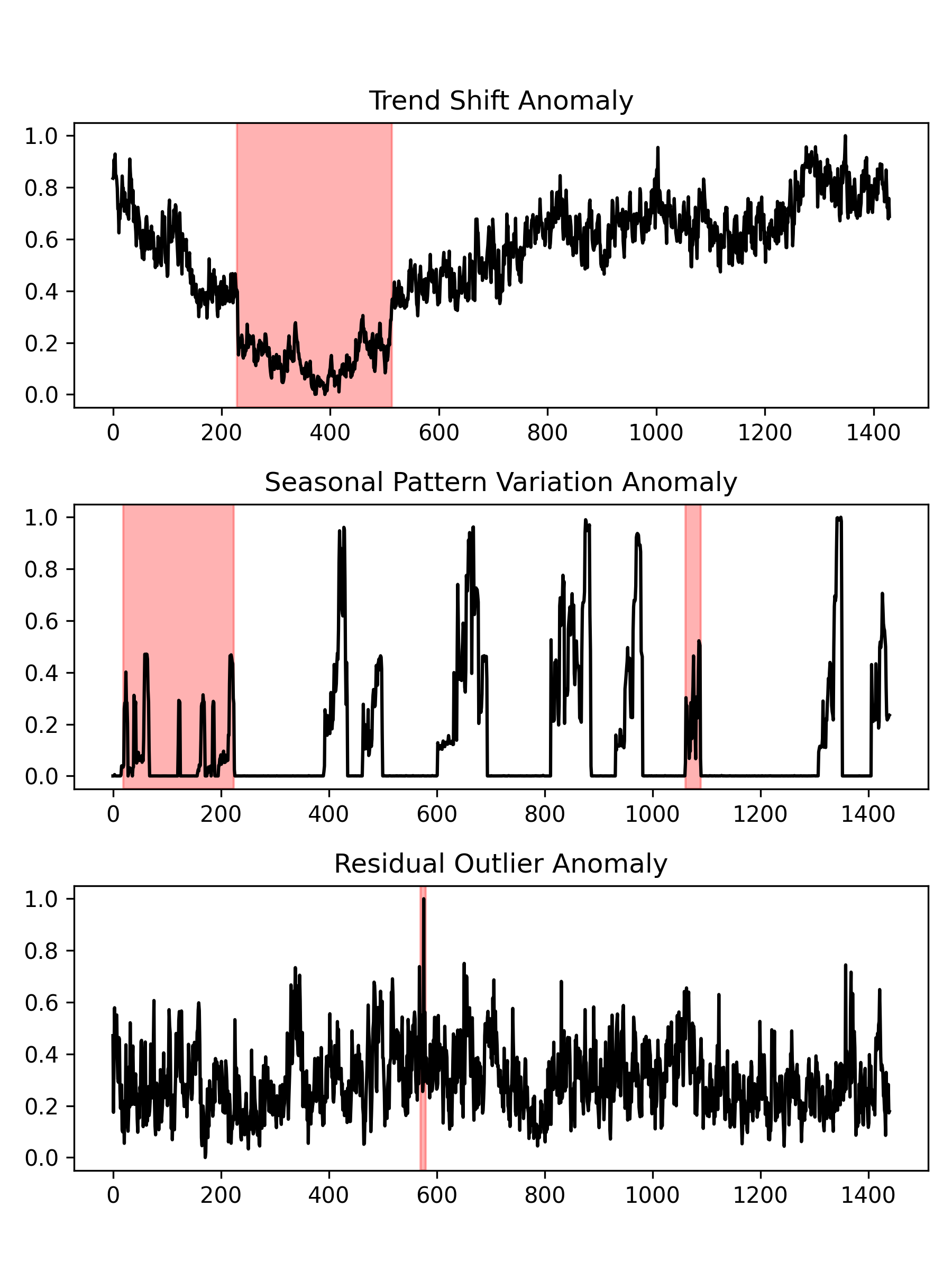
This document contains a detailed extraction of data and visual information from a set of three time-series charts illustrating different types of anomalies.
## General Layout and Structure
The image consists of three vertically stacked line charts. Each chart shares a common X-axis (time/index) ranging from **0 to approximately 1450** and a Y-axis (normalized value) ranging from **0.0 to 1.0**.
* **Language:** English
* **Data Series Color:** Black solid line
* **Anomaly Indicator:** Light red/pink shaded vertical regions
---
## 1. Trend Shift Anomaly (Top Chart)
### Component Isolation
* **Header:** Title "Trend Shift Anomaly"
* **Y-Axis:** Markers at [0.0, 0.2, 0.4, 0.6, 0.8, 1.0]
* **X-Axis:** Markers at [0, 200, 400, 600, 800, 1000, 1200, 1400]
### Trend Analysis
The data begins with a downward trend from 0.9 to 0.4. It then enters a sustained low-level period (the anomaly). Following the anomaly, the data exhibits a steady upward trend with high-frequency noise, eventually reaching a peak near 1.0 around index 1350.
### Anomaly Data
* **Type:** Level/Trend Shift.
* **Spatial Grounding:** A single large red shaded block.
* **X-Range:** Approximately **index 230 to index 510**.
* **Behavior:** During this window, the mean value of the series drops significantly to a range between 0.0 and 0.3, representing a "trough" anomaly compared to the surrounding global trend.
---
## 2. Seasonal Pattern Variation Anomaly (Middle Chart)
### Component Isolation
* **Header:** Title "Seasonal Pattern Variation Anomaly"
* **Y-Axis:** Markers at [0.0, 0.2, 0.4, 0.6, 0.8, 1.0]
* **X-Axis:** Markers at [0, 200, 400, 600, 800, 1000, 1200, 1400]
### Trend Analysis
The series consists of intermittent "bursts" or pulses of activity separated by periods of zero value (flatline). The normal pattern appears to be a complex pulse reaching heights of 0.8 to 1.0.
### Anomaly Data
* **Type:** Pattern Variation / Missing Cycle.
* **Anomaly Region 1:**
* **X-Range:** Approximately **index 20 to index 220**.
* **Behavior:** The pulses in this region are significantly lower in amplitude (peaking around 0.4) and have a different frequency/shape compared to the standard pulses seen at index 400, 650, and 850.
* **Anomaly Region 2:**
* **X-Range:** Approximately **index 1060 to index 1090**.
* **Behavior:** A very narrow shaded region where a pulse is truncated or fails to reach the expected height of the surrounding seasonal peaks.
---
## 3. Residual Outlier Anomaly (Bottom Chart)
### Component Isolation
* **Header:** Title "Residual Outlier Anomaly"
* **Y-Axis:** Markers at [0.0, 0.2, 0.4, 0.6, 0.8, 1.0]
* **X-Axis:** Markers at [0, 200, 400, 600, 800, 1000, 1200, 1400]
### Trend Analysis
The series represents a stochastic or "noisy" signal centered roughly around a mean of 0.3. It fluctuates rapidly between 0.1 and 0.6 throughout the entire duration.
### Anomaly Data
* **Type:** Point Outlier / Spike.
* **Spatial Grounding:** A very thin vertical red line.
* **X-Range:** Approximately **index 570 to index 580**.
* **Behavior:** A single, sharp vertical spike where the value reaches **1.0**. This is a distinct deviation from the local variance, as the surrounding data points do not exceed 0.7 in that specific neighborhood.
---
## Summary Table of Extracted Data
| Chart Title | Anomaly Type | Primary X-Range | Visual Characteristic |
| :--- | :--- | :--- | :--- |
| **Trend Shift Anomaly** | Level Shift | 230 - 510 | Sustained drop in mean value. |
| **Seasonal Pattern Variation** | Shape/Frequency | 20 - 220; 1060 - 1090 | Low amplitude pulses; irregular timing. |
| **Residual Outlier Anomaly** | Point Outlier | 570 - 580 | Single instantaneous spike to 1.0. |