## Diagram: RWKV-LM Neural Network Architecture
### Overview
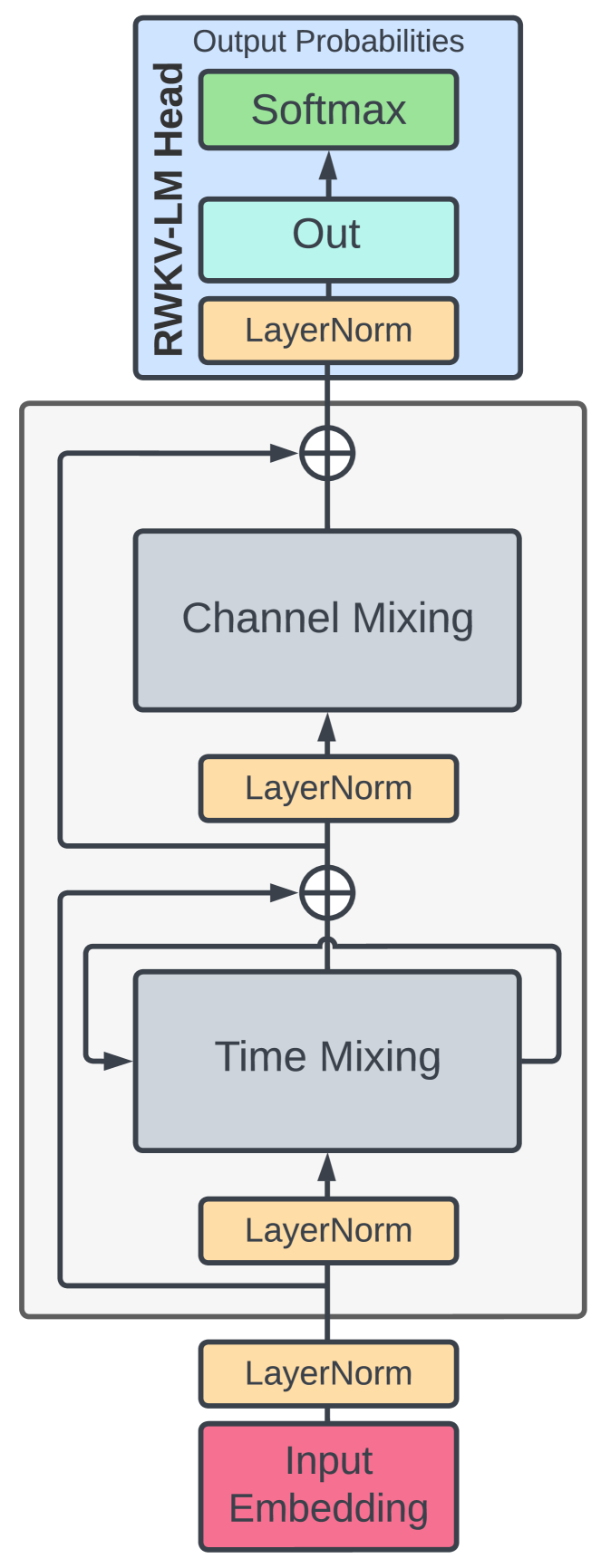
The diagram illustrates the architecture of an RWKV-LM (Recurrent Weighted Key Value Long Memory) neural network model. It shows the flow of data through various components, including input embedding, normalization layers, mixing operations, and output processing. The architecture combines recurrent and feed-forward elements with specialized mixing mechanisms.
### Components/Axes
1. **Input Section (Bottom)**
- Pink rectangle labeled "Input Embedding"
- Orange rectangle labeled "LayerNorm" (Layer Normalization)
2. **Middle Processing Layers**
- Gray rectangle labeled "Time Mixing" (horizontal data flow)
- Gray rectangle labeled "Channel Mixing" (vertical data flow)
- Orange rectangles labeled "LayerNorm" between mixing layers
3. **Output Section (Top)**
- Blue rectangle labeled "RWKV-LM Head"
- Green rectangle labeled "Softmax" (output probabilities)
- Light blue rectangle labeled "Out" (final output)
- Orange rectangle labeled "LayerNorm" before output
4. **Flow Indicators**
- Black arrows showing data flow direction
- Circular nodes representing data merging points
### Detailed Analysis
- **Input Path**:
- Input Embedding (pink) → LayerNorm (orange)
- Data flows upward through Time Mixing (gray)
- **Time Mixing Path**:
- Time Mixing (gray) → LayerNorm (orange)
- Data splits: part flows to Channel Mixing, part returns to Input path
- **Channel Mixing Path**:
- Channel Mixing (gray) → LayerNorm (orange)
- Data merges with Time Mixing output at circular node
- **Output Path**:
- Final LayerNorm (orange) → RWKV-LM Head (blue)
- Output Probabilities → Softmax (green) → Out (light blue)
### Key Observations
1. **Recurrent Architecture**: The circular data flow between Time Mixing and Channel Mixing suggests recurrent processing capabilities.
2. **Normalization**: LayerNorm appears at multiple stages, indicating its importance for training stability.
3. **Specialized Mixing**: Separate Time and Channel Mixing layers imply dimensionality-specific processing.
4. **Output Structure**: Softmax layer confirms this is a language modeling architecture producing token probabilities.
### Interpretation
This architecture combines elements of recurrent neural networks (RNNs) with transformer-like mixing mechanisms. The Time Mixing layer likely processes sequential dependencies, while Channel Mixing handles feature interactions. The multiple LayerNorm applications suggest careful attention to gradient flow and training stability. The RWKV-LM Head appears to be the final processing stage before probability calculation, indicating a hybrid approach between traditional RNNs and attention-based models. The architecture's design suggests optimization for both sequential processing and parallel computation through its mixing layers.