## Diagram: Accelerated Thinking and Consciousness Cycles
### Overview
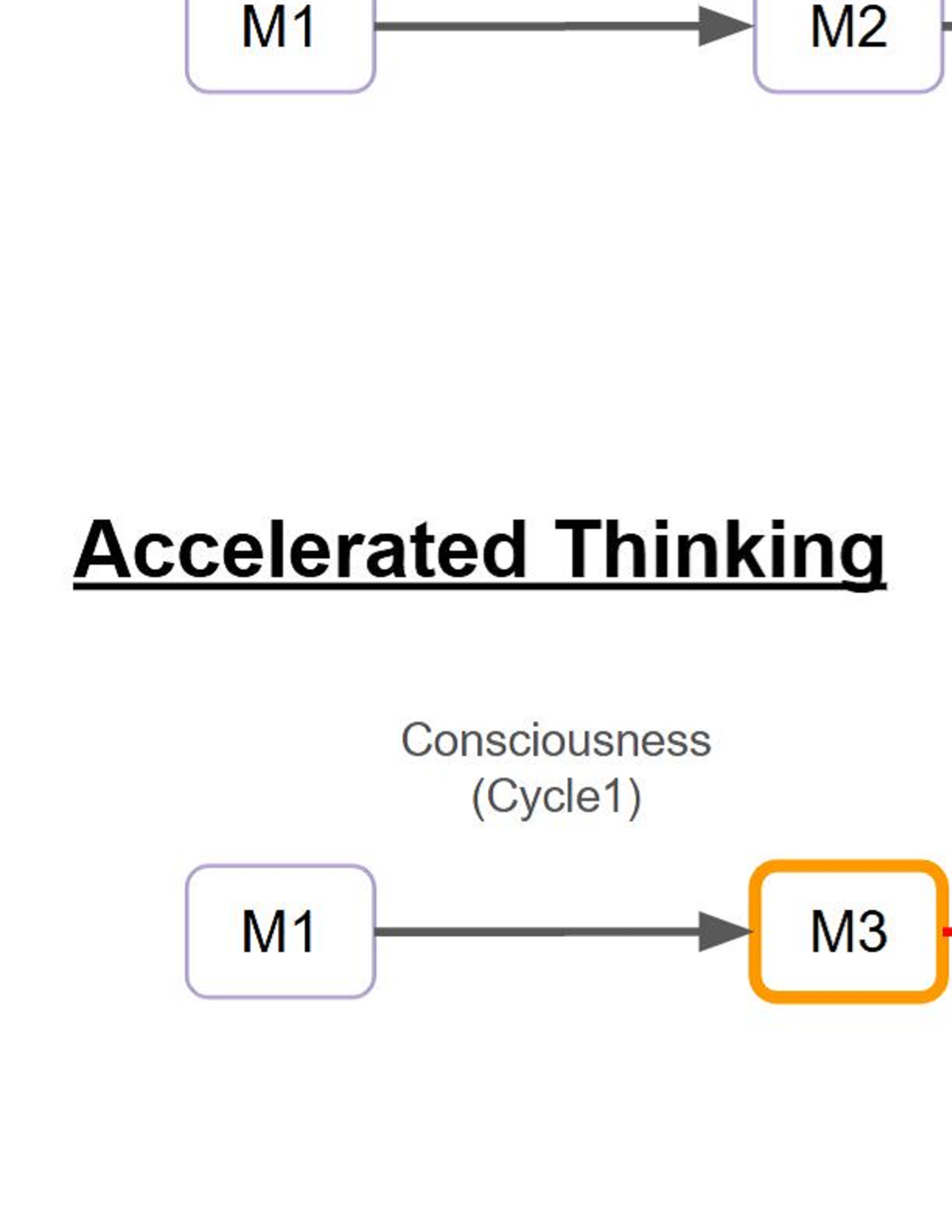
The image contains two sequential diagrams illustrating conceptual models of cognitive processes. Both diagrams use labeled modules (M1, M2, M3) connected by directional arrows to represent information flow. The first diagram is titled "Accelerated Thinking," while the second is labeled "Consciousness (Cycle1)."
### Components/Axes
- **Modules**:
- **M1**: Appears in both diagrams as the starting point.
- **M2**: Present in the first diagram but absent in the second.
- **M3**: Final module in both diagrams, highlighted with an orange border in both cases.
- **Arrows**:
- **First Diagram**: M1 → M2 → M3 (linear progression).
- **Second Diagram**: M1 → M3 (direct connection, bypassing M2).
- **Labels**:
- "Accelerated Thinking" (above the first diagram).
- "Consciousness (Cycle1)" (above the second diagram).
### Detailed Analysis
- **First Diagram ("Accelerated Thinking")**:
- Modules M1, M2, and M3 are connected sequentially.
- M3 is emphasized with an orange border, suggesting it is the focal output or endpoint.
- **Second Diagram ("Consciousness (Cycle1)")**:
- M1 connects directly to M3, omitting M2.
- M3 retains the orange border, maintaining consistency in its role as the endpoint.
### Key Observations
1. **Structural Difference**: The second diagram removes M2 from the flow, implying a simplified or optimized pathway.
2. **Color Coding**: Orange borders on M3 in both diagrams highlight its significance as the terminal module.
3. **Labeling**: The explicit mention of "Cycle1" in the second diagram suggests iterative or cyclical processes.
### Interpretation
The diagrams likely represent theoretical models of cognitive or computational processes:
- **"Accelerated Thinking"**: Emphasizes a multi-stage progression (M1→M2→M3), where intermediate processing (M2) is critical.
- **"Consciousness (Cycle1)"**: Suggests a streamlined or emergent pathway (M1→M3), possibly indicating a direct link between initial input (M1) and conscious output (M3), bypassing intermediate steps.
The removal of M2 in the second diagram could imply:
- A reduction in complexity for specific cycles.
- A shift in focus from procedural steps (M2) to direct experiential output (M3).
- An optimization for speed or efficiency in certain contexts.
The consistent use of orange for M3 across both diagrams underscores its role as the definitive endpoint, whether through linear or direct pathways.