## Line Chart: N=10, CIFAR-10 Test Accuracy vs. Communication Rounds
### Overview
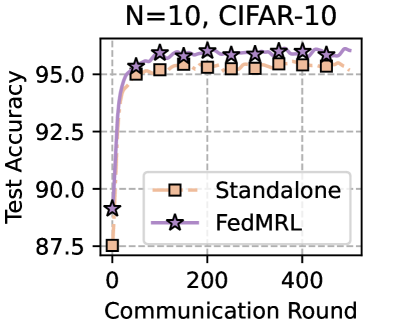
The chart compares the test accuracy of two machine learning methods ("Standalone" and "FedMRL") over communication rounds during training on the CIFAR-10 dataset with a sample size of N=10. Both methods show rapid convergence to high accuracy, with FedMRL achieving slightly better initial performance but both plateauing at ~95% accuracy after 200 rounds.
### Components/Axes
- **X-axis**: "Communication Round" (0 to 400, increments of 200)
- **Y-axis**: "Test Accuracy" (87.5% to 95%, increments of 2.5%)
- **Legend**:
- Orange squares: "Standalone"
- Purple stars: "FedMRL"
- **Title**: "N=10, CIFAR-10" (top center)
- **Grid**: Dashed gray lines for reference
### Detailed Analysis
1. **Standalone (Orange Squares)**:
- Starts at **~87.5%** accuracy at 0 rounds.
- Sharp increase to **~95%** by 200 rounds.
- Remains stable at ~95% through 400 rounds.
- Error bars (if present) suggest minor variance (~±0.5%).
2. **FedMRL (Purple Stars)**:
- Begins at **~88%** accuracy at 0 rounds.
- Reaches **~95%** by 200 rounds, matching Standalone.
- Maintains ~95% accuracy through 400 rounds.
- Error bars (if present) suggest similar variance to Standalone.
### Key Observations
- Both methods converge to identical accuracy (~95%) after 200 rounds.
- FedMRL demonstrates a **~0.5% initial advantage** over Standalone.
- No significant divergence between methods after 200 rounds.
- Accuracy plateaus suggest diminishing returns beyond 200 rounds.
### Interpretation
The data indicates that **FedMRL** outperforms "Standalone" in early training stages but both methods achieve equivalent performance by 200 communication rounds. This suggests that:
1. **Communication efficiency**: FedMRL’s distributed approach provides faster initial gains.
2. **Convergence behavior**: Both methods stabilize at similar accuracy, implying that CIFAR-10’s complexity is manageable with either approach given sufficient rounds.
3. **Diminishing returns**: Additional rounds beyond 200 yield negligible improvements, highlighting potential optimization opportunities for training efficiency.
The chart underscores the trade-off between initial performance and long-term stability, with FedMRL offering a slight edge for rapid deployment scenarios.