## Grid of Question-Answer Pairs: Educational Problem-Solving Examples
### Overview
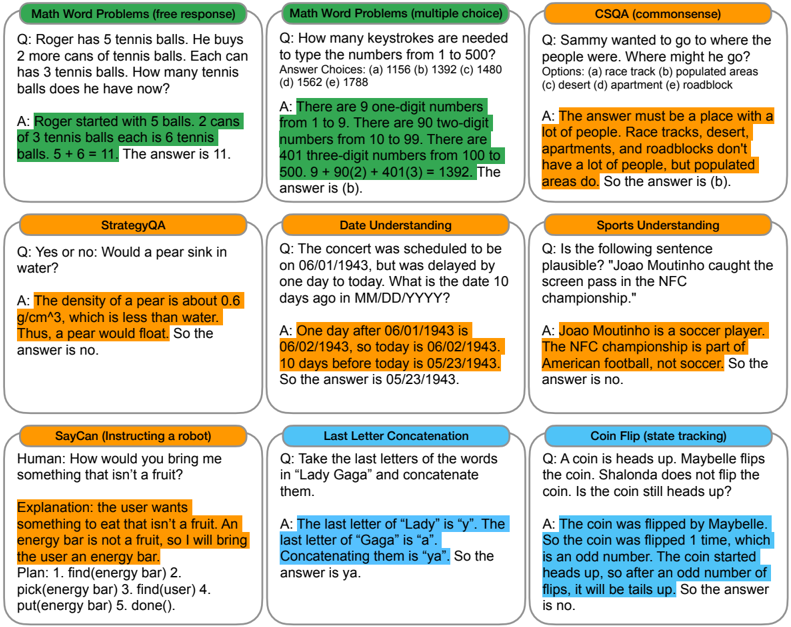
The image displays a 3x3 grid of question-answer pairs across three categories: **Math Word Problems**, **Commonsense Reasoning**, and **Instructional Tasks**. Each cell contains a question, a structured answer with highlighted reasoning, and color-coded category labels. The grid emphasizes step-by-step problem-solving and logical deduction.
### Components/Axes
- **Rows**: Three categories (Math, Commonsense, Instructional Tasks).
- **Columns**: Three question-answer pairs per category.
- **Color Coding**:
- **Green**: Math Word Problems.
- **Orange**: Commonsense Reasoning (CSQA, Sports Understanding).
- **Blue**: Instructional Tasks (SayCan, Last Letter Concatenation, Coin Flip).
- **Highlighted Text**: Key steps or reasoning in answers are emphasized with matching category colors.
### Detailed Analysis
#### Math Word Problems (Green)
1. **Question**: Roger has 5 tennis balls. He buys 2 more cans of 3 balls each. How many balls does he have now?
- **Answer**: Roger started with 5 balls. 2 cans of 3 balls each = 6 balls. Total: 5 + 6 = 11.
- **Highlighted**: "Roger started with 5 balls. 2 cans of 3 tennis balls each is 6 tennis balls. 5 + 6 = 11."
2. **Question**: How many keystrokes for numbers 1–500?
- **Answer**: 9 one-digit (1–9), 90 two-digit (10–99), 401 three-digit (100–500). Total: 9 + 90×2 + 401×3 = 1392.
- **Highlighted**: "9 + 90(2) + 401(3) = 1392."
3. **Question**: How many keys for numbers 1–500?
- **Answer**: Same as above. Answer: (b) 1392.
#### Commonsense Reasoning (Orange)
1. **Question**: Where might Sammy go to see people?
- **Answer**: Populated areas (b).
- **Highlighted**: "Race tracks, desert, apartments, and roadblocks don’t have a lot of people, but populated areas do."
2. **Question**: Is "Joao Moutinho caught the screen pass in the NFC championship" plausible?
- **Answer**: No. Joao Moutinho is a soccer player; the NFC is part of American football.
- **Highlighted**: "The NFC championship is part of American football, not soccer."
#### Instructional Tasks (Blue)
1. **Question**: How to bring something that isn’t a fruit?
- **Answer**: Bring an energy bar.
- **Highlighted**: "An energy bar is not a fruit, so I will bring the user an energy bar."
2. **Question**: Concatenate last letters of "Lady Gaga".
- **Answer**: "y" (Lady) + "a" (Gaga) = "ya".
- **Highlighted**: "The last letter of 'Lady' is 'y'. The last letter of 'Gaga' is 'a'. Concatenating them is 'ya'."
3. **Question**: Coin flip state tracking.
- **Answer**: Coin flipped by Maybelle (odd flips → tails).
- **Highlighted**: "The coin was flipped 1 time, which is an odd number. The coin started heads up, so after an odd number of flips, it will be tails up."
### Key Observations
- **Structured Reasoning**: Answers break down problems into explicit steps (e.g., arithmetic, logical deductions).
- **Color-Coded Highlighting**: Emphasizes critical reasoning steps (e.g., calculations, definitions).
- **Diverse Topics**: Covers math, physics, sports, and robotics, testing varied cognitive skills.
- **Educational Focus**: Designed to teach problem-solving frameworks (e.g., "Plan: find, pick, put").
### Interpretation
The grid demonstrates a pedagogical approach to teaching structured reasoning. By isolating problems into categories and highlighting key steps, it trains users to:
1. **Decompose problems** (e.g., separating quantities in math).
2. **Apply domain knowledge** (e.g., density for buoyancy, sports rules for plausibility).
3. **Follow procedural logic** (e.g., state tracking in coin flips).
The use of color and highlighting suggests an emphasis on visual learning and error reduction in complex tasks. The inclusion of both abstract (math) and real-world (commonsense) problems indicates a holistic approach to cognitive skill development.