\n
## Multiple Choice Question Sets
### Overview
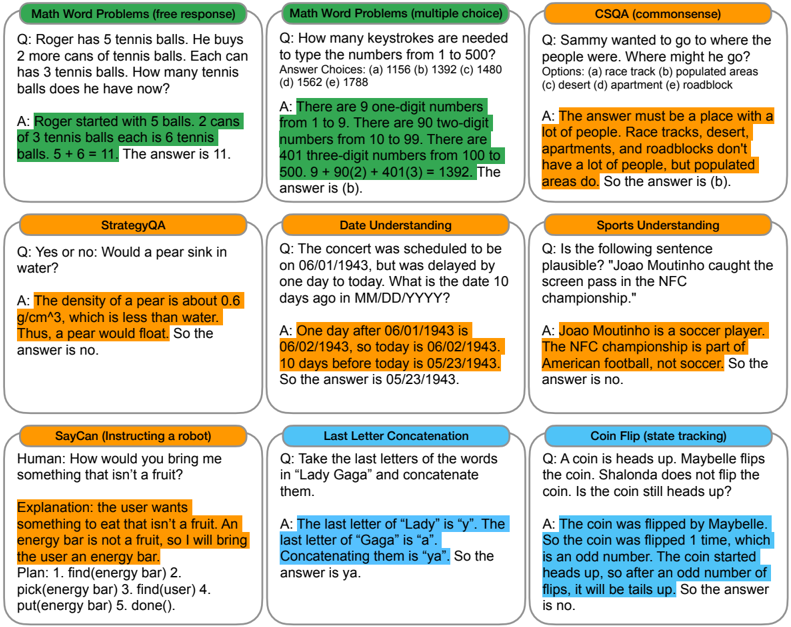
The image presents a collection of multiple-choice question sets, each focusing on a different type of reasoning or knowledge domain. The sets are arranged in a grid-like fashion. Each set includes a question (Q:) and a corresponding answer (A:). The question types include Math Word Problems (free response & multiple choice), Commonsense Question Answering (CSQA), StrategyQA, Date Understanding, Sports Understanding, Instruction Following (SayCan), Last Letter Concatenation, and Coin Flip (state tracking).
### Components/Axes
The image does not contain axes or charts. It consists of text blocks organized into question-answer pairs. Each question set is visually separated.
### Detailed Analysis or Content Details
Here's a transcription of each question set:
**1. Math Word Problems (free response)**
Q: Roger has 5 tennis balls. He buys 2 more cans of tennis balls. Each can has 3 tennis balls. How many tennis balls does he have now?
A: Roger started with 5 balls. 2 cans of 3 tennis balls each is 6 tennis balls. 5 + 6 = 11. The answer is 11.
**2. Math Word Problems (multiple choice)**
Q: How many keystrokes are needed to type the numbers from 1 to 500? Answer choices: (a) 1156 (b) 1392 (c) 1480 (d) 1562 (e) 1788
A: There are 9 one-digit numbers from 1 to 9. There are 90 two-digit numbers from 10 to 99. There are 401 three-digit numbers from 100 to 500. 9 + 90(2) + 401(3) = 1392. The answer is (b).
**3. CSQA (commonsense)**
Q: Sammy wanted to go where the people were. Where might he go? Options: (a) race track (b) populated areas (c) desert (d) apartment (e) roadblock
A: The answer must be a place with a lot of people. Race tracks, desert, apartments, and roadblocks don’t have a lot of people, but populated areas do. So the answer is (b).
**4. StrategyQA**
Q: Yes or no: Would a pear sink in water?
A: The density of a pear is about 0.6 g/cm^3, which is less than water. Thus, a pear would float. So the answer is no.
**5. Date Understanding**
Q: The concert was scheduled to be on 06/01/1943, but was delayed by one day to today. What is the date 10 days ago in MM/DD/YYYY?
A: One day after 06/01/1943 is 06/02/1943, so today is 06/02/1943. 10 days before today is 05/23/1943. So the answer is 05/23/1943.
**6. Sports Understanding**
Q: Is the following sentence plausible? "Joao Moutinho caught the screen pass in the NFC championship."
A: Joao Moutinho is a soccer player. The NFC championship is part of American football, not soccer. So the answer is no.
**7. SayCan (Instructing a robot)**
Q: Human: How can I turn a room light on that is out of view?
A: Explanation: This user wants to execute that action. The robot requires that the light is in the user’s camera view. So the robot will ask the user to point at the light. The robot will then ask the user to provide a language command for that action. (user) Point at the room light. (user) Turn the room light on.
**8. Last Letter Concatenation**
Q: Take the last letters of the words in "Lady Gaga" and concatenate them.
A: Last letter of "Lady" is y, last letter of "Gaga" is a, so the answer is ya.
**9. Coin Flip (state tracking)**
Q: A coin is heads up. Maybelle flips the coin. Shalonda does after the coin. The coin still heads up?
A: The coin was flipped by Maybelle and Shalonda. The coin is flipped twice, so the coin is tails up. The answer is no.
### Key Observations
The question sets cover a diverse range of cognitive skills. The answers are provided with varying degrees of explanation, ranging from simple calculations to detailed reasoning. The format is consistent across all sets, making it easy to compare and contrast the different question types.
### Interpretation
The image demonstrates a collection of diverse question-answering tasks designed to test different aspects of artificial intelligence and human reasoning. The inclusion of tasks like "SayCan" and "Coin Flip" suggests an interest in embodied AI and state tracking. The variety of question types (math, commonsense, strategy, date, sports) indicates a broad assessment of knowledge and reasoning abilities. The detailed explanations provided with some answers highlight the importance of not just getting the correct answer, but also understanding *why* it is correct. The image serves as a snapshot of a testing or training dataset for AI models.