## Pseudocode: Three-factor learning with PCM-trace algorithm
### Overview
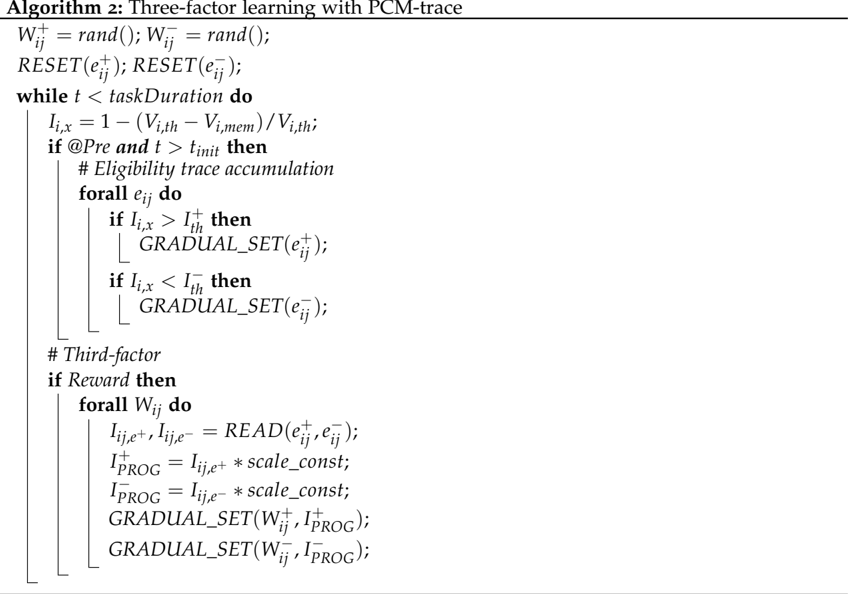
The image contains a technical pseudocode implementation of a three-factor learning algorithm incorporating PCM-trace mechanisms. The code defines variable initializations, iterative processes, and conditional logic for eligibility trace updates and reward-based weight adjustments.
### Components/Axes
- **Variables**:
- `W_ij^+ = rand()`: Positive weight initialization
- `W_ij^- = rand()`: Negative weight initialization
- `e_ij^+`, `e_ij^-`: Eligibility traces for positive/negative events
- `V_i,th`, `V_i,mem`: Threshold and memory values for eligibility calculation
- `I_i,x`: Eligibility index calculation variable
- `I_th^+`, `I_th^-`: Threshold values for eligibility comparison
- `scale_const`: Scaling constant for reward-based updates
- **Control Structures**:
- `while t < taskDuration`: Main iteration loop
- `if @Pre and t > t_init`: Eligibility trace accumulation condition
- `if Reward`: Reward signal processing block
- **Functions**:
- `GRADUAL_SET(e_ij)`: Gradual eligibility trace update
- `READ(e_ij^+, e_ij^-)`: Eligibility trace reading operation
- `RESET(e_ij)`: Eligibility trace reset operation
### Detailed Analysis
1. **Initialization Phase**:
- Random initialization of positive/negative weights (`W_ij^+`, `W_ij^-`)
- Reset of eligibility traces (`e_ij^+`, `e_ij^-`)
2. **Main Iteration Loop**:
- Continues while time `t` is less than task duration
- Calculates eligibility index: `I_i,x = 1 - (V_i,th - V_i,mem)/V_i,th`
- Eligibility trace accumulation triggered when:
- `@Pre` condition is met
- Time exceeds initialization threshold `t_init`
3. **Eligibility Trace Updates**:
- For each event `e_ij`:
- If `I_i,x > I_th^+`: Update positive trace `GRADUAL_SET(e_ij^+)`
- If `I_i,x < I_th^-`: Update negative trace `GRADUAL_SET(e_ij^-)`
4. **Third-Factor Processing**:
- Activated when reward signal is detected
- For each weight `W_ij`:
- Reads eligibility traces: `I_ij,e^+, I_ij,e^- = READ(e_ij^+, e_ij^-)`
- Calculates scaled traces:
- `I_PRG^+ = I_ij,e^+ * scale_const`
- `I_PRG^- = I_ij,e^- * scale_const`
- Updates weights with scaled traces:
- `GRADUAL_SET(W_ij^+, I_PRG^+)`
- `GRADUAL_SET(W_ij^-, I_PRG^-)`
### Key Observations
- The algorithm combines eligibility trace learning with reward-modulated weight updates
- Three distinct factors are implemented:
1. Eligibility trace accumulation
2. Threshold-based eligibility comparison
3. Reward-modulated weight adjustment
- The PCM-trace mechanism appears to integrate positive/negative trace dynamics with reward signals
### Interpretation
This pseudocode represents a hybrid learning architecture that:
1. Maintains separate positive/negative eligibility traces for each event
2. Uses threshold comparisons to determine trace update eligibility
3. Implements reward-based weight adjustments through scaled trace values
4. Employs gradual updates for both eligibility traces and weights
The PCM-trace component suggests a probabilistic contrastive mechanism where:
- Positive traces (`e_ij^+`) are strengthened by reward signals
- Negative traces (`e_ij^-`) are weakened by reward signals
- Weight updates (`W_ij`) are modulated by the difference between scaled positive/negative traces
The algorithm appears designed for reinforcement learning scenarios requiring:
- Temporal credit assignment (via eligibility traces)
- Reward-modulated value function updates
- Separate handling of positive/negative prediction errors