## Bar Chart: Mistral-7B-Instruct Performance Evaluation
### Overview
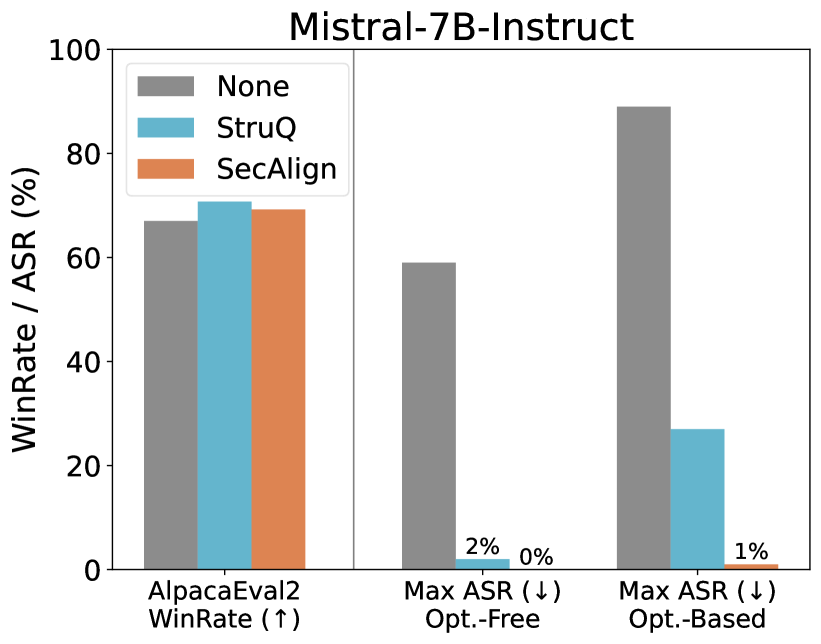
This is a grouped bar chart titled "Mistral-7B-Instruct," evaluating the model's performance across three different metrics or test conditions. The chart compares three methods: "None" (baseline), "StruQ," and "SecAlign." The primary metrics are a "WinRate" (where higher is better) and two variants of "Max ASR" (Attack Success Rate, where lower is better).
### Components/Axes
* **Title:** Mistral-7B-Instruct
* **Y-Axis:** Labeled "WinRate / ASR (%)". Scale ranges from 0 to 100 in increments of 20.
* **X-Axis:** Contains three categorical groups:
1. `AlpacaEval2 WinRate (↑)` - The upward arrow indicates higher values are desirable.
2. `Max ASR (↓) Opt.-Free` - The downward arrow indicates lower values are desirable. "Opt.-Free" likely means "Optimization-Free."
3. `Max ASR (↓) Opt.-Based` - The downward arrow indicates lower values are desirable. "Opt.-Based" likely means "Optimization-Based."
* **Legend:** Located in the top-left corner of the plot area.
* **Gray Bar:** `None`
* **Light Blue Bar:** `StruQ`
* **Orange Bar:** `SecAlign`
### Detailed Analysis
**1. AlpacaEval2 WinRate (↑) Group (Leftmost):**
* **Trend:** All three methods show relatively high and similar performance, with StruQ having a slight edge.
* **Data Points (Approximate):**
* `None` (Gray): ~67%
* `StruQ` (Light Blue): ~71%
* `SecAlign` (Orange): ~69%
**2. Max ASR (↓) Opt.-Free Group (Center):**
* **Trend:** A dramatic reduction in Attack Success Rate (ASR) is observed for both StruQ and SecAlign compared to the baseline.
* **Data Points (Approximate):**
* `None` (Gray): ~59%
* `StruQ` (Light Blue): 2% (explicitly labeled)
* `SecAlign` (Orange): 0% (explicitly labeled)
**3. Max ASR (↓) Opt.-Based Group (Rightmost):**
* **Trend:** The baseline (`None`) shows a very high ASR. Both defense methods significantly reduce it, with SecAlign showing near-total mitigation.
* **Data Points (Approximate):**
* `None` (Gray): ~89%
* `StruQ` (Light Blue): ~27%
* `SecAlign` (Orange): 1% (explicitly labeled)
### Key Observations
1. **Performance Parity on WinRate:** The core capability of the model, as measured by AlpacaEval2 WinRate, is largely unaffected by the application of StruQ or SecAlign defenses. All scores are within a few percentage points.
2. **Drastic ASR Reduction:** The most significant finding is the massive reduction in Attack Success Rate (ASR) when using StruQ or SecAlign. This is true for both optimization-free and optimization-based attack scenarios.
3. **SecAlign Superiority in Defense:** SecAlign consistently outperforms StruQ in reducing ASR, achieving 0% and 1% in the two ASR tests, compared to StruQ's 2% and ~27%.
4. **Vulnerability of Baseline:** The `None` (baseline) configuration is highly vulnerable, with ASR scores of ~59% and ~89% in the two attack scenarios.
### Interpretation
This chart demonstrates the effectiveness of the **StruQ** and **SecAlign** defense mechanisms when applied to the **Mistral-7B-Instruct** model. The data suggests a clear trade-off or, more accurately, a targeted intervention:
* **What it means:** The defenses are highly successful at their primary goal—preventing adversarial attacks (as shown by plummeting ASR scores)—without compromising the model's general helpfulness or performance on standard benchmarks (stable WinRate).
* **Why it matters:** This is a desirable outcome in AI safety and alignment research. It shows it's possible to "harden" a model against specific exploits (like prompt injection or jailbreaking) while preserving its utility. The near-zero ASR for SecAlign indicates it may be a particularly robust defense.
* **Underlying Pattern:** The chart tells a story of **selective resilience**. The model's core capabilities remain intact, but its susceptibility to manipulation is drastically reduced. The stark contrast between the high gray bars (baseline vulnerability) and the very low blue/orange bars (defense effectiveness) in the ASR sections is the central, compelling narrative of this evaluation.