## Flowchart: Comparison of PRM Frameworks
### Overview
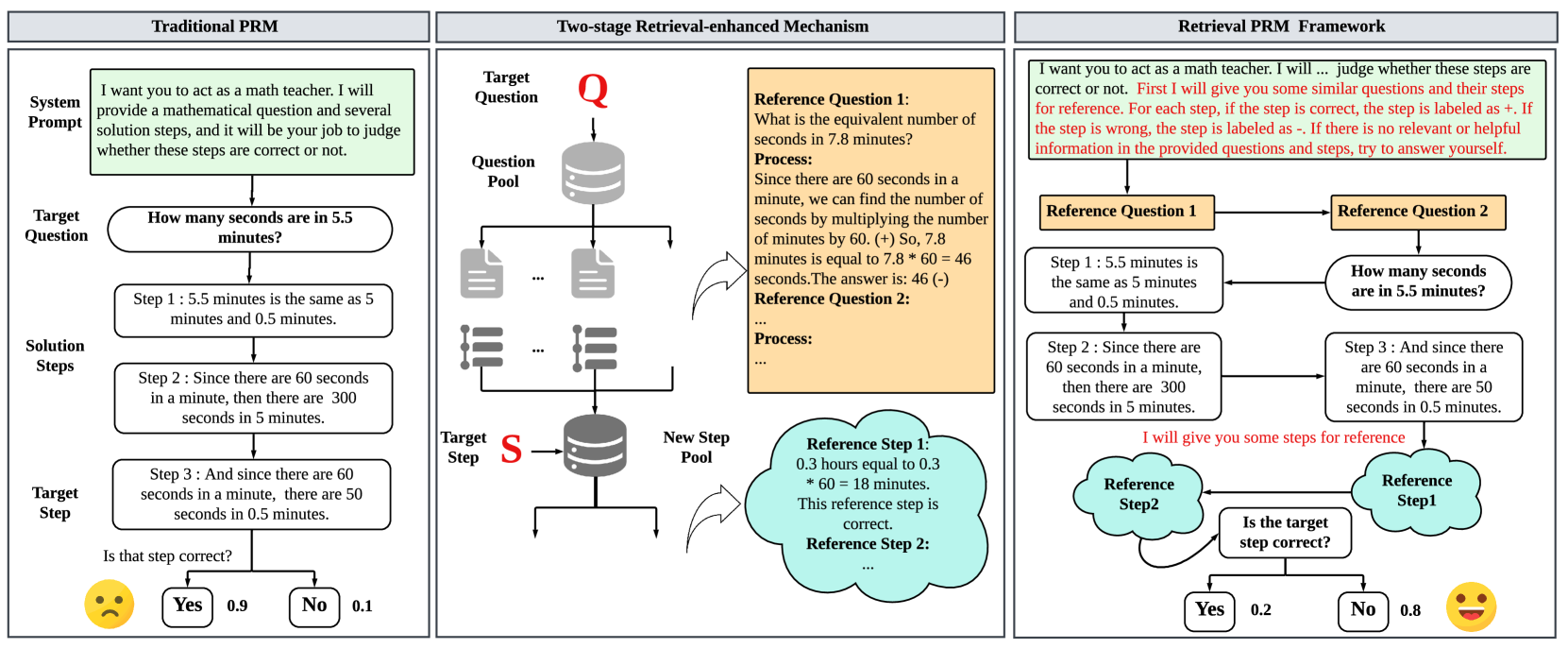
The image presents a comparative diagram of three different Problem Reasoning and Manipulation (PRM) frameworks: Traditional PRM, Two-stage Retrieval-enhanced Mechanism, and Retrieval PRM Framework. Each framework is illustrated as a flowchart, outlining the process from the initial prompt to the final evaluation.
### Components/Axes
**1. Traditional PRM (Left Panel):**
* **Title:** Traditional PRM
* **System Prompt:** "I want you to act as a math teacher. I will provide a mathematical question and several solution steps, and it will be your job to judge whether these steps are correct or not."
* **Target Question:** "How many seconds are in 5.5 minutes?"
* **Solution Steps:**
* Step 1: "5.5 minutes is the same as 5 minutes and 0.5 minutes."
* Step 2: "Since there are 60 seconds in a minute, then there are 300 seconds in 5 minutes."
* Step 3: "And since there are 60 seconds in a minute, there are 50 seconds in 0.5 minutes."
* **Target Step:** "Is that step correct?"
* **Decision Outcomes:**
* Yes: 0.9 (associated with a sad face emoji)
* No: 0.1
**2. Two-stage Retrieval-enhanced Mechanism (Middle Panel):**
* **Title:** Two-stage Retrieval-enhanced Mechanism
* **Target Question:** Labeled as "Q" in red.
* **Question Pool:** Represented by a database icon, followed by a series of document icons.
* **Target Step:** Labeled as "S" in red.
* **New Step Pool:** Represented by a database icon.
* **Reference Question 1:**
* "What is the equivalent number of seconds in 7.8 minutes?"
* Process: "Since there are 60 seconds in a minute, we can find the number of seconds by multiplying the number of minutes by 60. (+) So, 7.8 minutes is equal to 7.8 * 60 = 46 seconds. The answer is: 46 (-)"
* **Reference Question 2:**
* Process: "..."
* **Reference Step 1:**
* "0.3 hours equal to 0.3 * 60 = 18 minutes. This reference step is correct."
* **Reference Step 2:** "..."
**3. Retrieval PRM Framework (Right Panel):**
* **Title:** Retrieval PRM Framework
* **System Prompt:** "I want you to act as a math teacher. I will... judge whether these steps are correct or not. First I will give you some similar questions and their steps for reference. For each step, if the step is correct, the step is labeled as +. If the step is wrong, the step is labeled as -. If there is no relevant or helpful information in the provided questions and steps, try to answer yourself."
* **Reference Question 1:**
* Step 1: "5.5 minutes is the same as 5 minutes and 0.5 minutes."
* Step 2: "Since there are 60 seconds in a minute, then there are 300 seconds in 5 minutes."
* **Reference Question 2:**
* **Target Question:** "How many seconds are in 5.5 minutes?"
* Step 3: "And since there are 60 seconds in a minute, there are 50 seconds in 0.5 minutes."
* **Additional Text:** "I will give you some steps for reference"
* **Reference Step 2**
* **Reference Step 1**
* **Target Step:** "Is the target step correct?"
* **Decision Outcomes:**
* Yes: 0.2 (associated with a happy face emoji)
* No: 0.8
### Detailed Analysis
**Traditional PRM:**
* The system is given a direct question and a series of solution steps.
* The system must evaluate the correctness of the provided steps.
* The output suggests a high confidence (0.9) that the steps are incorrect, indicated by the sad face emoji.
**Two-stage Retrieval-enhanced Mechanism:**
* This framework involves retrieving relevant information from a question pool and a step pool.
* Reference questions and steps are used to aid in the problem-solving process.
* Reference Question 1 contains an arithmetic error: 7.8 * 60 = 468, not 46.
* The reference step is correct.
**Retrieval PRM Framework:**
* This framework also uses reference questions and steps.
* The system is provided with a target question and must determine the correctness of the steps.
* The output suggests a higher confidence (0.8) that the steps are incorrect, indicated by the happy face emoji.
### Key Observations
* The Traditional PRM and Retrieval PRM Frameworks both involve evaluating the correctness of solution steps.
* The Two-stage Retrieval-enhanced Mechanism incorporates a retrieval process to gather relevant information.
* There is an arithmetic error in Reference Question 1 within the Two-stage Retrieval-enhanced Mechanism.
* The confidence levels in the "Yes/No" decisions differ between the Traditional PRM and Retrieval PRM Frameworks.
### Interpretation
The diagram illustrates different approaches to problem-solving using PRM frameworks. The Traditional PRM relies on direct evaluation, while the Retrieval-enhanced mechanisms incorporate information retrieval to aid in the process. The arithmetic error in the Two-stage Retrieval-enhanced Mechanism highlights the importance of verifying the accuracy of retrieved information. The differing confidence levels in the final decisions suggest that the frameworks may have varying levels of effectiveness or biases. The use of emojis to represent the "Yes/No" outcomes adds a layer of emotional context to the decision-making process.