\n
## Diagram: Retrieval Framework for Mathematical Problem Solving
### Overview
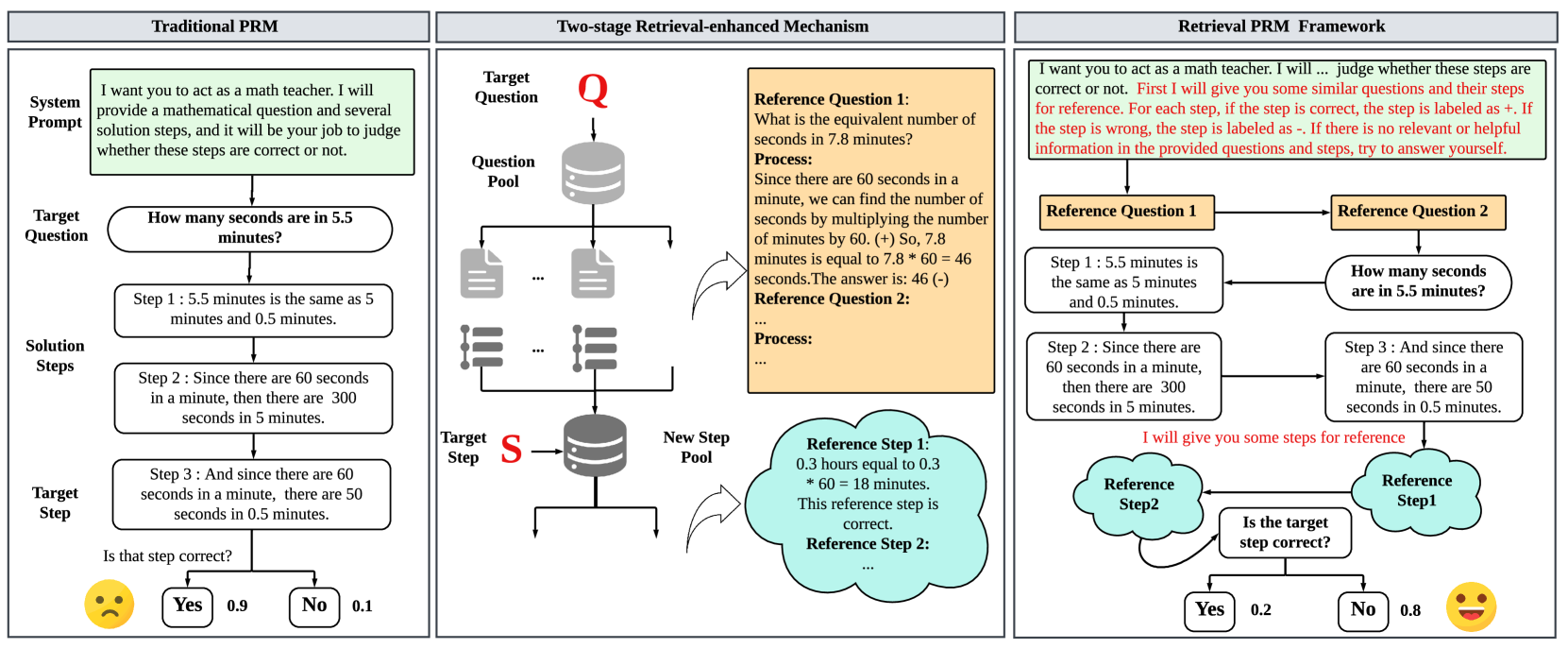
This diagram illustrates three different frameworks for solving mathematical problems: Traditional Prompting (PRM), a Two-stage Retrieval-enhanced Mechanism, and a Retrieval Framework. It focuses on how each framework handles a target question ("How many seconds are in 5.5 minutes?") and assesses the correctness of solution steps. The diagram uses flowcharts to depict the process within each framework, and includes example questions, steps, and confidence scores.
### Components/Axes
The diagram is divided into three main columns, each representing a different framework. Each column is further divided into sections for "System Prompt", "Target Question", "Solution Steps", and "Target Step". There are also visual elements like question pools, step pools, and decision points (Yes/No). Confidence scores are represented by bars with numerical values.
### Detailed Analysis or Content Details
**1. Traditional PRM (Left Column)**
* **System Prompt:** "I want you to act as a math teacher. I will provide a mathematical question and several solution steps, and it will be your job to judge whether these steps are correct or not."
* **Target Question:** "How many seconds are in 5.5 minutes?"
* **Solution Steps:**
* Step 1: "5.5 minutes is the same as 5 minutes and 0.5 minutes."
* Step 2: "Since there are 60 seconds in a minute, then there are 300 seconds in 5 minutes."
* Step 3: "And since there are 60 seconds in a minute, there are 30 seconds in 0.5 minutes."
* **Target Step:** "Is that step correct?"
* **Confidence Score:** A bar graph shows a confidence score of approximately 0.9 (90%) for "Yes" and 0.1 (10%) for "No".
**2. Two-stage Retrieval-enhanced Mechanism (Middle Column)**
* **System Prompt:** Not explicitly shown, but implied to be related to retrieval.
* **Target Question:** Represented by a "Q" icon, leading to a "Question Pool".
* **Reference Question 1:** "What is the equivalent number of seconds in 7.8 minutes?"
* **Process:** "Since there are 60 seconds in a minute, we can find the number of seconds by multiplying the number of minutes by 60. (+/-) So, 7.8 minutes is equal to 7.8 * 60 = 468 seconds. The answer is: 468 (+/-)"
* **Reference Question 2:** "Process:" (text is incomplete, but implies a similar calculation).
* **Target Step:** Represented by an "S" icon, leading to a "New Step Pool".
* **Reference Step 1:** "0.3 hours equal to 0.3 * 60 = 18 minutes." - Correct.
* **Reference Step 2:** (text is incomplete).
**3. Retrieval Framework (Right Column)**
* **System Prompt:** "I want you to act as a math teacher. I will... judge whether these steps are correct or not. First I will give you some similar questions and their steps for reference. For each step, if the step is correct, the step is labeled as +. If the step is wrong, the step is labeled as -. If there is no relevant or helpful information in the provided questions and steps, try to answer yourself."
* **Target Question:** "How many seconds are in 5.5 minutes?"
* **Reference Question 1:**
* Step 1: "5.5 minutes is the same as 5 minutes and 0.5 minutes."
* **Reference Question 2:**
* Step 1: "How many seconds are in 5.5 minutes?"
* **Reference Step 1:** "I will give you some steps for reference"
* **Decision Point:** "Is the target step correct?"
* **Confidence Score:** A bar graph shows a confidence score of approximately 0.2 (20%) for "Yes" and 0.8 (80%) for "No".
### Key Observations
* The Traditional PRM framework shows a high confidence in the correctness of the steps (90% Yes).
* The Retrieval Framework shows a low confidence in the correctness of the steps (20% Yes, 80% No).
* The Two-stage Retrieval-enhanced Mechanism includes reference questions and steps, suggesting a process of comparison and validation.
* The diagram highlights the importance of providing reference material for evaluating the correctness of solution steps.
* The confidence scores vary significantly between the frameworks, indicating different levels of certainty in the solution.
### Interpretation
The diagram demonstrates a progression in problem-solving frameworks, from a simple prompting approach to more sophisticated retrieval-enhanced methods. The Traditional PRM relies solely on the model's internal knowledge, while the Retrieval Framework leverages external information (reference questions and steps) to assess correctness. The Two-stage Retrieval-enhanced Mechanism appears to be an intermediate step, utilizing retrieval to provide context for the model.
The differing confidence scores suggest that the retrieval-enhanced frameworks may be more critical in their assessment of solution steps, potentially identifying errors that the Traditional PRM might overlook. The lower confidence in the Retrieval Framework could indicate that the reference material is not sufficiently relevant or helpful, or that the model struggles to effectively integrate the retrieved information.
The diagram highlights the potential benefits of retrieval-augmented generation (RAG) in improving the accuracy and reliability of mathematical problem-solving systems. It also suggests that the quality and relevance of the retrieved information are crucial factors in the success of these systems. The use of "+" and "-" labels for reference steps indicates a nuanced evaluation process, going beyond simple correctness judgments. The incomplete text in some sections suggests that the diagram is a work in progress or a simplified representation of a more complex system.