## Bar Chart: Verification Paradigms and Performance Gains
### Overview
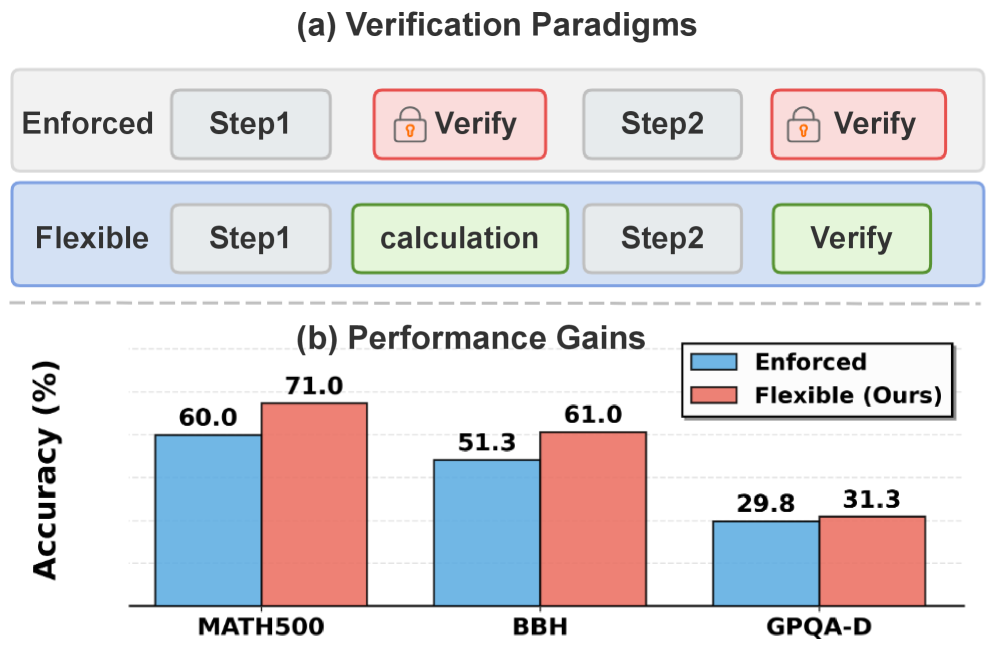
The image presents a two-part figure. Part (a) illustrates two verification paradigms: "Enforced" and "Flexible." Part (b) is a bar chart comparing the accuracy (%) of these two paradigms across three datasets: MATH500, BBH, and GPQA-D.
### Components/Axes
**Part (a): Verification Paradigms**
* **Title:** (a) Verification Paradigms
* **Paradigm 1:** Enforced (Steps: Step1, Verify (with lock icon), Step2, Verify (with lock icon))
* **Paradigm 2:** Flexible (Steps: Step1, calculation, Step2, Verify)
**Part (b): Performance Gains**
* **Title:** (b) Performance Gains
* **Y-axis:** Accuracy (%)
* **X-axis:** Datasets (MATH500, BBH, GPQA-D)
* **Legend:**
* Blue: Enforced
* Red: Flexible (Ours)
### Detailed Analysis
**Part (b): Performance Gains**
* **MATH500:**
* Enforced (Blue): 60.0%
* Flexible (Red): 71.0%
* **BBH:**
* Enforced (Blue): 51.3%
* Flexible (Red): 61.0%
* **GPQA-D:**
* Enforced (Blue): 29.8%
* Flexible (Red): 31.3%
**Trend Verification:**
* For each dataset, the "Flexible" paradigm (red) consistently shows higher accuracy than the "Enforced" paradigm (blue).
### Key Observations
* The "Flexible" paradigm consistently outperforms the "Enforced" paradigm across all three datasets.
* The performance difference between the two paradigms is most significant for the MATH500 dataset.
* The accuracy scores are generally lower for the GPQA-D dataset compared to MATH500 and BBH.
### Interpretation
The data suggests that the "Flexible" verification paradigm, as implemented by the authors ("Ours"), leads to performance gains in accuracy compared to the "Enforced" paradigm. This is consistent across all three datasets tested. The difference in performance may be attributed to the different verification steps outlined in part (a) of the figure. The "Enforced" paradigm includes a "Verify" step with a lock icon after both "Step1" and "Step2", while the "Flexible" paradigm includes a "calculation" step after "Step1" and a "Verify" step after "Step2". The "Flexible" paradigm's "calculation" step may allow for more adaptable or nuanced verification, leading to higher accuracy. The lower accuracy scores on the GPQA-D dataset may indicate that this dataset is inherently more challenging for both paradigms.