\n
## Bar Chart: Performance Gains of Verification Paradigms
### Overview
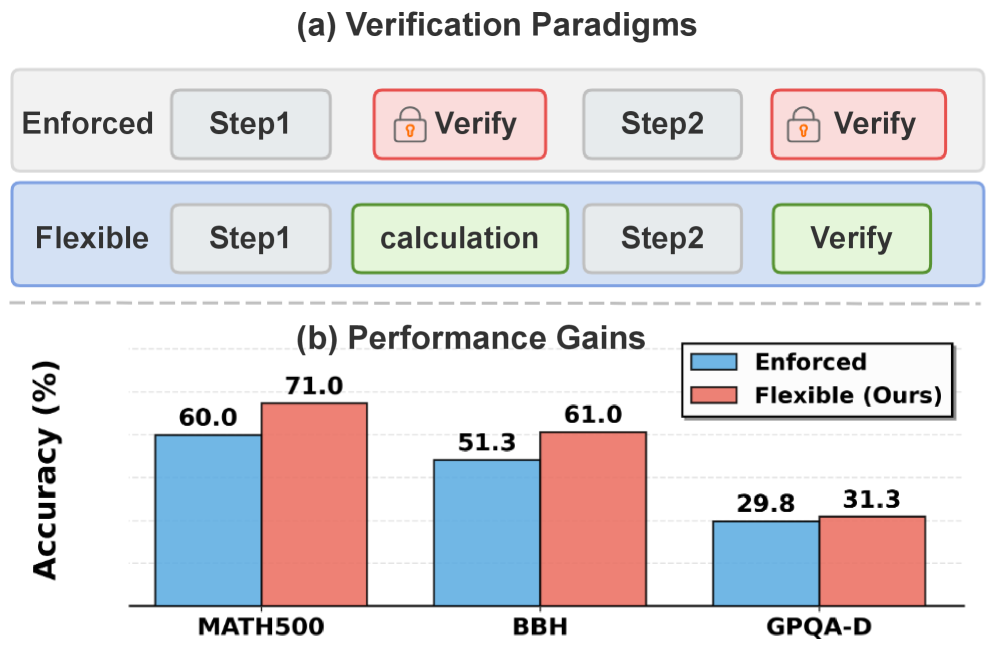
The image presents a comparison of two verification paradigms – "Enforced" and "Flexible" – across three benchmarks: MATH500, BBH, and GPQA-D. The comparison is based on accuracy, measured in percentage (%). The upper portion of the image illustrates the two paradigms visually.
### Components/Axes
* **Title:** (a) Verification Paradigms, (b) Performance Gains
* **X-axis:** Benchmarks - MATH500, BBH, GPQA-D
* **Y-axis:** Accuracy (%) - Scale ranges from approximately 0% to 80%.
* **Legend:**
* Blue: Enforced
* Red: Flexible (Ours)
* **Diagram Elements:** "Step1", "Step2", "Verify", "calculation" labels within boxes representing the paradigms.
### Detailed Analysis
The chart consists of three sets of paired bar graphs, one for each benchmark.
* **MATH500:**
* Enforced: Accuracy is approximately 60.0%.
* Flexible: Accuracy is approximately 71.0%.
* **BBH:**
* Enforced: Accuracy is approximately 51.3%.
* Flexible: Accuracy is approximately 61.0%.
* **GPQA-D:**
* Enforced: Accuracy is approximately 29.8%.
* Flexible: Accuracy is approximately 31.3%.
The upper section of the image shows two rows representing the "Enforced" and "Flexible" paradigms.
* **Enforced Paradigm:** Consists of "Step1" box, a "Verify" box (with a warning symbol), "Step2" box, and another "Verify" box (with a warning symbol).
* **Flexible Paradigm:** Consists of "Step1" box, a "calculation" box, "Step2" box, and a "Verify" box (with a checkmark symbol).
### Key Observations
* The "Flexible" paradigm consistently outperforms the "Enforced" paradigm across all three benchmarks.
* The largest performance gain is observed in the MATH500 benchmark, with a difference of approximately 11.0% in accuracy.
* The smallest performance gain is observed in the GPQA-D benchmark, with a difference of approximately 1.5% in accuracy.
* The "Enforced" paradigm includes a "Verify" step after each step, while the "Flexible" paradigm includes a "calculation" step instead of a "Verify" step after the first step.
### Interpretation
The data suggests that the "Flexible" verification paradigm is more effective than the "Enforced" paradigm in achieving higher accuracy across the tested benchmarks. The inclusion of a "calculation" step in the "Flexible" paradigm, instead of immediate verification, may allow for more robust and accurate results. The consistent outperformance of the "Flexible" paradigm indicates a potential advantage in its approach to verification. The relatively small gain in GPQA-D suggests that this benchmark may be less sensitive to the differences between the two paradigms, or that other factors are influencing performance. The visual representation of the paradigms highlights the key difference in their approach: immediate verification versus a calculation step followed by verification. The warning symbol on the "Verify" boxes in the "Enforced" paradigm could imply potential issues or limitations in that approach.