## Chart/Diagram Type: SHAP Value Comparison for Textual Analysis Models
### Overview
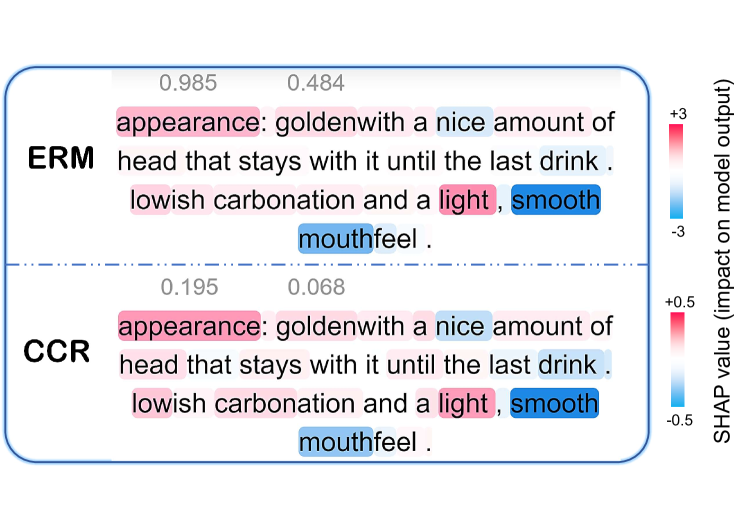
The image compares the SHAP (SHapley Additive exPlanations) values of two models, **ERM** and **CCR**, analyzing their sensitivity to specific words in a textual description. Words are color-coded (pink for positive impact, blue for negative impact) based on their influence on model output, with numerical values indicating the magnitude of impact.
### Components/Axes
- **Y-Axis**: Labels for the two models: **ERM** (top) and **CCR** (bottom).
- **X-Axis**: No explicit label, but represents the textual description:
*"appearance: golden with a nice amount of head that stays with it until the last drink . lowish carbonation and a light , smooth mouthfeel ."*
- **Color Scale (Right)**:
- **Legend**: Red (positive SHAP values, +3) to Blue (negative SHAP values, -3).
- **Label**: "SHAP value (impact on model output)".
- **Numerical Values**:
- **ERM**: 0.985 (top-left) and 0.484 (top-right).
- **CCR**: 0.195 (bottom-left) and 0.068 (bottom-right).
### Detailed Analysis
#### ERM Section
- **Highlighted Words**:
- **Positive Impact (Pink)**: "appearance," "golden," "light," "smooth."
- **Negative Impact (Blue)**: "nice," "drink," "mouthfeel."
- **SHAP Values**:
- "appearance" and "golden" show strong positive impacts (0.985).
- "light" and "smooth" have moderate positive impacts (0.484).
- "nice," "drink," and "mouthfeel" have negative impacts (values not explicitly labeled but inferred from blue shading).
#### CCR Section
- **Highlighted Words**:
- **Positive Impact (Pink)**: "appearance," "golden," "light," "smooth."
- **Negative Impact (Blue)**: "nice," "drink," "mouthfeel."
- **SHAP Values**:
- "appearance" and "golden" show weaker positive impacts (0.195).
- "light" and "smooth" have minimal positive impacts (0.068).
- "nice," "drink," and "mouthfeel" have negative impacts (values not explicitly labeled but inferred from blue shading).
### Key Observations
1. **ERM vs. CCR Sensitivity**:
- ERM assigns significantly higher SHAP values to "appearance" (0.985 vs. 0.195) and "golden" (0.985 vs. 0.195), indicating stronger reliance on these features.
- CCR’s SHAP values are uniformly lower, suggesting weaker sensitivity to all words.
2. **Color Intensity**:
- ERM’s pink and blue shading is more pronounced, reflecting larger absolute SHAP values.
- CCR’s shading is fainter, indicating smaller impacts.
3. **Word-Specific Trends**:
- "nice" and "drink" consistently show negative impacts in both models.
- "mouthfeel" has a stronger negative impact in ERM than in CCR.
### Interpretation
- **Model Behavior**:
- ERM prioritizes **sensory descriptors** ("golden," "smooth") and **appearance** for its predictions, while downplaying "nice" and "drink."
- CCR’s predictions are less influenced by these words, suggesting a more generalized or less feature-specific approach.
- **Practical Implications**:
- ERM may be better suited for tasks requiring detailed analysis of textual nuances (e.g., wine reviews).
- CCR’s lower SHAP values imply it might overlook critical features, potentially reducing accuracy in context-dependent tasks.
- **Anomalies**:
- The stark contrast in SHAP values between ERM and CCR for "appearance" and "golden" highlights a potential design difference in how the models weigh textual features.
This analysis underscores the importance of model-specific feature sensitivity in natural language processing tasks, with ERM demonstrating a more granular understanding of the input text.