## Diagram: Math Problem Solution Process
### Overview
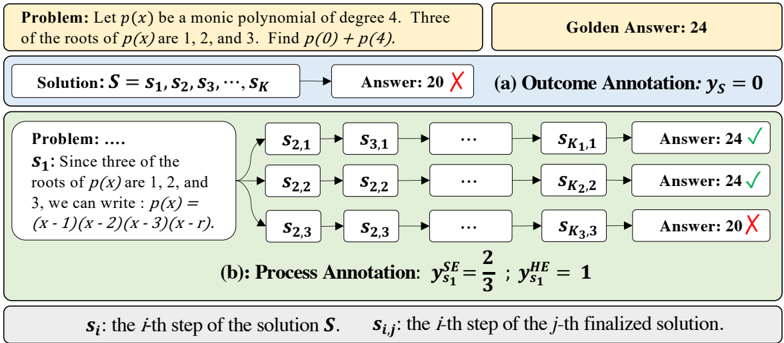
The image depicts a diagram illustrating the process of solving a mathematical problem. It shows the problem statement, the golden answer, a solution path, and annotations for both the outcome and the process. The diagram is divided into sections representing the problem, the solution steps, and the final answer, with indicators of correctness.
### Components/Axes
* **Problem Statement (Top-Left, in a yellow box):** "Problem: Let p(x) be a monic polynomial of degree 4. Three of the roots of p(x) are 1, 2, and 3. Find p(0) + p(4)."
* **Golden Answer (Top-Right, in a yellow box):** "Golden Answer: 24"
* **Solution Path (Blue Box):** "Solution: S = s1, s2, s3, ..., sK" leading to "Answer: 20" with a red "X" indicating an incorrect answer.
* **(a) Outcome Annotation:** ys = 0
* **Detailed Solution Steps (Green Box):**
* **Problem:** "Problem: ..."
* **S1:** "S1: Since three of the roots of p(x) are 1, 2, and 3, we can write: p(x) = (x-1)(x-2)(x-3)(x-r)."
* Three parallel paths, each representing a possible solution approach, labeled as follows:
* Path 1: s2,1 -> s3,1 -> ... -> sK,1 -> Answer: 24 ✓ (Correct)
* Path 2: s2,2 -> s3,2 -> ... -> sK,2 -> Answer: 24 ✓ (Correct)
* Path 3: s2,3 -> s3,3 -> ... -> sK,3 -> Answer: 20 X (Incorrect)
* **(b) Process Annotation:** ySEs1 = 2/3 ; yHEs1 = 1
* **Legend (Bottom, in a gray box):**
* "si: the i-th step of the solution S."
* "si,j: the i-th step of the j-th finalized solution."
### Detailed Analysis or ### Content Details
* The problem involves finding the value of p(0) + p(4) for a monic polynomial p(x) of degree 4, given three of its roots.
* The "Golden Answer" is 24, indicating the correct solution to the problem.
* The initial solution path "S" leads to an incorrect answer of 20, as marked by the red "X".
* The detailed solution steps show three parallel paths, each starting from the initial step S1.
* Two of the paths (Path 1 and Path 2) lead to the correct answer of 24, as indicated by the green checkmarks.
* One path (Path 3) leads to an incorrect answer of 20, as indicated by the red "X".
* The process annotation provides values for ySEs1 and yHEs1, which are 2/3 and 1, respectively. The meaning of these variables is not explicitly defined in the image.
* The legend defines the notation used for the solution steps: "si" represents the i-th step of the solution S, and "si,j" represents the i-th step of the j-th finalized solution.
### Key Observations
* The diagram illustrates multiple solution paths to the same problem, with some paths leading to the correct answer and others leading to incorrect answers.
* The annotations provide information about the outcome of the initial solution path and the process of the detailed solution steps.
* The diagram uses visual cues (green checkmarks and red "X" marks) to indicate the correctness of the answers.
### Interpretation
The diagram demonstrates a problem-solving process where multiple approaches are explored, and the correctness of each approach is evaluated. It highlights the importance of exploring different solution paths and verifying the correctness of the final answer. The process annotation suggests a way to quantify the effectiveness or correctness of the initial steps in the solution process. The diagram could be used to illustrate the concept of solution diversity and the importance of error detection in problem-solving.