## Diagram: Polynomial Root Problem Solution Process
### Overview
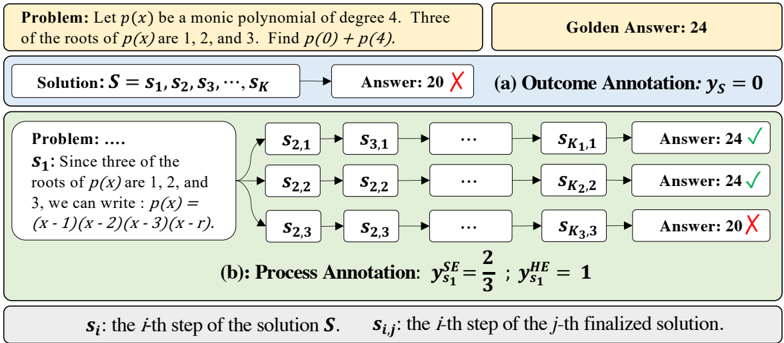
The diagram illustrates a step-by-step solution process for a mathematical problem involving a monic polynomial of degree 4 with known roots (1, 2, 3) and an unknown root (r). It compares two solution paths: one leading to an incorrect answer (20) and another to the correct answer (24), annotated with process variables and outcome indicators.
### Components/Axes
1. **Problem Statement** (Top-left):
- Text: "Let p(x) be a monic polynomial of degree 4. Three of the roots of p(x) are 1, 2, and 3. Find p(0) + p(4)."
- Golden Answer: 24 (Top-right).
2. **Solution Structure** (Middle):
- **Solution Path**:
- Labeled steps: S = S₁, S₂, S₃, ..., Sₖ.
- Outcome Annotation: "Answer: 20 ❌" (yₛ = 0).
- **Process Annotation** (Bottom):
- Detailed steps: S₁ → S₂,₁ → S₃,₁ → ... → Sₖ,₁ (Answer: 24 ✔️), S₂,₂ → S₂,₃ → ... → Sₖ,₂ (Answer: 24 ✔️), S₂,₃ → Sₖ,₃ (Answer: 20 ❌).
- Variables: yₛᴱ = 2/3; yₛ₁ = 1.
3. **Legend** (Bottom-center):
- Definitions:
- sᵢ: The i-th step of the solution S.
- sᵢⱼ: The i-th step of the j-th finalized solution.
### Detailed Analysis
- **Problem Statement**:
- Polynomial p(x) is monic (leading coefficient = 1) with roots 1, 2, 3, and r. The task is to compute p(0) + p(4).
- **Solution Path**:
- Initial steps (S₁, S₂, ..., Sₖ) lead to an incorrect answer (20), marked with a red X and yₛ = 0.
- **Process Annotation**:
- **S₁**: Explicitly defines p(x) = (x-1)(x-2)(x-3)(x-r), establishing the polynomial's form.
- **S₂,₁ → Sₖ,₁**: Correct path leading to Answer: 24 ✔️.
- **S₂,₂ → Sₖ,₂**: Alternative correct path (Answer: 24 ✔️).
- **S₂,₃ → Sₖ,₃**: Incorrect path (Answer: 20 ❌).
- **Legend**:
- yₛᴱ = 2/3: Likely represents a weighting factor for solution steps.
- yₛ₁ = 1: Indicates full confidence in the first step (S₁).
### Key Observations
1. **Divergent Outcomes**: Two solution paths yield the same correct answer (24), while one leads to an incorrect answer (20).
2. **Step Finalization**: The process annotation distinguishes between "finalized" solutions (S₂,₁/Sₖ,₁ and S₂,₂/Sₖ,₂) and non-finalized steps (S₂,₃/Sₖ,₃).
3. **Confidence Metrics**: yₛ₁ = 1 suggests S₁ is a foundational, error-free step, while yₛᴱ = 2/3 implies partial confidence in subsequent steps.
### Interpretation
The diagram demonstrates a structured approach to solving polynomial problems, emphasizing:
- **Root Identification**: Explicitly defining the polynomial's form using known roots (S₁).
- **Solution Branching**: Multiple paths (S₂,₁/S₂,₂/S₂,₃) represent different methodological approaches, with some leading to correct results and others to errors.
- **Confidence Indicators**: The legend's variables (yₛᴱ, yₛ₁) quantify confidence in solution steps, suggesting a probabilistic or iterative refinement process.
The correct answer (24) arises from properly accounting for the unknown root (r) in the polynomial's expansion, while the incorrect answer (20) likely stems from an incomplete or misapplied step (e.g., omitting r in calculations). The process annotation highlights the importance of validating intermediate steps to avoid errors in final results.