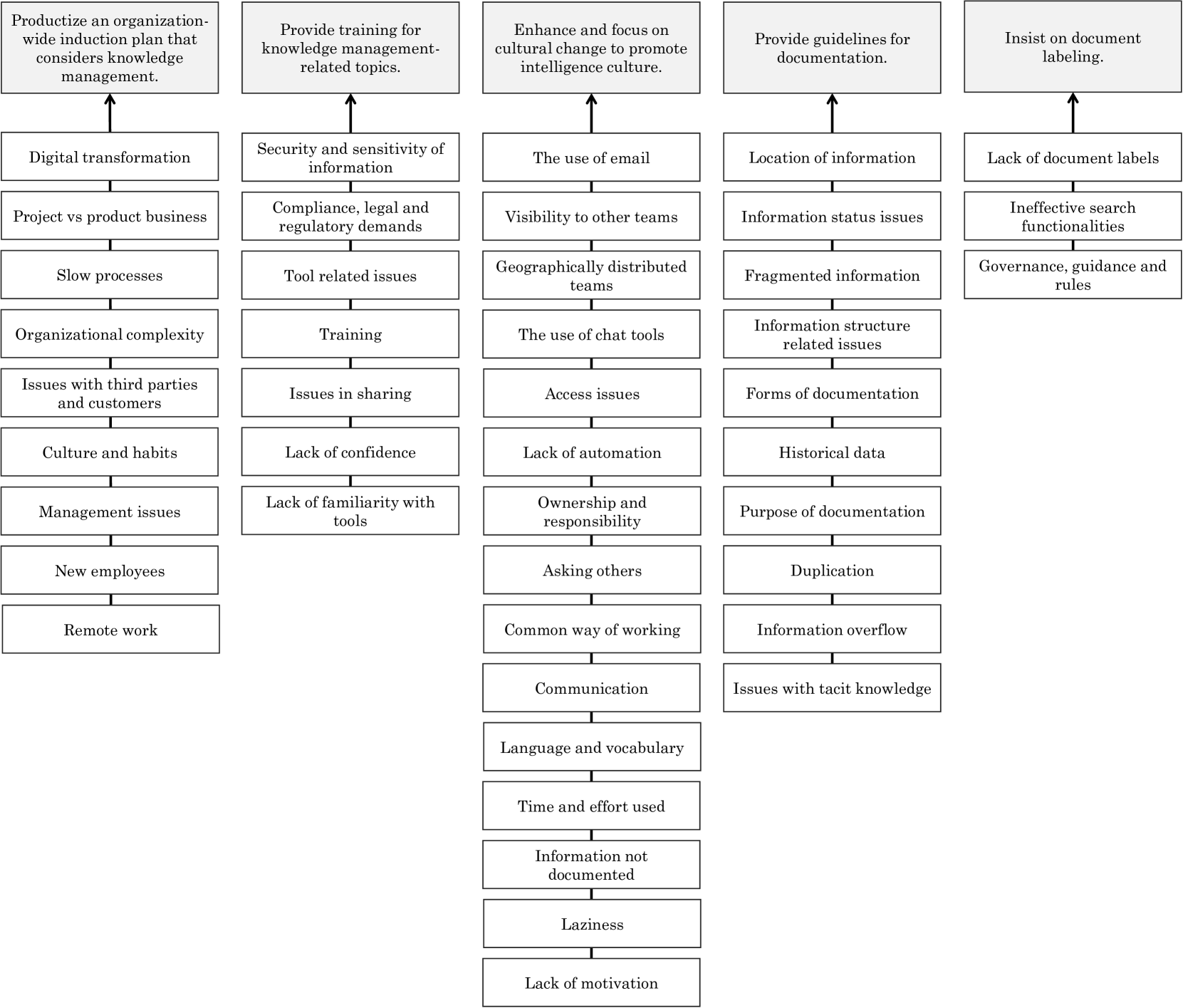
## Diagram: Knowledge Management Induction Plan
### Overview
The image presents a diagram illustrating the factors that contribute to the need for a knowledge management induction plan. It shows a hierarchical structure where high-level goals are supported by more specific issues and challenges. The diagram is organized into five columns, each starting with a high-level objective and branching down into related factors.
### Components/Axes
The diagram consists of rectangular boxes connected by vertical arrows. The boxes contain text describing various aspects of knowledge management. The arrows indicate a hierarchical relationship, where the lower boxes contribute to or influence the boxes above them.
The top row consists of five gray boxes:
1. "Productize an organization-wide induction plan that considers knowledge management."
2. "Provide training for knowledge management-related topics."
3. "Enhance and focus on cultural change to promote intelligence culture."
4. "Provide guidelines for documentation."
5. "Insist on document labeling."
The subsequent rows contain white boxes with black text, representing contributing factors.
### Detailed Analysis or ### Content Details
**Column 1:**
* Top: "Productize an organization-wide induction plan that considers knowledge management."
* Second Level: "Digital transformation"
* Third Level: "Project vs product business"
* Fourth Level: "Slow processes"
* Fifth Level: "Organizational complexity"
* Sixth Level: "Issues with third parties and customers"
* Seventh Level: "Culture and habits"
* Eighth Level: "Management issues"
* Ninth Level: "New employees"
* Tenth Level: "Remote work"
**Column 2:**
* Top: "Provide training for knowledge management-related topics."
* Second Level: "Security and sensitivity of information"
* Third Level: "Compliance, legal and regulatory demands"
* Fourth Level: "Tool related issues"
* Fifth Level: "Training"
* Sixth Level: "Issues in sharing"
* Seventh Level: "Lack of confidence"
* Eighth Level: "Lack of familiarity with tools"
**Column 3:**
* Top: "Enhance and focus on cultural change to promote intelligence culture."
* Second Level: "The use of email"
* Third Level: "Visibility to other teams"
* Fourth Level: "Geographically distributed teams"
* Fifth Level: "The use of chat tools"
* Sixth Level: "Access issues"
* Seventh Level: "Lack of automation"
* Eighth Level: "Ownership and responsibility"
* Ninth Level: "Asking others"
* Tenth Level: "Common way of working"
* Eleventh Level: "Communication"
* Twelfth Level: "Language and vocabulary"
* Thirteenth Level: "Time and effort used"
**Column 4:**
* Top: "Provide guidelines for documentation."
* Second Level: "Location of information"
* Third Level: "Information status issues"
* Fourth Level: "Fragmented information"
* Fifth Level: "Information structure related issues"
* Sixth Level: "Forms of documentation"
* Seventh Level: "Historical data"
* Eighth Level: "Purpose of documentation"
* Ninth Level: "Duplication"
* Tenth Level: "Information overflow"
* Eleventh Level: "Issues with tacit knowledge"
**Column 5:**
* Top: "Insist on document labeling."
* Second Level: "Lack of document labels"
* Third Level: "Ineffective search functionalities"
* Fourth Level: "Governance, guidance and rules"
* Fifth Level: "Information not documented"
* Sixth Level: "Laziness"
* Seventh Level: "Lack of motivation"
### Key Observations
* The diagram highlights a multi-faceted approach to knowledge management, covering aspects from technology and training to culture and documentation.
* Each high-level objective is supported by a series of increasingly specific factors, indicating a cause-and-effect relationship.
* The diagram emphasizes the importance of addressing both technical and human factors in knowledge management.
### Interpretation
The diagram illustrates the complexity of implementing effective knowledge management within an organization. It suggests that a successful knowledge management induction plan must consider a wide range of factors, including technological infrastructure, training programs, cultural norms, and documentation practices. The hierarchical structure emphasizes that addressing the root causes of knowledge management issues is crucial for achieving the desired outcomes. The diagram serves as a visual aid for understanding the interconnectedness of various elements in a knowledge management system and can be used to guide the development of a comprehensive induction plan.