## Diagram: Knowledge Graph Construction for Question Answering
### Overview
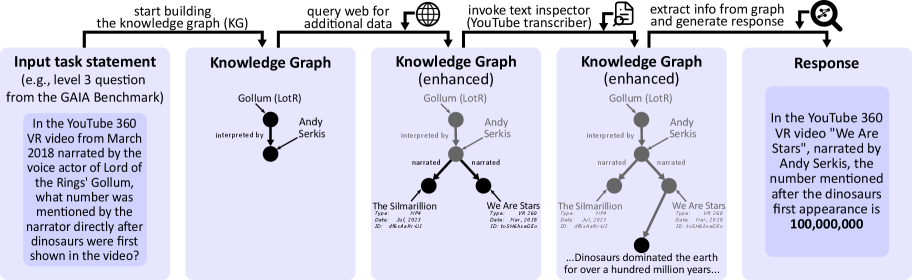
The image illustrates the process of building a knowledge graph to answer a question posed about a YouTube 360 VR video. The process starts with an input task statement, builds a basic knowledge graph, enhances it with additional data from the web and a YouTube transcriber, and finally extracts information to generate a response.
### Components/Axes
The diagram is divided into five main stages, arranged horizontally from left to right:
1. **Input task statement:** Contains the question to be answered.
2. **Knowledge Graph:** Initial knowledge graph built from the input statement.
3. **Knowledge Graph (enhanced):** Knowledge graph enhanced with additional data.
4. **Knowledge Graph (enhanced):** Further enhanced knowledge graph.
5. **Response:** The final answer generated.
Each stage is marked with a title and separated by arrows indicating the flow of information. The top of the diagram includes labels indicating the actions performed at each stage: "start building the knowledge graph (KG)", "query web for additional data", "invoke text inspector (YouTube transcriber)", and "extract info from graph and generate response".
### Detailed Analysis or Content Details
**1. Input task statement:**
* Text: "Input task statement (e.g., level 3 question from the GAIA Benchmark)"
* Question: "In the YouTube 360 VR video from March 2018 narrated by the voice actor of Lord of the Rings' Gollum, what number was mentioned by the narrator directly after dinosaurs were first shown in the video?"
**2. Knowledge Graph:**
* Nodes: "Gollum (LotR)" and "Andy Serkis"
* Edge: "interpreted by" connecting Gollum to Andy Serkis.
**3. Knowledge Graph (enhanced):**
* Nodes: "Gollum (LotR)", "Andy Serkis", and "The Silmarillion", "We Are Stars"
* Edges: "interpreted by" connecting Andy Serkis to "The Silmarillion" and "We Are Stars", "interpreted by" connecting Gollum to Andy Serkis.
* "The Silmarillion" details: Type: JP4, Date: Jul, 2023, ID: d6xAaRv-UI
* "We Are Stars" details: Type: VR 260, Date: Mar, 2018, ID: tSHGAGEo
**4. Knowledge Graph (enhanced):**
* Nodes: "Gollum (LotR)", "Andy Serkis", "The Silmarillion", "We Are Stars"
* Edges: "interpreted by" connecting Andy Serkis to "The Silmarillion" and "We Are Stars", "interpreted by" connecting Gollum to Andy Serkis.
* "The Silmarillion" details: Type: JP4, Date: Jul, 2023, ID: d6xAaRv-UI
* "We Are Stars" details: Type: VR 260, Date: Mar, 2018, ID: tSHGAGEo
* Text: "...Dinosaurs dominated the earth for over a hundred million years..."
**5. Response:**
* Text: "In the YouTube 360 VR video 'We Are Stars', narrated by Andy Serkis, the number mentioned after the dinosaurs first appearance is 100,000,000"
### Key Observations
* The knowledge graph evolves from a simple relationship between "Gollum" and "Andy Serkis" to a more complex structure including "The Silmarillion" and "We Are Stars".
* The "enhanced" knowledge graphs incorporate information about the type, date, and ID of the related media.
* The final response directly answers the question posed in the input statement.
### Interpretation
The diagram illustrates a question-answering system that leverages knowledge graphs. The system starts with a user's question and constructs a knowledge graph to represent the entities and relationships involved. It then enhances this graph by querying external sources (the web and a YouTube transcriber) to gather additional information. Finally, it extracts the relevant information from the enhanced graph to generate a concise and accurate answer to the user's question. The example demonstrates how knowledge graphs can be used to reason about complex information and provide meaningful answers to natural language queries.