\n
## Diagram: Knowledge Graph Construction Process
### Overview
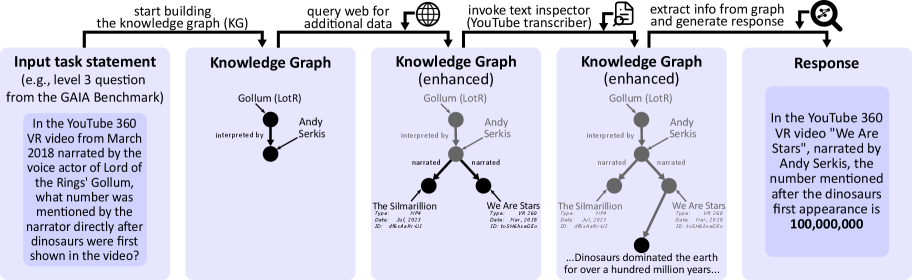
The image depicts a diagram illustrating the process of constructing a knowledge graph (KG) to answer a complex question posed from the GAIA Benchmark. The process involves starting with an initial KG, querying the web for additional data, invoking a text inspector (specifically a YouTube transcriber), and finally extracting information from the enhanced graph to generate a response. The diagram shows the evolution of the knowledge graph through these stages, with examples of nodes and relationships.
### Components/Axes
The diagram is structured horizontally, showing a sequence of steps. The main components are:
* **Input Task Statement:** A text box containing a complex question from the GAIA Benchmark.
* **Knowledge Graph:** Three iterations of a knowledge graph are shown, labeled "Knowledge Graph", "Knowledge Graph (enhanced)", and "Knowledge Graph (enhanced)".
* **Query Web:** An icon representing a globe with the text "query web for additional data".
* **Invoke Inspector:** An icon representing a computer screen with the text "invoke inspector (YouTube transcriber)".
* **Extract Info & Generate Response:** An icon representing a cross mark with the text "extract info from graph and generate response".
* **Response:** A text box containing the answer generated from the knowledge graph.
* **Arrows:** Arrows indicate the flow of the process from left to right.
### Detailed Analysis or Content Details
**1. Input Task Statement:**
The text reads: "In the YouTube 360 VR video from March 2018 narrated by the voice actor of Lord of the Rings’ Gollum, what number was mentioned by the narrator directly after dinosaurs were first shown in the video?"
**2. Knowledge Graph (Initial):**
* **Nodes:**
* Gollum (LotR)
* Andy Serkis
* **Relationship:**
* "interpreted by" connecting Gollum (LotR) to Andy Serkis.
**3. Knowledge Graph (Enhanced - Stage 1):**
* **Nodes:**
* Gollum (LotR)
* Andy Serkis
* The Silmarillion
* **Relationships:**
* "interpreted by" connecting Gollum (LotR) to Andy Serkis.
* "narrated" connecting Andy Serkis to The Silmarillion.
* The Silmarillion has the following attributes:
* Type: Audio
* Date: Jul, 2017
* ID: 20160426-07
**4. Knowledge Graph (Enhanced - Stage 2):**
* **Nodes:**
* Gollum (LotR)
* Andy Serkis
* The Silmarillion
* We Are Stars
* **Relationships:**
* "interpreted by" connecting Gollum (LotR) to Andy Serkis.
* "narrated" connecting Andy Serkis to both The Silmarillion and We Are Stars.
* We Are Stars has the following attributes:
* Type: VR 360
* Date: Mar, 2018
* ID: 20160426-10
* A text snippet is connected to "We Are Stars": "...Dinosaurs dominated the earth for over a hundred million years..."
**5. Response:**
The text reads: "In the YouTube 360 VR video “We Are Stars”, narrated by Andy Serkis, the number mentioned after the dinosaurs first appearance is 100,000,000"
**6. Process Flow:**
* The process starts with the "Input Task Statement".
* An initial "Knowledge Graph" is built.
* The web is queried for "additional data".
* A "YouTube transcriber" is invoked.
* The "Knowledge Graph" is enhanced with the new data.
* Information is extracted from the enhanced graph to generate the "Response".
### Key Observations
* The diagram demonstrates how a knowledge graph can be iteratively built and enhanced to answer complex questions.
* The inclusion of a YouTube transcriber highlights the importance of processing multimedia content to extract relevant information.
* The example shows how the graph connects entities (Gollum, Andy Serkis, videos) and their relationships (interpreted by, narrated).
* The final response is directly derived from the information contained within the enhanced knowledge graph.
### Interpretation
The diagram illustrates a sophisticated approach to question answering, leveraging knowledge graphs and multimedia processing. The process begins with a natural language query and transforms it into a structured representation (the knowledge graph). By querying the web and transcribing video content, the graph is enriched with relevant information. The final step involves extracting the answer from the graph, demonstrating the power of this approach for complex reasoning and information retrieval. The diagram highlights the importance of combining structured knowledge with unstructured data (video transcripts) to achieve accurate and comprehensive answers. The specific example focuses on temporal relationships ("directly after") and numerical extraction, showcasing the system's ability to handle nuanced queries. The inclusion of metadata (Type, Date, ID) for each video suggests a focus on provenance and data quality.