\n
## Bar Chart: Top-1 Accuracy vs. Representation Size
### Overview
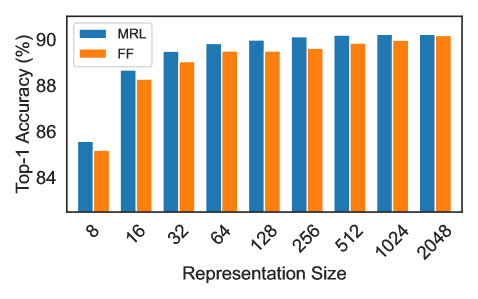
This bar chart compares the Top-1 Accuracy of two models, MRL and FF, across varying Representation Sizes. The chart uses bar graphs to display the accuracy values for each model at each representation size.
### Components/Axes
* **X-axis:** Representation Size. Values are: 8, 16, 32, 64, 128, 256, 512, 1024, 2048.
* **Y-axis:** Top-1 Accuracy (%). Scale ranges from approximately 83% to 91%.
* **Legend:**
* MRL (Blue)
* FF (Orange)
### Detailed Analysis
The chart consists of paired bars for each representation size, representing the Top-1 Accuracy of MRL and FF.
* **Representation Size 8:** MRL ≈ 85.5%, FF ≈ 84.5%
* **Representation Size 16:** MRL ≈ 88.3%, FF ≈ 88.3%
* **Representation Size 32:** MRL ≈ 89.3%, FF ≈ 88.7%
* **Representation Size 64:** MRL ≈ 89.7%, FF ≈ 89.3%
* **Representation Size 128:** MRL ≈ 89.8%, FF ≈ 89.7%
* **Representation Size 256:** MRL ≈ 89.9%, FF ≈ 89.8%
* **Representation Size 512:** MRL ≈ 90.1%, FF ≈ 89.9%
* **Representation Size 1024:** MRL ≈ 90.3%, FF ≈ 90.1%
* **Representation Size 2048:** MRL ≈ 90.4%, FF ≈ 90.3%
**Trends:**
* **MRL:** The blue bars (MRL) generally show an upward trend, increasing in height as the Representation Size increases. The increase appears to plateau after a Representation Size of 1024.
* **FF:** The orange bars (FF) also show an upward trend, similar to MRL, but consistently remain slightly below MRL's accuracy values. The increase also plateaus after a Representation Size of 1024.
### Key Observations
* MRL consistently outperforms FF across all Representation Sizes.
* The difference in accuracy between MRL and FF is relatively small, especially at larger Representation Sizes.
* Both models exhibit diminishing returns in accuracy as the Representation Size increases beyond 1024.
### Interpretation
The data suggests that increasing the Representation Size generally improves the Top-1 Accuracy of both the MRL and FF models. However, the improvement becomes marginal at larger Representation Sizes, indicating a point of diminishing returns. MRL consistently demonstrates slightly higher accuracy than FF, suggesting it may be a more effective model for this task, or that it benefits more from increased representation size. The plateauing of accuracy suggests that other factors, beyond Representation Size, may be limiting the performance of both models. This could include the quality of the training data, the model architecture, or the optimization algorithm used. Further investigation would be needed to determine the optimal Representation Size and identify other potential areas for improvement.