## Bar Chart: Top-1 Accuracy Comparison Between MRL and FF Across Representation Sizes
### Overview
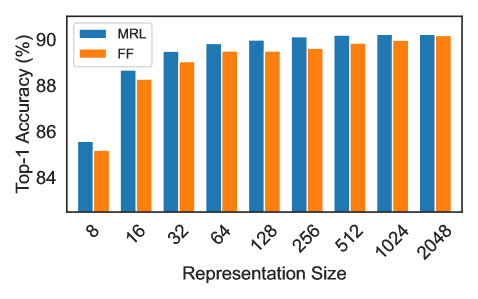
The chart compares the Top-1 Accuracy (%) of two methods, **MRL** (blue bars) and **FF** (orange bars), across varying **Representation Sizes** (8 to 2048). Both methods show increasing accuracy with larger representation sizes, with MRL consistently outperforming FF by small margins.
### Components/Axes
- **X-axis**: Representation Size (logarithmic scale: 8, 16, 32, 64, 128, 256, 512, 1024, 2048).
- **Y-axis**: Top-1 Accuracy (%) (range: 84% to 90%).
- **Legend**:
- Blue = MRL
- Orange = FF
- **Bar Groups**: Paired bars for each representation size, with MRL (blue) on the left and FF (orange) on the right.
### Detailed Analysis
- **Representation Size 8**:
- MRL: ~85.5%
- FF: ~85.0%
- **Representation Size 16**:
- MRL: ~88.5%
- FF: ~88.0%
- **Representation Size 32**:
- MRL: ~89.2%
- FF: ~88.8%
- **Representation Size 64**:
- MRL: ~89.5%
- FF: ~89.1%
- **Representation Size 128**:
- MRL: ~89.7%
- FF: ~89.3%
- **Representation Size 256**:
- MRL: ~89.8%
- FF: ~89.5%
- **Representation Size 512**:
- MRL: ~90.0%
- FF: ~89.7%
- **Representation Size 1024**:
- MRL: ~90.2%
- FF: ~90.0%
- **Representation Size 2048**:
- MRL: ~90.5%
- FF: ~90.3%
### Key Observations
1. **Upward Trend**: Both methods show a clear increase in Top-1 Accuracy as representation size grows.
2. **Consistent MRL Advantage**: MRL outperforms FF by ~0.2–0.5% across all sizes, with the gap narrowing at larger scales (e.g., 0.2% at 2048).
3. **Diminishing Returns**: Accuracy improvements plateau at larger sizes (e.g., 1024–2048), suggesting limited gains beyond ~1024.
### Interpretation
The data indicates that **MRL** is marginally more effective than **FF** for improving Top-1 Accuracy, particularly at smaller representation sizes. However, both methods converge in performance at larger scales (2048), implying that representation size has a diminishing impact on accuracy gains. This could reflect architectural optimizations in MRL or saturation of model capacity at higher dimensions. The trend underscores the importance of balancing representation size with computational efficiency in model design.