## Causal Diagram: Fairness Levels
### Overview
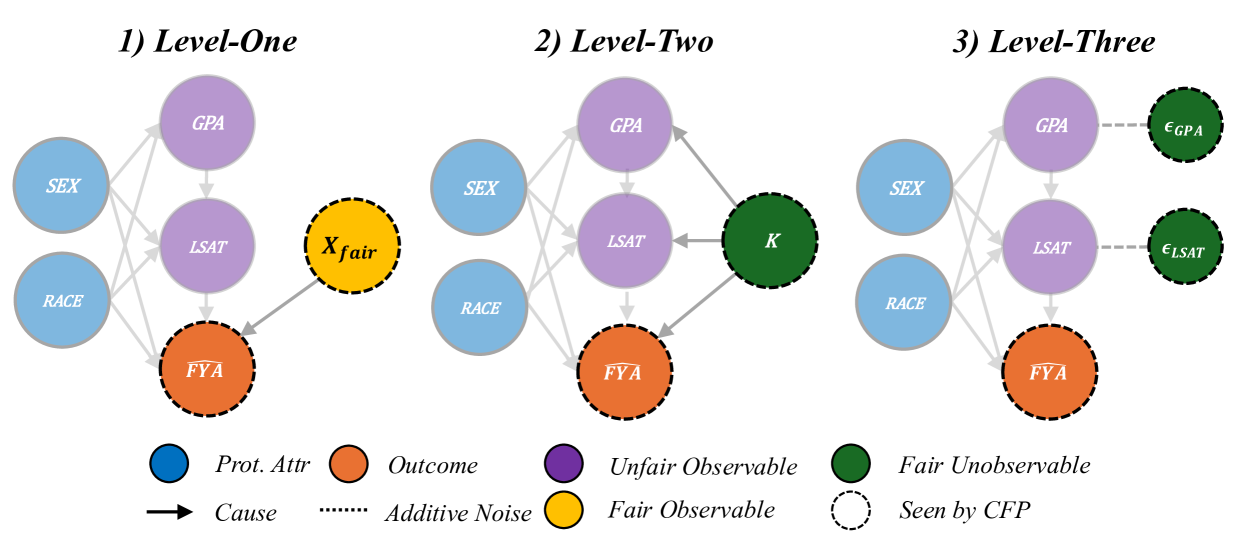
The image presents three causal diagrams, labeled "Level-One," "Level-Two," and "Level-Three," illustrating different levels of fairness considerations in a predictive model. Each diagram depicts relationships between protected attributes (e.g., race, sex), unfair observables (e.g., GPA, LSAT), a fair observable (Xfair), an outcome (FYA), and fair unobservables (epsilon GPA, epsilon LSAT, K). The diagrams use nodes to represent variables and arrows to indicate causal relationships. Dashed lines represent additive noise, and dashed circles indicate variables seen by the CFP (Counterfactual Fairness Prediction).
### Components/Axes
* **Nodes:** Represent variables.
* Blue: Protected Attributes (Prot. Attr) - SEX, RACE
* Orange: Outcome - FYA (First Year Average)
* Purple: Unfair Observable - GPA (Grade Point Average), LSAT (Law School Admission Test)
* Yellow: Fair Observable - Xfair
* Green: Fair Unobservable - K, epsilon GPA, epsilon LSAT
* **Edges:** Represent relationships between variables.
* Solid Arrow: Cause - Indicates a causal relationship.
* Dashed Line: Additive Noise - Represents random variation or error.
* **Circles with Dashed Outline:** Seen by CFP (Counterfactual Fairness Prediction).
* **Titles:**
* 1) Level-One
* 2) Level-Two
* 3) Level-Three
* **Legend:** Located at the bottom of the image, explaining the node colors and edge types.
### Detailed Analysis or Content Details
**1) Level-One:**
* Nodes: GPA, LSAT, SEX, RACE, FYA, Xfair
* Relationships:
* SEX and RACE both have causal effects on GPA, LSAT, and FYA.
* GPA and LSAT both have causal effects on FYA.
* Xfair has a causal effect on FYA.
* Xfair is seen by CFP.
* FYA is seen by CFP.
**2) Level-Two:**
* Nodes: GPA, LSAT, SEX, RACE, FYA, K
* Relationships:
* SEX and RACE both have causal effects on GPA, LSAT, and FYA.
* GPA and LSAT both have causal effects on FYA.
* K has a causal effect on FYA.
* K is seen by CFP.
* FYA is seen by CFP.
**3) Level-Three:**
* Nodes: GPA, LSAT, SEX, RACE, FYA, epsilon GPA, epsilon LSAT
* Relationships:
* SEX and RACE both have causal effects on GPA, LSAT, and FYA.
* GPA and LSAT both have causal effects on FYA.
* epsilon GPA is additive noise to GPA.
* epsilon LSAT is additive noise to LSAT.
* FYA is seen by CFP.
* epsilon GPA is seen by CFP.
* epsilon LSAT is seen by CFP.
### Key Observations
* The diagrams illustrate a progression in fairness considerations.
* Level-One introduces a fair observable, Xfair, that directly influences the outcome.
* Level-Two introduces a fair unobservable, K, that directly influences the outcome.
* Level-Three introduces additive noise terms, epsilon GPA and epsilon LSAT, to GPA and LSAT respectively.
* Protected attributes (SEX, RACE) consistently influence GPA, LSAT, and FYA across all levels.
* The outcome, FYA, is always seen by the CFP.
### Interpretation
The diagrams represent different approaches to achieving fairness in a predictive model. Level-One focuses on incorporating a fair observable feature, while Level-Two introduces a fair unobservable variable. Level-Three acknowledges the presence of noise or error in the unfair observable variables. The progression from Level-One to Level-Three suggests an increasing complexity in modeling and addressing fairness concerns. The consistent influence of protected attributes highlights the need to mitigate bias introduced by these variables. The fact that FYA is always seen by the CFP indicates that the model is always aware of the outcome, allowing for potential adjustments to improve fairness.