## Textual Logic Puzzle: Logical Conclusion Question
### Overview
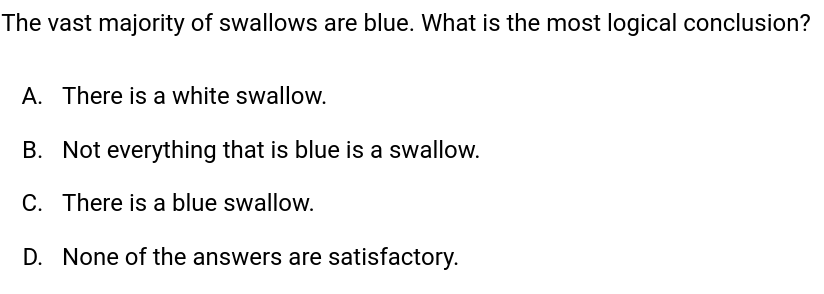
The image contains a multiple-choice logic question presented in plain text. The content focuses on deductive reasoning based on a statistical premise regarding the color of swallows.
### Components
* **Question Stem:** A single sentence establishing the premise and asking for a conclusion.
* **Options:** Four distinct choices labeled A, B, C, and D.
### Detailed Analysis
The text is presented in English. The content is transcribed below:
* **Question Stem:** "The vast majority of swallows are blue. What is the most logical conclusion?"
* **Option A:** "There is a white swallow."
* **Option B:** "Not everything that is blue is a swallow."
* **Option C:** "There is a blue swallow."
* **Option D:** "None of the answers are satisfactory."
### Key Observations
* The premise uses the quantifier "vast majority," which implies a statistical distribution where the color blue is dominant among the set of "swallows."
* The options test the ability to distinguish between a *possibility* (A), a *general truth* (B), a *logical necessity* (C), and a *null result* (D).
### Interpretation
This is a test of formal logic and deductive reasoning.
* **Logical Deduction:**
* **Premise:** "The vast majority of swallows are blue."
* **Analysis of Option A:** "There is a white swallow." This is a possibility, but it is not a logical necessity. The premise does not exclude the existence of other colors, but it does not confirm them either.
* **Analysis of Option B:** "Not everything that is blue is a swallow." While this is a true statement in the real world, it is a *non-sequitur* in the context of this specific logic puzzle. It does not follow from the premise provided.
* **Analysis of Option C:** "There is a blue swallow." This is the only logically necessary conclusion. If a "vast majority" of a group possesses a specific trait, then at least one member of that group must possess that trait. Therefore, the existence of at least one blue swallow is guaranteed by the premise.
* **Analysis of Option D:** Since Option C is a valid logical conclusion, Option D is incorrect.
**Conclusion:** Option C is the correct answer because it is the only statement that is necessarily true based strictly on the provided premise.