\n
## Text Block: Logical Reasoning Question
### Overview
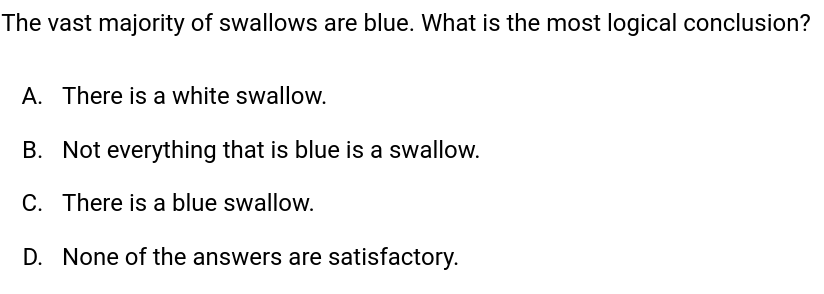
The image presents a multiple-choice question testing logical reasoning. It states a premise ("The vast majority of swallows are blue") and asks for the most logical conclusion.
### Content Details
The text is entirely in English. Here's a transcription of the complete text:
"The vast majority of swallows are blue. What is the most logical conclusion?
A. There is a white swallow.
B. Not everything that is blue is a swallow.
C. There is a blue swallow.
D. None of the answers are satisfactory."
### Key Observations
The question focuses on understanding statistical prevalence versus absolute certainty. The premise establishes a high probability of a swallow being blue, but doesn't exclude the possibility of swallows being other colors.
### Interpretation
The question tests the ability to distinguish between a likely scenario and a definitive conclusion. The premise states a majority, not a totality. Therefore, the existence of a non-blue swallow (like a white one) doesn't contradict the premise. Option B is a true statement, but doesn't follow *from* the premise. Option C is already stated in the premise. Option D is incorrect as one of the answers *is* logical. The most logical conclusion is that there exists a white swallow, as the premise only states the majority are blue, not all. This is a classic example of a logical fallacy where a statistical trend is misinterpreted as an absolute rule.