## Textual Content: Multiple-Choice Question on Swallow Colors
### Overview
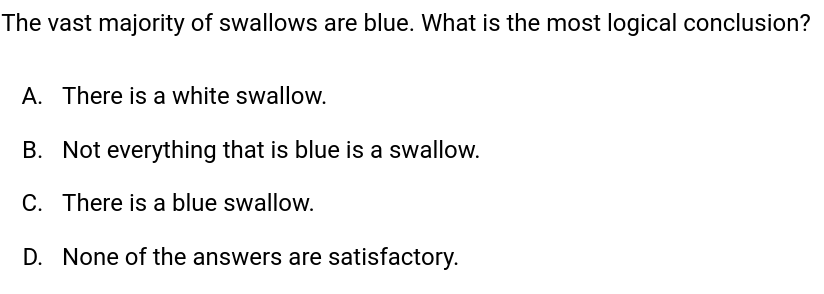
The image contains a multiple-choice question presented in plain text. The question and answer options are formatted with labels (A, B, C, D) and punctuation. No visual elements (e.g., charts, diagrams) are present.
### Components/Axes
- **Question**: "The vast majority of swallows are blue. What is the most logical conclusion?"
- **Answer Options**:
- **A**: "There is a white swallow."
- **B**: "Not everything that is blue is a swallow."
- **C**: "There is a blue swallow."
- **D**: "None of the answers are satisfactory."
### Content Details
- **Question Text**:
- "The vast majority of swallows are blue." (Premise)
- "What is the most logical conclusion?" (Query)
- **Answer Text**:
- **A**: Asserts the existence of a white swallow.
- **B**: States a logical negation ("Not all blue things are swallows").
- **C**: Asserts the existence of a blue swallow.
- **D**: Rejects all options as unsatisfactory.
### Key Observations
1. The question tests logical inference from a statistical premise ("vast majority").
2. Option **C** directly follows from the premise (if most swallows are blue, at least one must be blue).
3. Option **B** introduces a separate logical principle (inverse of the premise).
4. Option **A** is unrelated to the premise (no information about white swallows is provided).
5. Option **D** is a meta-commentary on the validity of the options.
### Interpretation
- **Logical Structure**: The premise establishes a probabilistic claim ("vast majority"), which implies the existence of at least one blue swallow. This makes **C** the most direct conclusion.
- **Distractors**:
- **A** is a non sequitur (irrelevant to the premise).
- **B** misapplies logical negation (the premise does not claim *all* blue things are swallows).
- **D** is self-referential but does not address the premise’s validity.
- **Ambiguity**: The term "vast majority" is vague (e.g., 51% vs. 99%), but even a small majority necessitates at least one blue swallow.
This question evaluates understanding of existential quantification and logical fallacies. The correct answer hinges on recognizing that a majority implies existence, not universality.