## Diagram: Hashing Scheme
### Overview
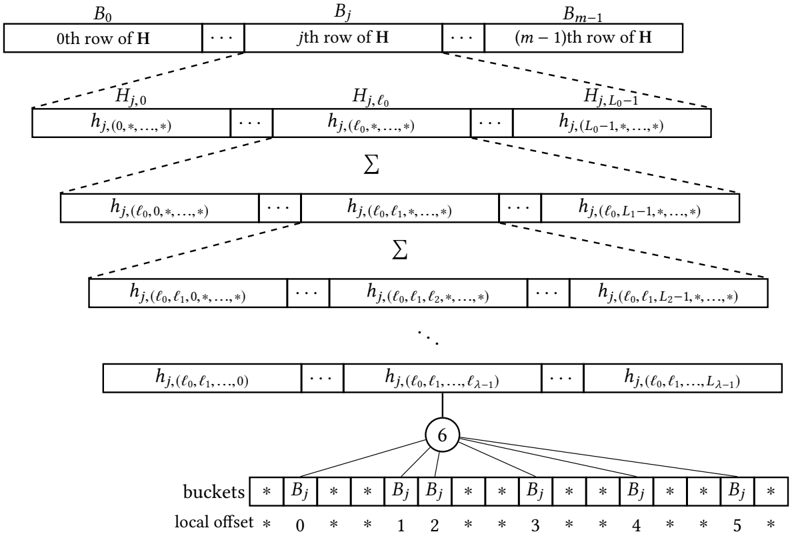
The image illustrates a hashing scheme, likely used in computer science or data structures. It depicts a hierarchical breakdown of rows of a matrix H into smaller components, culminating in a mapping to buckets based on a local offset.
### Components/Axes
* **Top Level:**
* `B0`: 0th row of H
* `Bj`: jth row of H
* `Bm-1`: (m-1)th row of H
* **Second Level:**
* `Hj,0`
* `hj,(0,*,...,*)`
* `Hj,l0`
* `hj,(l0,*,...,*)`
* `Hj,L0-1`
* `hj,(L0-1,*,...,*)`
* **Summation Symbols:** Two summation symbols (Σ) indicate aggregation or combination of elements.
* **Lower Levels:**
* `hj,(l0,0,*,...,*)`
* `hj,(l0,l1,*,...,*)`
* `hj,(l0,L1-1,*,...,*)`
* `hj,(l0,l1,l2,*,...,*)`
* `hj,(l0,L1,L2-1,*,...,*)`
* `...` (Indicates continuation of the pattern)
* `hj,(l0,l1,...,0)`
* `hj,(l0,l1,...,lλ-1)`
* `hj,(l0,l1,...,Lλ-1)`
* **Final Node:** A circle containing the number "6".
* **Bottom Level:**
* `buckets`: `* Bj * * Bj Bj * * Bj * * Bj * * Bj * * Bj * *`
* `local offset`: `* 0 * * 1 2 * * 3 * * 4 * * 5 *`
### Detailed Analysis
The diagram shows a hierarchical decomposition process.
1. **Top Level:** The rows of a matrix H, denoted as `B0`, `Bj`, and `Bm-1`, are the starting point.
2. **Second Level:** Each row `Bj` is further divided into components `Hj,0`, `Hj,l0`, and `Hj,L0-1`. These components contain elements denoted as `hj,(...)`.
3. **Summation:** The summation symbols suggest that elements from the previous level are combined or aggregated.
4. **Lower Levels:** The elements `hj,(...)` are further refined, with indices `l0`, `l1`, `l2`, etc., being introduced. The ellipsis (...) indicates that this process continues for multiple levels.
5. **Final Mapping:** The final elements are mapped to buckets. The number "6" in the circle likely represents a hash function or a specific parameter in the hashing process.
6. **Buckets and Local Offset:** The bottom level shows the buckets, labeled `Bj`, and their corresponding local offsets, ranging from 0 to 5. The asterisks (*) likely represent separators or other bucket elements.
### Key Observations
* The diagram illustrates a multi-level hashing scheme.
* The rows of matrix H are progressively broken down into smaller components.
* The summation symbols indicate aggregation or combination of elements.
* The final mapping is to buckets with local offsets.
### Interpretation
The diagram represents a hashing algorithm where data is progressively refined and mapped to buckets. The hierarchical structure suggests a process of breaking down data into smaller, more manageable pieces before hashing. The local offset indicates the position within a specific bucket. The number "6" likely represents a parameter of the hash function, such as the number of bits used for indexing or a constant factor in the calculation. This type of hashing scheme could be used to efficiently store and retrieve data in a large dataset. The asterisks in the buckets and local offsets are likely placeholders or separators, indicating that the actual values would be determined during the hashing process.