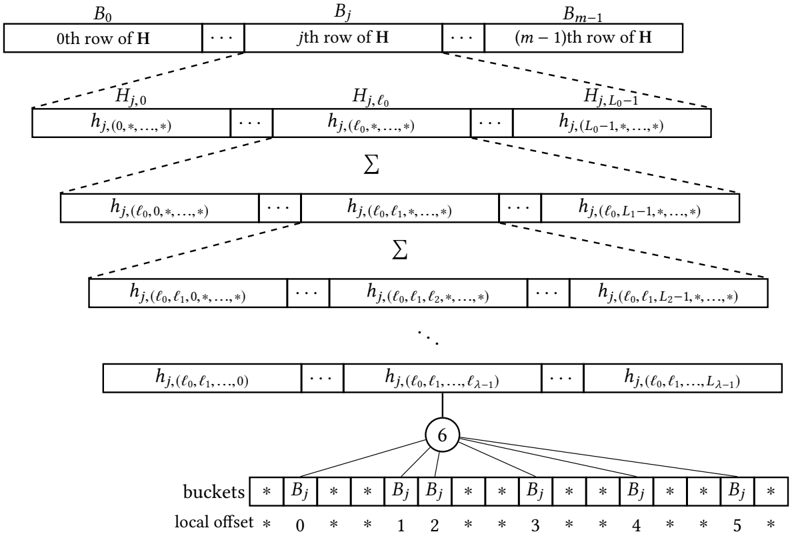
## Diagram: Hierarchical Matrix Decomposition with Bucket Allocation
### Overview
The diagram illustrates a hierarchical decomposition of matrix elements into "buckets" with local offsets. It shows a multi-level structure where rows of a matrix **H** are broken down into progressively refined sub-elements, ultimately mapped to buckets labeled **B₀** to **B₅** with associated local offsets (0–5). Dotted lines indicate relationships between matrix elements and their bucket assignments.
---
### Components/Axes
1. **Matrix Rows (Top Section)**:
- **B₀** to **Bₘ₋₁**: Represent rows of matrix **H** (0th to (m−1)th row).
- Each row contains elements like **Hⱼ,₀**, **Hⱼ,ℓ₀**, **Hⱼ,L₀−1**, with indices varying across dimensions (e.g., **hⱼ(0,*,...,*)**, **hⱼ(ℓ₀,*,...,*)**).
2. **Summation Layers (Middle Section)**:
- **Σ Symbols**: Indicate aggregation operations across indices (e.g., **hⱼ(ℓ₀,ℓ₁,*,...,*)**).
- Elements are grouped by increasing specificity in their index patterns (e.g., **hⱼ(ℓ₀,ℓ₁,...,L₁−1)**).
3. **Buckets and Local Offsets (Bottom Section)**:
- **Buckets**: Labeled **B₀** to **B₅**, each marked with a star (*) symbol.
- **Local Offsets**: Numerical values (0–5) positioned below buckets, suggesting positional identifiers within buckets.
4. **Dotted Lines**:
- Connect matrix elements to buckets, implying a mapping or allocation logic (e.g., **hⱼ(ℓ₀,ℓ₁,...,L₁−1)** maps to **B₃** with offset 3).
---
### Detailed Analysis
- **Matrix Element Indices**:
- Elements are parameterized by indices like **ℓ₀, ℓ₁, ..., L₁−1**, which likely represent hierarchical or partitioned dimensions of **H**.
- The use of **\*** in indices (e.g., **hⱼ(0,*,...,*)**) suggests wildcard or variable dimensions, possibly indicating sparsity or aggregation.
- **Bucket Allocation**:
- Buckets **B₀–B₅** are evenly spaced at the bottom, with local offsets 0–5 directly below them.
- Dotted lines from elements to buckets imply a one-to-one or many-to-one mapping (e.g., **hⱼ(ℓ₀,ℓ₁,...,L₁−1)** maps to **B₃** with offset 3).
- **Hierarchical Structure**:
- The diagram progresses from coarse (entire rows **B₀–Bₘ₋₁**) to fine-grained (bucket-specific elements **hⱼ(ℓ₀,ℓ₁,...,L₁−1)**).
- Summation symbols (**Σ**) indicate iterative refinement or aggregation across dimensions.
---
### Key Observations
1. **No Numerical Data**: The diagram lacks explicit numerical values, focusing instead on symbolic relationships and structural patterns.
2. **Consistent Labeling**:
- All bucket labels (**B₀–B₅**) and offsets (0–5) are explicitly marked.
- Matrix elements follow a consistent indexing convention (e.g., **Hⱼ,ℓ₀**, **Hⱼ,ℓ₁**).
3. **Spatial Grounding**:
- **B₀** is top-left, **Bₘ₋₁** is top-right.
- Buckets are bottom-aligned, with offsets directly beneath them.
4. **Legend Ambiguity**:
- No explicit legend is present, but the star (*) symbol and offset numbering likely serve as implicit identifiers.
---
### Interpretation
This diagram represents a **hierarchical data structure** for organizing matrix elements into optimized storage or computation units (buckets). Key insights:
- **Efficient Access**: By decomposing **H** into buckets with local offsets, the structure may enable faster retrieval or parallel processing of sub-elements.
- **Aggregation Logic**: Summation symbols (**Σ**) suggest that certain elements are precomputed or grouped for efficiency (e.g., sparse matrix operations).
- **Indexing Strategy**: The use of **\*** in indices implies a flexible or adaptive partitioning scheme, possibly for handling variable-sized data or dynamic resizing.
The absence of numerical values limits quantitative analysis, but the structural patterns emphasize **modularity** and **scalability** in matrix operations. This could be relevant to fields like machine learning (e.g., tensor decomposition) or distributed computing (e.g., sharding data across nodes).