## Line Chart: MUSHRA (95% Confidence Interval) vs Bitrate (kbps)
### Overview
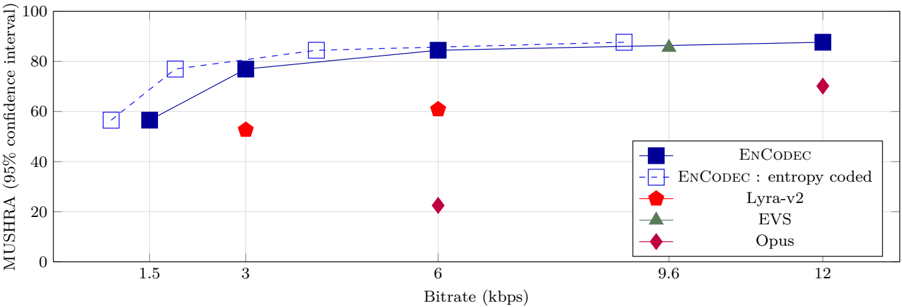
The chart compares the performance of audio codecs (ENCODEC, Lyra-v2, EVS, Opus) across varying bitrates (1.5–12 kbps) using MUSHRA scores (95% confidence interval). The y-axis represents MUSHRA scores (0–100%), while the x-axis shows bitrate in kbps. Data points are plotted at 1.5, 3, 6, 9.6, and 12 kbps.
### Components/Axes
- **X-axis**: Bitrate (kbps) with markers at 1.5, 3, 6, 9.6, and 12.
- **Y-axis**: MUSHRA (95% confidence interval) from 0% to 100%.
- **Legend**:
- **ENCODEC**: Solid blue squares (■) and dashed blue line (entropy coded).
- **Lyra-v2**: Red pentagons (🔴).
- **EVS**: Green triangles (🔺).
- **Opus**: Purple diamonds (💎).
### Detailed Analysis
1. **ENCODEC (■)**:
- Scores increase steadily from ~55% (1.5 kbps) to ~85% (12 kbps).
- Entropy-coded variant (dashed line) shows similar trends but slightly lower scores (~80% at 12 kbps).
2. **Lyra-v2 (🔴)**:
- Scores rise from ~50% (1.5 kbps) to ~60% (3 kbps), then drop to ~20% at 6 kbps, recovering to ~65% at 12 kbps.
3. **EVS (🔺)**:
- Scores plateau at ~85% from 3 kbps onward, with a peak at 9.6 kbps (~88%).
4. **Opus (💎)**:
- Scores increase from ~20% (1.5 kbps) to ~70% (12 kbps), with a notable dip at 6 kbps (~25%).
### Key Observations
- **ENCODEC** consistently outperforms other codecs across all bitrates.
- **Lyra-v2** exhibits a sharp decline at 6 kbps, suggesting potential instability or inefficiency at this bitrate.
- **EVS** maintains high scores above 3 kbps, peaking at 9.6 kbps.
- **Opus** shows gradual improvement but lags behind ENCODEC and EVS at higher bitrates.
### Interpretation
The data suggests that **ENCODEC** and **EVS** are more robust and efficient across the tested bitrates, with ENCODEC achieving the highest scores. **Lyra-v2**'s anomalous drop at 6 kbps warrants further investigation, possibly indicating codec-specific limitations. **Opus** performs adequately but requires higher bitrates to approach the performance of ENCODEC/EVS. The entropy-coded ENCODEC variant demonstrates near-parity with the standard version, highlighting its efficiency. These trends imply that codec choice and bitrate allocation significantly impact perceptual audio quality in MUSHRA evaluations.