TECHNICAL ASSET FINGERPRINT
83afdd92b4094890f96b21c7
Click to view fullscreen
Press ESC or click to close
FOUND IN PAPERS
EXPERT: healer-alpha-free VERSION 1
RUNTIME: free/openrouter/healer-alpha
INTEL_VERIFIED
## Sequence Diagram: TEE-Based Batch Verification Protocol
### Overview
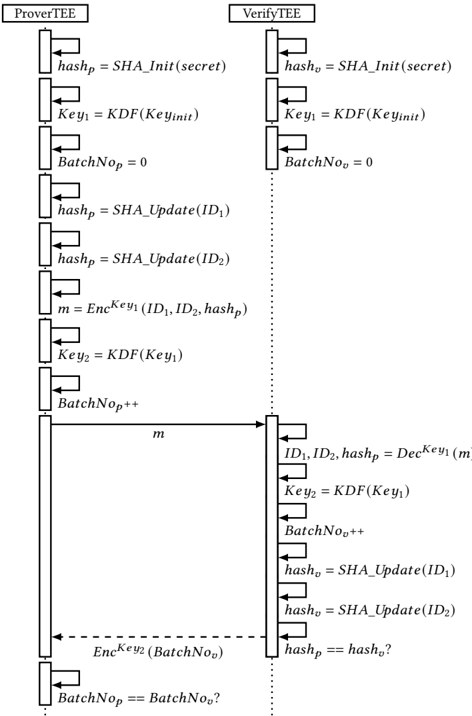
This image is a technical sequence diagram illustrating a cryptographic protocol between two Trusted Execution Environment (TEE) entities: **ProverTEE** and **VerifyTEE**. The protocol involves initializing secrets, deriving keys, updating hashes with identifiers, encrypting a batch of data, and performing verification checks. The diagram uses standard UML sequence diagram notation with vertical lifelines and horizontal message arrows.
### Components/Axes
* **Entities (Lifelines):**
* **ProverTEE** (Left vertical line): The entity that proves or generates the batch data.
* **VerifyTEE** (Right vertical line): The entity that verifies the batch data.
* **Message Flow:** Time progresses vertically from top to bottom. Solid arrows represent synchronous calls or messages. The dashed arrow represents a return message or data transmission.
* **Key Functions & Variables:**
* `SHA_Init(secret)`, `SHA_Update(data)`: Functions for initializing and updating a SHA hash state.
* `KDF(Key)`: Key Derivation Function.
* `EncKey(data)`, `DecKey(data)`: Encryption and Decryption using a specific key.
* `hash_p`, `hash_v`: Hash states for Prover and Verifier, respectively.
* `Key_1`, `Key_2`: Derived cryptographic keys.
* `BatchNo_p`, `BatchNo_v`: Batch number counters for Prover and Verifier.
* `ID_1`, `ID_2`: Identifiers included in the batch.
* `m`: The encrypted message containing the batch data.
### Detailed Analysis
The protocol proceeds in the following sequence:
**1. Initialization (Top Section - Parallel Setup):**
* **ProverTEE:**
* `hash_p = SHA_Init(secret)`
* `Key_1 = KDF(Key_init)`
* `BatchNo_p = 0`
* **VerifyTEE:**
* `hash_v = SHA_Init(secret)`
* `Key_1 = KDF(Key_init)`
* `BatchNo_v = 0`
* *Observation:* Both parties initialize identical hash states and keys from a shared secret and key_init, establishing a common starting point.
**2. ProverTEE Batch Processing (Left Lifeline, Middle Section):**
* `hash_p = SHA_Update(ID_1)`
* `hash_p = SHA_Update(ID_2)`
* *Trend:* The prover's hash state is sequentially updated with two identifiers.
* `m = EncKey_1(ID_1, ID_2, hash_p)`
* The prover encrypts the two identifiers and its current hash state using `Key_1` to create message `m`.
* `Key_2 = KDF(Key_1)`
* A second key is derived from the first.
* `BatchNo_p++`
* The prover's batch number is incremented (from 0 to 1).
**3. Message Transmission (Center):**
* A solid arrow labeled `m` points from ProverTEE to VerifyTEE, indicating the encrypted batch data is sent.
**4. VerifyTEE Processing & Verification (Right Lifeline, Lower Section):**
* `ID_1, ID_2, hash_p = DecKey_1(m)`
* The verifier decrypts message `m` using its `Key_1` to recover the identifiers and the prover's hash state.
* `Key_2 = KDF(Key_1)`
* The verifier independently derives `Key_2`.
* `BatchNo_v++`
* The verifier's batch number is incremented (from 0 to 1).
* `hash_v = SHA_Update(ID_1)`
* `hash_v = SHA_Update(ID_2)`
* *Trend:* The verifier updates its own hash state with the same identifiers in the same order.
* **First Verification Check (Dashed Arrow):**
* A dashed arrow labeled `EncKey_2(BatchNo_v)` points from VerifyTEE back to ProverTEE. The verifier sends its encrypted batch number.
* **Second Verification Check (Bottom):**
* `hash_p == hash_v?`
* The prover (or a final check) compares the hash state it computed (`hash_p`) with the hash state the verifier computed (`hash_v`) and sent back (implied by the protocol logic, though the direct transmission of `hash_v` is not shown as a separate arrow).
* `BatchNo_p == BatchNo_v?`
* A final check compares the batch numbers from both parties.
### Key Observations
1. **Symmetry and Replication:** The protocol is designed for the verifier to replicate the prover's state. Both perform identical `SHA_Init`, `KDF`, and `SHA_Update` operations on the same inputs (`secret`, `Key_init`, `ID_1`, `ID_2`).
2. **Two-Key Structure:** The use of `Key_1` for encrypting the batch data (`m`) and `Key_2` for encrypting the verification response (`BatchNo_v`) suggests a layered security approach or separation of concerns.
3. **Implicit Trust in Shared Secrets:** The protocol's security fundamentally relies on the ProverTEE and VerifyTEE starting with identical, secret values (`secret` and `Key_init`).
4. **Final Consistency Checks:** The protocol concludes with two equality checks (`hash_p == hash_v?` and `BatchNo_p == BatchNo_v?`). These are the core verification steps to ensure both parties have processed the same data in the same way.
### Interpretation
This diagram depicts a **remote attestation or batch verification protocol** designed for a Trusted Execution Environment (TEE) context. Its purpose is to allow a Verifier (VerifyTEE) to cryptographically confirm that a Prover (ProverTEE) has correctly processed a specific batch of data (identified by `ID_1`, `ID_2`) without the verifier needing to see the raw data or the prover's internal secret.
* **How it works:** The prover commits to the batch by hashing the IDs and encrypting that commitment. The verifier, using a shared secret, independently reconstructs the same commitment. The final hash comparison proves the verifier's view matches the prover's. The batch number check ensures synchronization and prevents replay attacks.
* **Why it matters:** This enables trust in distributed systems where one TEE must vouch for the correct execution of a task performed by another TEE. It's a building block for secure multi-party computation, confidential computing, or auditable logging within a hardware-rooted trust boundary.
* **Notable Anomaly/Design Choice:** The diagram shows `hash_p` being sent inside the encrypted message `m` and then used in a final comparison. This implies the verifier must send its computed `hash_v` back to the prover (or a third party) for the check `hash_p == hash_v?` to occur, which is not explicitly drawn as a separate message arrow. The dashed arrow for `EncKey_2(BatchNo_v)` is the only return message shown. This suggests the diagram may be a simplified view, or the final hash check is performed by a component that receives both values through other means.
DECODING INTELLIGENCE...