## Diagram: Task 0a938d79 Color Pattern Generation
### Overview
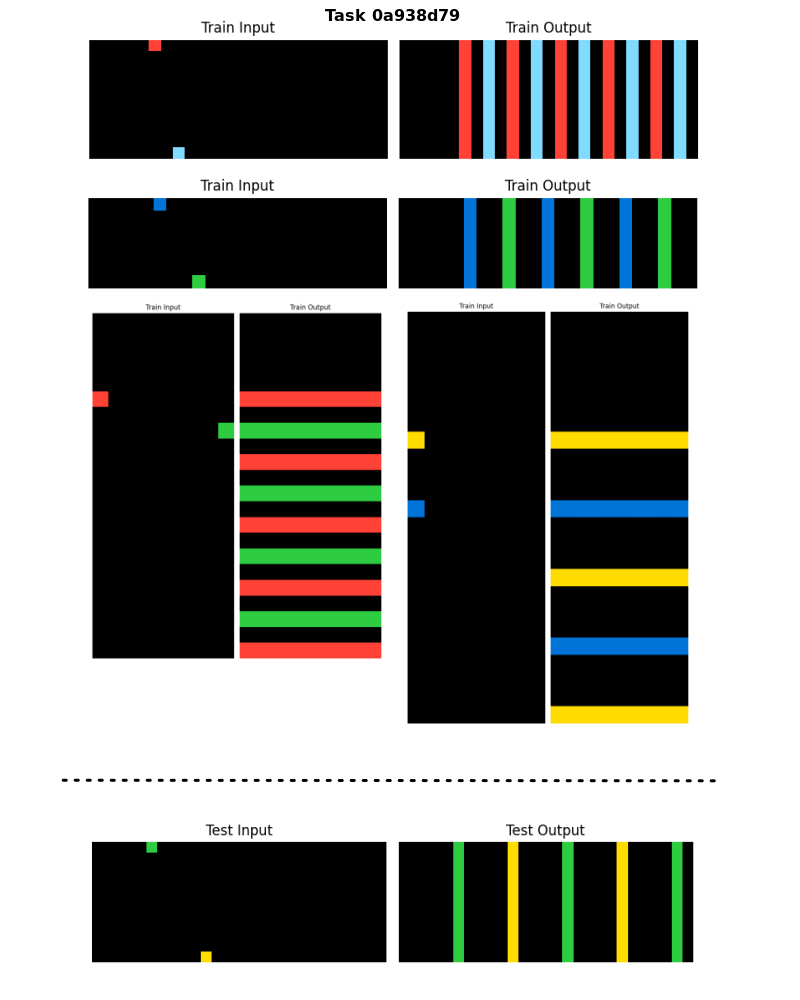
The diagram illustrates a pattern generation task where input color pairs produce alternating output sequences. The system demonstrates consistent color alternation in outputs based on input combinations, with a clear legend mapping colors to labels (A-D).
### Components/Axes
- **Legend**: Located at the bottom of the diagram, mapping colors to labels:
- Red = A
- Blue = B
- Green = C
- Yellow = D
- **Sections**:
1. **Train Input 1**: Red (A) + Blue (B) → Alternating A/B output
2. **Train Input 2**: Blue (B) + Green (C) → Alternating B/C output
3. **Train Input 3**: Red (A) + Green (C) → Alternating A/C output
4. **Test Input**: Green (C) + Yellow (D) → Alternating C/D output
- **Output Structure**: All outputs show strict alternation of input colors, maintaining positional consistency (e.g., first output matches first input color).
### Detailed Analysis
- **Train Input 1**:
- Input: Red (A) at top-left, Blue (B) at bottom-right
- Output: 12 alternating vertical bars starting with A (Red)
- **Train Input 2**:
- Input: Blue (B) at top-left, Green (C) at bottom-right
- Output: 12 alternating vertical bars starting with B (Blue)
- **Train Input 3**:
- Input: Red (A) at top-left, Green (C) at bottom-right
- Output: 12 alternating vertical bars starting with A (Red)
- **Test Input**:
- Input: Green (C) at top-left, Yellow (D) at bottom-right
- Output: 12 alternating vertical bars starting with C (Green)
### Key Observations
1. **Pattern Consistency**: All outputs strictly alternate between the two input colors, regardless of input order
2. **Positional Fidelity**: First output bar always matches first input color
3. **Color Mapping**: Legend confirms color-to-label correspondence (A-D)
4. **Sequence Length**: All outputs contain exactly 12 bars (6 pairs of alternating colors)
### Interpretation
This diagram demonstrates a sequence generation system that:
- Learns to alternate between two input colors in output sequences
- Maintains positional consistency (first input color becomes first output color)
- Generalizes to unseen color pairs (Test Input C+D follows same pattern as trained A/B, B/C, A/C)
- Shows no positional bias - output sequence length remains constant regardless of input configuration
The system appears to implement a simple state machine where:
1. First input color becomes initial state
2. Alternates between input colors for fixed number of steps
3. Maintains output sequence length invariant to input configuration
No numerical data present - analysis based on categorical pattern recognition.